

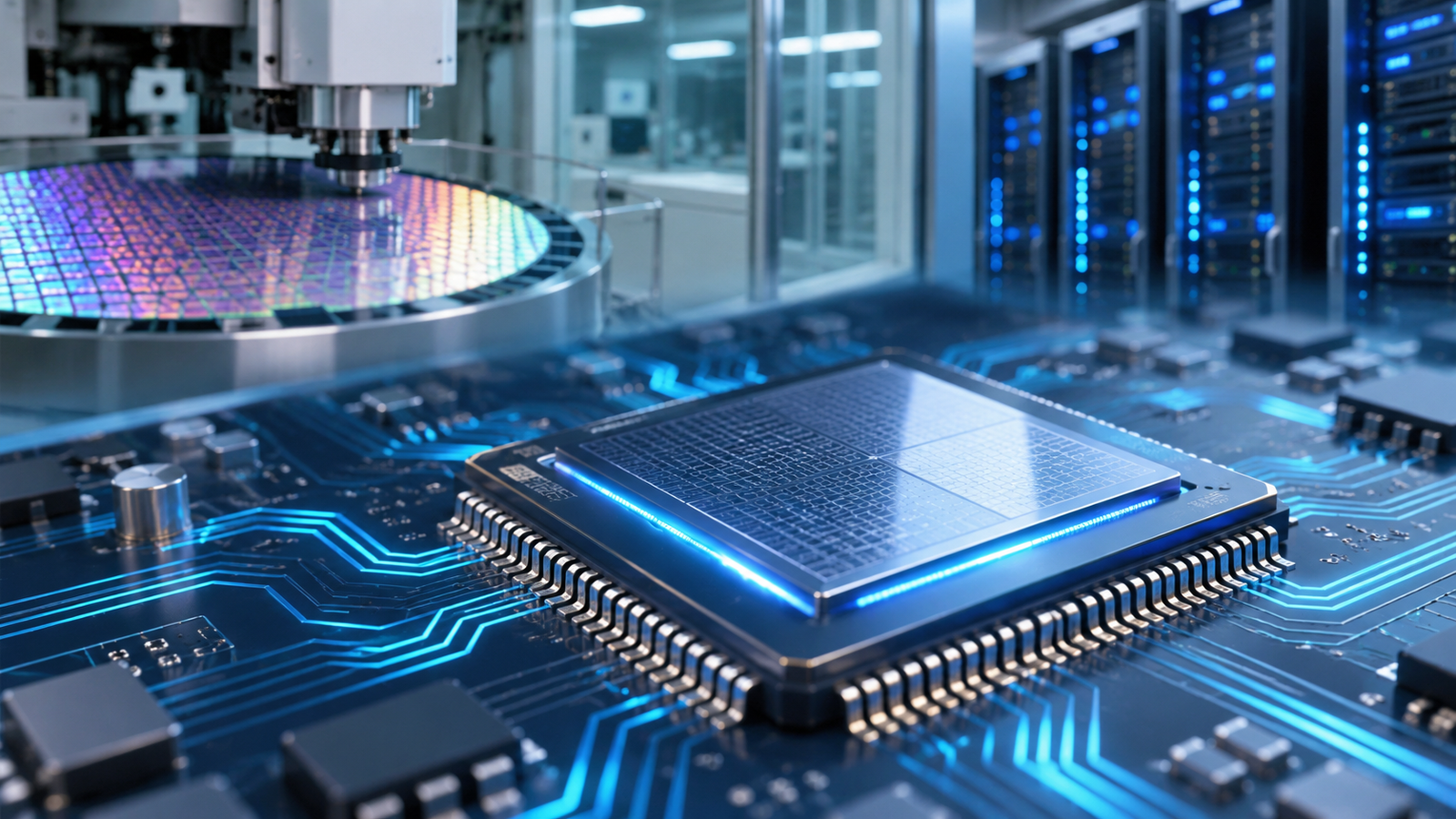
Semiconductor Sector Outlook
The semiconductor sector enters the final weeks of 2026 at a critical inflection point, after a powerful rally driven by artificial intelligence infrastructure, November’s sharp correction has exposed the risks of elevated valuations and crowded positioning. The question for investors is no longer whether AI will create demand for semiconductors, but whether that demand can generate earnings and cash flows sufficient to justify expectations.
AI Spending Remains the Foundation of Growth
The structural outlook remains encouraging. Gartner’s August forecast projects global semiconductor revenue of US$1.6 trillion in 2026 and US$1.9 trillion in 2027, with memory and AI infrastructure driving much of the expansion. These are forecasts rather than assured outcomes, and the pace of growth leaves the industry vulnerable to any slowdown in capital spending.
Cloud hyperscalers continue to require advanced accelerators, networking technology, high-bandwidth memory and sophisticated manufacturing capacity. As the market shifts from training large AI models toward widespread inference, demand could broaden beyond the leading GPU platforms. Custom silicon, memory, optical connectivity and efficient power management are increasingly important parts of the investment thesis.
Where the Next Phase of Leadership Could Emerge
- NVIDIA (NVDA) and AMD (AMD): Accelerated computing remains a major growth opportunity, although competition, customer concentration and the cost of deploying AI infrastructure warrant careful attention.
- Broadcom (AVGO) and Marvell Technology (MRVL): Custom AI accelerators and high-speed networking could benefit as cloud operators seek greater efficiency and reduced dependence on general-purpose accelerators.
- Micron Technology (MU): High-bandwidth memory offers considerable growth potential, but memory pricing remains cyclical and sensitive to capacity additions.
- Taiwan Semiconductor Manufacturing (TSM) and ASML (ASML): Advanced fabrication, lithography and packaging remain essential to the industry’s development, with geopolitical exposure and capital intensity representing important risks.
- Texas Instruments (TXN) and Analog Devices (ADI): Industrial, automotive and analog demand offers a different recovery opportunity, particularly if manufacturing activity improves in 2027.
Valuations and the Earnings Test
November’s sell-off demonstrates how quickly semiconductor valuations can adjust when investors question the returns on AI investment. Even an expanding industry can produce disappointing equity returns when earnings expectations are excessive. The most attractive opportunities may arise where sustainable profit growth, competitive advantages and strong balance sheets are not already fully reflected in share prices.
Three Possible Paths for 2027
Base case: AI investment continues to expand, but growth rates moderate and semiconductor performance becomes more selective. Companies delivering earnings revisions and durable cash generation lead the recovery.
Bull case: AI adoption accelerates, inference demand expands and industrial demand recovers alongside data-centre investment. Earnings estimates improve across a wider range of chipmakers, supporting a broader recovery.
Bear case: Hyperscalers defer capital expenditure, memory supply catches up with demand, export restrictions intensify or interest rates remain restrictive. Earnings estimates and valuation multiples could fall together, extending the correction.
Technical and Macroeconomic Outlook
A sustainable sector recovery would ideally be accompanied by improving market breadth, higher lows in semiconductor indices and stronger relative performance against the S&P 500. A short-term relief rally alone would not establish a new uptrend. Investors should also monitor real interest rates, corporate spending guidance, memory prices and semiconductor order trends. These are prospective confirmation signals, not a claim that a technical reversal has already occurred.
General Outlook
The general outlook for sector outlook is constructive over the medium to long term, but cautious in the near term. The industry is moving beyond a period of relatively indiscriminate AI enthusiasm toward greater differentiation between companies. Expect the next phase of semiconductor leadership to favour businesses with pricing power, defendable technology, credible earnings visibility and disciplined investment. Analysts point out that Investors should remain selective and recognize that a strong structural growth story does not eliminate cyclical or valuation risk.

STA Research (StockTargetAdvisor.com) is a independent Investment Research company that specializes in stock forecasting and analysis with integrated AI, based on our platform stocktargetadvisor.com, EST 2007.
Related research

How Trump’s Tariffs Could Shake Up Magna International’s Auto Parts Business

STA Research (Rank#25) Maintained “Hold” Rating on Starbucks, $110 target (SBUX:NSD)

Bank of Canada Looks to Pause rates as Recession Looms

Perimeter Medical Imaging AI Inc. (PINK:CA) Raymond James Cuts Target After Earnings

Rogers Sugar Inc. (RSI:CA) Analysts Update Coverage After Earnings

Silver X Mining Corp. (AGX:CA) Ventum Capital Cuts Target to $2.10
A monthly perspective in your inbox.
Five research sections in the STA Research Professional Newsletter.