

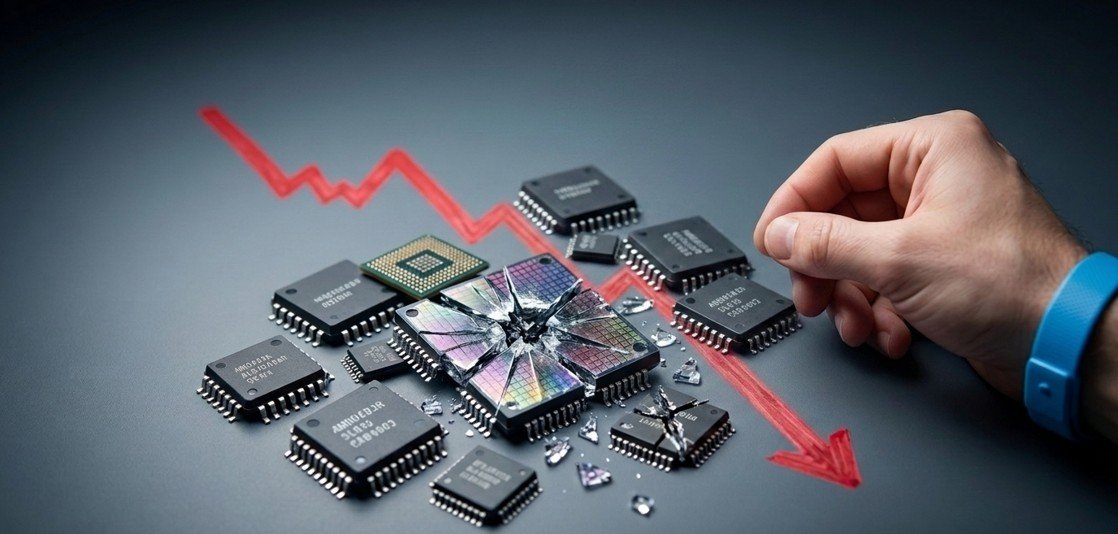
Chip Stocks Under Pressure
(About StockTargetAdvisor.com (STA Research) is a Canadian investment research company specializing in advanced stock research and analysis. Our research team comprises of Financial Professionals)
The semiconductor sector has been the driving force behind the global stock market rally over the past two years, fueled by unprecedented investment in artificial intelligence (AI), cloud computing, and advanced data centre infrastructure. As chip stocks have climbed to record highs, investors have become increasingly concerned that stretched valuations could lead to a sharp correction capable of pulling the broader market lower. The current market data suggests that while semiconductor stocks remain vulnerable to heightened volatility, the probability of the sector alone triggering a full-scale market crash remains relatively low.
One of the most important valuation metrics indicates that many leading semiconductor companies are trading at forward price-to-earnings (P/E) multiples well above their long-term historical averages. Elevated valuations naturally increase downside risk because investors have already priced in significant future earnings growth. If AI-related spending were to slow, corporate capital expenditures declined, or earnings guidance disappointed, valuation multiples could compress rapidly, resulting in substantial share price declines across the sector.
Despite elevated valuations, semiconductor fundamentals remain considerably stronger than those observed during previous technology bubbles. The industry’s largest companies continue to generate robust revenue growth, expanding operating margins, record levels of free cash flow, and strong returns on equity. Unlike speculative market periods where valuations became disconnected from financial performance, today’s leading chip manufacturers continue to produce substantial earnings that support higher share prices. As long as earnings growth remains intact, the sector retains a solid fundamental foundation despite its premium valuation.
Another important metric is market concentration. Semiconductor companies now represent a significant weighting within major equity indices such as the Nasdaq 100 and the S&P 500. As a result, a sharp decline in chip stocks would almost certainly pressure index funds, technology exchange-traded funds (ETFs), and passive investment portfolios. However, recent market action suggests improving sector rotation, with financials, industrials, energy, and defensive sectors contributing more meaningfully to overall market performance. This broader market participation reduces the likelihood that weakness within semiconductors alone would trigger a widespread market collapse.
Institutional positioning also remains supportive of the sector. While investors have taken profits following the industry’s exceptional rally, there is limited evidence of broad institutional selling. Professional portfolio managers continue maintaining meaningful exposure to semiconductor companies because long-term earnings estimates remain favourable and AI infrastructure spending continues to support revenue growth. Current trading patterns indicate sector rotation among technology leaders rather than wholesale capital exiting the semiconductor industry.
From a macroeconomic perspective, the conditions typically associated with major market crashes remain largely absent. Credit markets continue to function normally, corporate balance sheets remain healthy, and there are few signs of systemic financial stress. Historically, major equity bear markets are more commonly triggered by deteriorating economic conditions, tightening credit availability, rising default rates, or severe liquidity shortages rather than weakness confined to a single industry.
Historical market data also suggests that semiconductor stocks regularly experience corrections ranging from 15% to 30% without causing prolonged bear markets. Given the sector’s higher beta, increased volatility is expected, particularly following extended rallies. In many previous market cycles, these corrections ultimately created attractive buying opportunities once earnings growth resumed and investor confidence returned.
Overall, semiconductor stocks are more likely to undergo a healthy valuation correction than cause a broader market crash. While elevated valuations warrant caution and could produce increased short-term volatility, strong earnings growth, healthy free cash flow generation, improving market breadth, and stable macroeconomic conditions continue to support the sector’s longer-term outlook. Investors should closely monitor earnings guidance, AI capital spending trends, valuation multiples, institutional fund flows, and overall economic conditions, as these factors will ultimately determine whether any future semiconductor weakness remains sector-specific or evolves into a broader market correction.

STA Research (StockTargetAdvisor.com) is a independent Investment Research company that specializes in stock forecasting and analysis with integrated AI, based on our platform stocktargetadvisor.com, EST 2007.