

STA RESEARCH · U.S. & CANADA
Wall Street and the TSX Open Higher as Nvidia Lags and Oil Falls
North American stocks rose at the opening bell, while Nvidia came under pressure before the open and investors looked ahead to U.S. inflation data.
November 9, 2026 · Morning update · By STA Research
NOVEMBER 9, 2026 · TECHNOLOGY, OIL AND INFLATION
Stocks rebound at the opening bell
The Dow led the U.S. opening gains after last week’s AI-related selloff. Canada’s benchmark also opened higher as weaker crude eased some concerns about energy-driven inflation. The index readings below are from 9:30 a.m. ET.
U.S. markets: Nvidia diverges from the Nasdaq
Nvidia (NVDA) fell about 6% in premarket trading after the company disclosed a board investigation involving CEO Jensen Huang, Investopedia reported. The Nasdaq’s higher open despite Nvidia’s premarket weakness makes semiconductor participation worth watching. Gains across other chipmakers and sectors would suggest the rebound has support beyond a handful of AI stocks.
Canadian markets: Lower oil puts producers in focus
Reuters reported that Brent crude fell 1.8% to about US$96 a barrel in its early snapshot, while gold rose 0.9%. Sustained declines in crude could relieve cost pressure for fuel-intensive businesses and weigh on revenue for Canadian producers. Investors are watching this week’s U.S. inflation data for clues about the Federal Reserve’s next move.
Canadian stocks in focus
Barrick Mining (ABX:CA) reported higher third-quarter profit as stronger gold prices offset lower reported production. The miner reiterated its full-year production guidance. Strathcona Resources (SCR:CA) agreed to acquire Greenfire Resources (GFR:CA) in a proposed deal that Reuters valued at C$2.7 billion to C$2.9 billion including debt. The acquisition would expand Strathcona’s Alberta oil sands operations.
More constructive scenario
Gains broaden into financials and industrials, chip shares stabilise and easing crude helps contain inflation concerns.
More cautious scenario
Selling spreads from Nvidia to other chipmakers, or a rebound in oil pushes yields higher and pressures growth stocks.
STA Research outlook
STA Research remains selective after last week’s selloff. Follow-through across sectors and steadier Treasury yields would make the opening gains more durable. In Canada, Barrick’s results and the proposed Greenfire acquisition give investors company-specific developments to assess alongside moves in gold and crude.
Sources · Reuters U.S. open · Reuters TSX open · Reuters commodities snapshot · Investopedia premarket report · Barrick results · Reuters Strathcona deal report
STA RESEARCH · U.S. & CANADA
Nasdaq Attempts a Rebound as Strong U.S. Jobs Revive Rate Concerns
Technology shares seek stability after Thursday’s selloff, while weaker Canadian employment highlights a widening economic divide.
November 6, 2026 · Morning update · By STA Research
NOVEMBER 6, 2026 · JOBS, TECHNOLOGY AND INTEREST RATES
A rebound faces a tougher interest-rate test
North American markets enter Friday with investors weighing a possible technology recovery against resilient U.S. employment and softer Canadian conditions. Reuters’ 8:31 a.m. ET snapshot showed Nasdaq-100 futures up 1.37%, S&P 500 futures up 0.11% and Dow futures down 0.96%. These are premarket indications, not cash-index returns or closing prices.
U.S. employment strengthens the policy debate
The Bureau of Labor Statistics reported October payroll growth of 165,000 and unemployment of 4.1%. Average hourly earnings increased 0.4% on the month and 3.1% over the year. Revisions added 84,000 jobs to August and September combined. Employment growth was led by professional and business services, health care, and transportation and warehousing.
STA Research’s interpretation is that a resilient labour market supports household income and corporate demand, but gives the Federal Reserve less reason to ease policy quickly. Rising financing costs would make an equity recovery harder to sustain, particularly for businesses whose valuations depend heavily on profits expected far into the future. Strong employment does not, by itself, determine the next rate decision.
Technology rebounds from a confirmed correction
Reuters reported that Thursday’s Nasdaq decline confirmed a correction, as chipmakers faced concerns over potential AI regulation following the midterm elections. Friday’s early Nasdaq futures recovery suggests some willingness to revisit the sector after heavy selling. The next test is whether buying survives the opening session and broadens beyond a small group of technology leaders.
For companies such as Nvidia (NVDA), Advanced Micro Devices (AMD) and Celestica (CLS:CA), our analytical focus remains on earnings expectations, customer capital spending and the conversion of demand into cash flow. These are stocks to monitor for the AI theme; no current-session price moves are asserted here.
Canadian employment points to softer domestic demand
Statistics Canada reported employment was little changed in October, down 4,700, while unemployment rose to 6.7% from 6.5%. Private-sector employment fell 53,000, largely offset by a 50,000 increase in public-sector jobs. Wholesale and retail trade lost 29,000 positions, while construction added 16,000 and educational services added 15,000. Annual hourly wage growth slowed to 2.2% from 2.3%.
For the TSX, this suggests continued sensitivity in consumer businesses, credit demand and loan quality. U.S. rate pressure alongside Canadian labour-market slack could complicate the domestic policy outlook. Banks, property companies and indebted businesses warrant close attention to funding costs and cash generation.
Oil and sector participation remain central
Reuters’ early Canadian market report showed TSX 60 futures down 0.3% at 5:42 a.m. ET and Brent crude down 0.4%. Those readings preceded the employment releases. Lower sustained energy prices could ease costs for consumers and transport businesses, while reducing revenue support for Canadian producers. Subsequent commodity and currency movements will help determine whether the TSX can stabilise.
More constructive scenario
Technology stabilises, yields settle and earnings expectations hold. Broader participation would provide stronger evidence of recovery than an isolated premarket bounce.
More cautious scenario
Higher yields and renewed selling in AI shares overwhelm bargain hunting. Softer Canadian demand adds pressure to earnings and credit quality.
STA Research outlook
STA Research retains a cautious, selective near-term outlook. The U.S. jobs report offers evidence of economic resilience, while Canada’s figures point to more slack. This combination favours careful assessment of valuations, balance sheets and sustainable free cash flow. A durable recovery requires evidence from actual trading, earnings revisions and wider sector participation; early futures gains alone do not establish a market bottom.
STA RESEARCH · U.S. & CANADA
Technology Selloff Reverses the Midterm Rally as Oil Rebounds
U.S. and Canadian equities retreat as chip earnings and AI infrastructure concerns unsettle investors.
November 5, 2026 · Intraday market update · By STA Research
NOVEMBER 5, 2026 · TECHNOLOGY, ENERGY AND EARNINGS
A sharp reversal tests confidence in the rebound
North American markets fell Thursday after Wednesday’s post-election gains. In a late-morning report published at 11:38 a.m. ET, the Dow stood at 52,219.14, down 1,136.98 points. The S&P 500 fell 212.50 points to 7,476.12, and the Nasdaq Composite lost 1,019.48 points to 24,717.03. The TSX declined 476.02 points to 35,865.38.
Intraday figures from November 5 reports, rather than closing prices. Individual stock moves below reflect the separately identified reporting times.
U.S. stocks face renewed pressure
Weak smartphone chip sales at Qualcomm added to concerns about technology demand. Reuters reported that the stock fell 13.5% in its 10:46 a.m. ET market snapshot. Nvidia and Meta were also among the prominent shares under pressure. For investors, the reversal raises questions about the durability of the relief rally.
Canadian stocks follow technology lower
Canadian technology shares fell 5.4% in the same Reuters snapshot, with Celestica down 14.6% and BlackBerry down 7.2%. Gildan Activewear dropped 24.7% after quarterly sales missed expectations. Energy rose 0.4%, providing some support as crude recovered. Friday’s Canadian employment report is the next domestic catalyst, with a Reuters poll anticipating 13,600 additional jobs and unemployment of 6.5%.
Oil rebounds after its steep decline
Crude recovered more than US$2 a barrel as investors assessed the future of the Iran conflict and renewed tanker incidents. The rebound followed a decline of more than 8% on Wednesday. Lower energy costs had supported the inflation outlook, but renewed supply concerns show how quickly that support can change.
Stocks in focus beyond the technology selloff
ConocoPhillips (COP) raised its dividend after beating adjusted profit expectations. Canadian Natural Resources (CNQ:CA) also beat quarterly profit estimates, supported by higher crude prices and production. Nutrien (NTR:CA) missed profit estimates as sulfur costs and lower nitrogen sales volumes weighed on results.
More constructive scenario
Oil stabilises, earnings expectations hold up and buying broadens across sectors. Technology shares begin to establish support as investors reassess valuations.
More cautious scenario
Disappointing forecasts and persistent concerns about AI spending extend the selloff. Renewed energy inflation adds pressure to margins and financing conditions.
STA Research outlook
STA Research maintains a cautious, selective near-term outlook. Today’s reversal suggests election clarity alone is insufficient to sustain the rebound. Earnings quality, cash generation, debt obligations and the price paid for future growth remain central to assessing opportunities. A stabilisation in technology and broader sector participation would improve confidence.
MARKET ANALYSIS | NOVEMBER 4, 2026
U.S. and Canadian Stocks Rally After Midterms as Gold Rises and Oil Falls
By STA Research · Wednesday morning update
U.S. Markets
U.S. stocks opened higher after Democrats won control of both chambers of Congress. Investors appeared to welcome the prospect that divided government could limit major policy shifts. At the opening bell, the Dow gained 1.93%, the S&P 500 rose 1.14%, and the Nasdaq Composite advanced 1.07%. Some data centre stocks came under pressure as investors weighed the possibility of tighter AI oversight.
Canadian Markets
The S&P/TSX Composite rose 1.29% to 35,990.05 by 10:36 a.m. ET, led by miners. December gold futures traded above US$4,000 an ounce in the morning, while December WTI crude fell below US$93 a barrel. Higher gold supported miners, while weaker crude weighed on the outlook for oil producers.
Stock in Focus
Advanced Micro Devices (AMD) jumped 7.3% in premarket trading after quarterly data centre revenue rose 97% to US$8.55 billion. Management said it expects total revenue growth of more than 80% in 2027. AMD’s early gain stood out against weakness in some other data centre stocks.
MARKET ANALYSIS | NOVEMBER 3, 2026
Nasdaq and S&P 500 Rebound as Oil Eases Ahead of Midterm Results
By STA Research · Tuesday morning update
U.S. Markets: Chipmakers Lead the Rebound
The Nasdaq Composite rose 0.62% and the S&P 500 gained 0.29% by 9:57 a.m. ET Tuesday, while the Dow fell 0.49%. The technology rebound followed several turbulent sessions and came a day after the Nasdaq-100 closed more than 10% below its record closing high. Investors were awaiting U.S. midterm election results.
Canadian Markets: Shopify Weighs on the TSX
The S&P/TSX Composite fell about 0.3% by 10:46 a.m. ET, giving back part of Monday’s 0.5% gain. Shopify slipped after reporting results and weighed on Canadian technology shares. On Monday, industrials and miners led the Canadian rebound while the energy sector fell 4.8%.
Oil Pullback Eases Inflation Concerns
WTI settled 7.4% lower at US$96.46 a barrel on Monday, and Brent extended its decline Tuesday morning. Easing crude prices helped support U.S. sentiment by easing concern about energy-driven inflation. In Canada, lower oil prices also weighed on producers, limiting the benefit for the TSX.
Stocks in Focus
- Nvidia (NVDA) rose 2.7% as semiconductor shares rebounded.
- Advanced Micro Devices (AMD) gained 4% ahead of earnings after the close.
- Apple (AAPL) fell 2% after warning that higher memory-chip costs would pressure holiday-quarter gross margins.
- Palantir Technologies (PLTR) slid 4.9% despite a stronger-than-expected revenue forecast.
- Shopify (SHOP:CA) declined after results, putting pressure on the Canadian technology sector.
STA Research Outlook
AMD’s earnings and the midterm results are the next tests for the rebound. With the Dow and TSX lower in morning trading, watch whether buying broadens beyond chipmakers and whether crude holds its recent decline.
Sources · Reuters U.S. market report · Reuters Canadian market report
STA RESEARCH | U.S. & CANADA
Is the Stock Market Heading for a Correction? Nasdaq Selloff Raises Warning Signs
Technology stocks retreat as investors reassess AI spending, earnings expectations and the prospect of prolonged restrictive interest rates.
October 31, 2026 | Weekend Market Outlook | By STA Research
Friday’s Market Close: The Selloff Broadens
U.S. stocks ended Friday, October 30, sharply lower. The Nasdaq Composite fell 2.86% to 25,437.00, the S&P 500 lost 1.82% to 7,580.07, and the Dow Jones Industrial Average declined 1.09% to 51,770.31. Canada’s S&P/TSX Composite slipped 1.74% to 35,620.03.
| Index | Change | Close |
|---|---|---|
| Nasdaq Composite | -2.86% | 25,437.00 |
| S&P 500 | -1.82% | 7,580.07 |
| Dow Jones | -1.09% | 51,770.31 |
| S&P/TSX Composite | -1.74% | 35,620.03 |
Is a Market Correction Beginning?
STA Research’s assessment: correction risk is elevated, but a broad-market correction is not yet confirmed.
The Nasdaq has declined approximately 7.8% from its October 6 closing high, placing it closer to the conventional 10% correction threshold. Semiconductor shares have experienced even sharper selling, reflecting concerns about stretched valuations and the sustainability of AI-related capital spending.
Investors are increasingly questioning whether exceptionally large infrastructure investments can produce sufficient earnings growth and free cash flow to justify current market valuations.
A technology-led pullback could remain contained. However, if weakness spreads to financials, industrials and consumer-oriented companies, the risk of a broader correction would increase.
Five Warning Signals Investors Should Monitor
- Nasdaq drawdown: A decline of 10% or more from the recent peak would meet the conventional definition of a market correction.
- Market breadth: Weakness extending beyond technology into other major sectors would indicate broader selling pressure.
- Earnings revisions: Deteriorating corporate forecasts could place additional pressure on elevated equity valuations.
- Interest rates: Restrictive monetary policy and persistent inflation could limit support for growth stocks.
- Credit conditions and volatility: Rising volatility and tighter financing conditions could signal increasing investor risk aversion.
Canadian Markets: Global Weakness Reaches the TSX
Canada’s benchmark index declined 1.74% on Friday as technology and materials stocks faced selling pressure. Weakness in gold mining shares and broader concerns about global growth added to the market’s decline.
Canadian equities remain exposed to fluctuations in commodity prices, international investor sentiment and monetary policy. Energy producers may benefit from stronger oil prices, while financial and economically sensitive companies face a more challenging environment.
Canada’s Economy Stalls for a Second Consecutive Month
Statistics Canada reported on October 30 that real gross domestic product remained essentially unchanged in August, marking the second consecutive month of stagnant economic growth. July also recorded no growth, following a 0.4% expansion in June.
The latest figures indicate that Canadian economic momentum weakened during the third quarter after the second-quarter rebound. Preliminary estimates suggest that GDP declined 0.1% in September, although the figure remains subject to revision.
Available monthly data suggest third-quarter economic growth of approximately 0.3% quarter over quarter, indicating a relatively subdued pace of expansion.
Economic performance remained uneven across industries. Retail trade advanced 1.2% and manufacturing increased 0.3% in August, while wholesale trade declined 1.4%.
For investors, slower economic growth raises concerns about corporate earnings, household spending, credit demand and business investment. Combined with persistent inflation and elevated borrowing costs, the weakening economic backdrop increases downside risks for Canadian equities.
STA Research believes that Canada’s slowing economy strengthens the case for a cautious and selective investment approach. However, two consecutive months of stagnant GDP do not independently confirm a recession or an impending market correction.
Interest Rates and Inflation Remain Important Risks
The Federal Reserve’s decision to maintain its policy rate at 3.75%–4.00% reinforces concerns that restrictive financing conditions could persist longer than investors previously anticipated.
In Canada, higher interest rates and slowing domestic growth create a difficult environment for interest-rate-sensitive sectors, particularly real estate, consumer discretionary businesses and heavily indebted companies.
Renewed energy inflation could further complicate the outlook by increasing costs for households and businesses while reducing the flexibility of central banks to support economic growth.
STA Research Market Outlook: Cautious, Not Yet Outright Bearish
STA Research believes the probability of a broader equity-market correction has increased as elevated technology valuations confront weaker earnings expectations, substantial AI infrastructure spending, restrictive monetary policy and slowing economic growth.
A further 10%–15% equity-market decline remains a plausible risk scenario if earnings forecasts deteriorate and selling pressure spreads beyond technology. However, this is not a confirmed forecast, and stronger earnings, stabilizing bond yields and improving market participation could support a recovery.
In Canada, stagnant economic growth and persistent inflation introduce additional vulnerabilities. Although energy and resource companies may provide selective opportunities, broader market conditions remain sensitive to international volatility and domestic economic weakness.
STA Research recommends a disciplined investment strategy focused on capital preservation, earnings quality, sustainable cash flow, reasonable valuations and strong balance sheets.
Investors should monitor whether market rebounds are supported by improving fundamentals and broad sector participation or represent temporary recoveries within a developing correction.
Market data through October 30, 2026. STA Research commentary is provided for informational and educational purposes and does not constitute personalized investment advice.
STA RESEARCH | U.S. & CANADA
AI Earnings Selloff Hits Nasdaq as Oil Surges and Inflation Risks Intensify
Technology stocks face renewed selling pressure as investors reassess AI spending, while rising energy prices and restrictive monetary policy complicate the outlook.
Friday, October 30, 2026 | By STA Research
Morning market analysis. Figures do not represent final closing prices.
U.S. Market Overview: AI Investment Comes Under Scrutiny
U.S. equities faced pronounced selling pressure Friday morning, led by the technology-heavy Nasdaq. Nasdaq-100 futures declined approximately 2% ahead of the opening bell, while S&P 500 futures fell approximately 1% as investors reacted to disappointing earnings and guidance from major technology companies.
Amazon and Alphabet faced increased scrutiny over AI-related capital expenditures, while Intel’s outlook also disappointed investors. The market’s focus is shifting from the growth potential of artificial intelligence to whether exceptionally large infrastructure investments can produce sustainable profits and free cash flow.
Elevated technology valuations leave little room for disappointing results, increasing the possibility of continued volatility across the Nasdaq and semiconductor sector.
Federal Reserve: Interest Rates Remain Restrictive
On October 28, the Federal Reserve maintained its federal funds target range at 3.75%–4.00%. The decision reinforced concerns that elevated inflation and resilient economic activity could keep borrowing costs higher for longer.
Higher interest rates increase financing costs and place additional pressure on highly valued growth companies. Investors are increasingly prioritizing companies with reliable earnings, strong balance sheets, sustainable margins and positive free cash flow.
Energy Markets: Oil Prices Rise
Oil prices advanced amid renewed geopolitical uncertainty and concerns surrounding shipping disruptions in the Strait of Hormuz. Higher crude prices could benefit energy producers while increasing costs for transportation, manufacturing and consumers.
Persistently elevated energy prices could complicate the inflation outlook and reduce the flexibility of central banks to lower interest rates.
Energy equities may offer relative resilience, although the strength and duration of the oil rally remain important variables.
Canadian Market Outlook: Higher Rates Reshape Sector Leadership
The Bank of Canada increased its overnight policy rate by 25 basis points to 2.50% on October 28, highlighting persistent inflation pressures and the potential for rising energy costs to affect broader consumer prices.
Canadian energy companies could benefit from higher crude prices, while financial institutions, utilities, real estate companies and consumer-sensitive businesses face a more challenging interest-rate environment.
The TSX’s significant exposure to natural resources provides some diversification from U.S. technology weakness, although Canadian equities remain vulnerable to broader global market volatility.
Stocks in Focus
| U.S. Stocks | Canadian Stocks |
|---|---|
| Alphabet (GOOGL) — AI spending and earnings | Celestica (CLS:CA) — AI infrastructure demand |
| Amazon (AMZN) — Capital intensity and cash flow | Shopify (SHOP:CA) — Growth valuations |
| Intel (INTC) — Semiconductor outlook | Agnico Eagle (AEM:CA) — Gold and mining |
| Microsoft (MSFT) — Cloud and AI earnings | Canadian Natural Resources (CNQ:CA) — Oil prices |
| Nvidia (NVDA) — AI demand and valuations | Royal Bank (RY:CA) — Rates and credit conditions |
Stocks in focus reflect current market themes and are not investment recommendations.
STA Research Market Outlook
STA Research maintains a cautious near-term outlook as elevated technology valuations confront an increasingly demanding earnings environment. Substantial AI infrastructure investment, restrictive interest rates and renewed energy inflation introduce meaningful downside risks for growth-oriented equities.
While longer-term AI demand remains constructive, investors are becoming more selective, emphasizing profitability, sustainable free cash flow and balance-sheet strength rather than revenue growth alone.
Canadian energy producers may provide relative resilience if oil prices remain firm, although elevated borrowing costs and global equity volatility could pressure the broader TSX.
STA Research believes investors should prioritize earnings quality, reasonable valuations, financial strength and disciplined risk management during the current period of market uncertainty.
Key indicators to monitor: Technology earnings revisions, Treasury yields, crude oil prices, central bank commentary and semiconductor sector performance.
STA RESEARCH · U.S. & CANADA
Fed Holds Rates as Persistent Inflation Keeps Tightening Risk Alive
The Federal Reserve holds its benchmark range at 3.75%–4.00%, but a split vote and elevated inflation keep the prospect of further tightening in focus.
October 28, 2026 · Post-FOMC market update · By STA Research
October 28, 2026 · Federal Reserve, inflation and market volatility
Fed holds rates as inflation remains elevated
The Federal Reserve held its federal funds target range at 3.75%–4.00% on October 28, following September’s quarter-point increase. The FOMC voted 10–2 to hold; Lisa D. Cook and Beth M. Hammack preferred another 25-basis-point increase. The statement described economic activity as expanding at a strong pace, resilient domestic spending, robust capital investment and little change in unemployment. The central bank also stressed that inflation remains elevated and that further information will guide the appropriate policy stance. This was a pause in tightening, not a signal that rate cuts are imminent.
Updated after the Federal Reserve’s October 28 policy announcement. The decision and dissenting votes are confirmed; sector implications and future policy scenarios are STA Research analysis, not guaranteed outcomes.
What the Fed’s hawkish hold means
The hold was broadly expected, but the two votes for an increase underline the inflation risk within the Committee. The Fed did not commit to another hike, and the meeting provided no assurance of a near-term cut. Strong output, robust investment and a stable unemployment rate give policymakers scope to wait for more inflation evidence. For markets, the important distinction is between a steady policy rate and genuinely easier financial conditions: long-term Treasury yields and credit costs may remain high even while the Fed pauses.
Inflation, oil and bond yields shape the risk
Energy costs, wage pressure and other persistent price increases can make the inflation outlook harder to manage. Bond markets are especially important: rising longer-term yields increase borrowing costs for businesses and households and can reduce the valuation investors assign to future profits. Housing, real estate investment trusts, utilities and highly leveraged companies are often more sensitive to that shift.
A stronger U.S. dollar and higher yields could pressure some commodity prices and global risk assets, although the direction of any one asset is not guaranteed. Traders should watch the market’s response to the Fed, not simply the words in the announcement.
AI stocks face a demanding earnings test
Artificial intelligence remains a major driver of technology and semiconductor shares, but high expectations create vulnerability to even modest earnings disappointments. Large investments in data centres, chips, networks and power infrastructure can support suppliers while reducing buyers’ free cash flow. STA Research is watching whether this spending translates into durable revenue, margins and cash generation.
Higher interest rates raise the cost of funding ambitious expansion and can put greater pressure on richly valued growth companies. A strong earnings report may still support an individual stock, but a durable market advance generally benefits from broader participation beyond a handful of AI leaders.
Canadian stocks face a parallel policy decision
The Bank of Canada’s October 28 decision brings an additional domestic catalyst. Rate expectations influence mortgage costs, credit demand, consumer spending and the Canadian dollar. Canadian banks could benefit from some lending margins while facing weaker borrowing demand or higher credit losses. Property and consumer-sensitive businesses remain vulnerable to prolonged tight financial conditions.
Energy and materials can respond differently: oil producers may benefit from stronger realised crude prices, while mining shares reflect commodity prices, currency movements and operating costs. Investors should avoid treating the TSX as a single interest-rate trade.
More constructive scenario
Inflation improves, policymakers avoid a fresh tightening surprise, bond yields settle and corporate earnings support current valuations. Wider market participation would strengthen confidence in the rally.
More cautious scenario
Policy guidance stays restrictive, yields rise and expensive AI shares struggle to justify their valuations. Weak consumer demand or deteriorating credit conditions could broaden selling pressure.
STA Research outlook
STA Research retains a cautious, selective outlook after the Fed’s hold. The central bank’s emphasis on elevated inflation, paired with two dissenters favouring an increase, means investors should not mistake a pause for the start of an easing cycle. Resilient growth and corporate profits can support equities, but expensive financing and stretched AI valuations leave markets sensitive to bond yields. Persistent price pressure alongside slowing future demand would increase stagflation and recession risk, though neither outcome is inevitable. Focus on earnings quality, balance-sheet strength, cash flow and broader market participation.
Source: Federal Reserve October 28, 2026 FOMC statement. Fed decision and vote are official; sector implications and scenarios are STA Research analysis. For information only; not personal investment advice.
Earlier coverage
October 27 Market Analysis
October 27, 2026 — Celestica Leads Canada’s AI Trade as U.S. Earnings Drive Big Moves
STA RESEARCH · U.S. & CANADA
Stocks in Focus: Celestica Leads Canada’s AI Trade as U.S. Earnings Drive Big Moves
A simple guide to today’s market drivers, five Canadian stocks to watch and five American stocks making headlines.
October 27, 2026 · Intraday update · By STA Research
Today’s market outlook
AI rebounds, but earnings and interest rates still matter
U.S. stocks advanced in late-morning trading, with technology leading. Canada’s market was more subdued: gains in mining and technology competed with weaker energy shares. Celestica was a standout following its quarterly report.
This is an intraday report, not a closing summary. “In focus” means selected for news, earnings or sector relevance; it is not an exchange-wide ranking by trading volume or a buy recommendation. Canadian upcoming-event and sector watches are identified below.
What this means for investors
STA Research’s assessment is that a strong company report can lift an individual stock without confirming a broad market recovery. Investors should distinguish improving business performance from a temporary increase in enthusiasm. For AI suppliers, the key question is whether new orders become profitable sales and cash flow. For their customers, it is whether the revenue earned justifies the cost of building capacity.
Wednesday’s Federal Reserve and Bank of Canada decisions are the next major policy tests. A Fed hold is widely expected, while markets anticipate a possible Canadian rate increase. Neither outcome is decided. Higher borrowing costs would make debt-funded expansion harder and could restrain consumer spending.
Market context: Reuters U.S. intraday report and Reuters Canadian intraday report. Canadian observations are from 10:28 a.m. ET; U.S. observations from 11:52 a.m. ET.
Five Canadian stocks to watch
| Company | Why it is in focus | What to watch / main risk |
|---|---|---|
| Celestica (CLS:CA) Today’s earnings mover |
Quarterly results and today’s investor day put its data-centre business in the spotlight. Shares rose about 10% in Reuters’ morning report. | Watch the outlook for customer demand and margins. Rapid expansion brings execution and customer-concentration risk. |
| Shopify (SHOP:CA) Upcoming earnings |
Results are scheduled for November 3 before markets open. | Watch merchant sales, payments growth and cash generation. A strong business can still disappoint if expectations are too high. |
| Agnico Eagle (AEM:CA) Upcoming earnings |
Third-quarter results are due October 28 after markets close. | Compare gold production, operating costs and guidance. Higher gold prices do not guarantee stronger margins. |
| Teck Resources (TECK.B:CA) Operational news |
Teck confirmed strike action at Highland Valley Copper, with the operation running at reduced capacity. | The duration and production impact matter. Copper strength may be offset by disrupted output. |
| Canadian Natural Resources (CNQ:CA) Energy-sector watch |
Our selected producer to monitor as oil weakness weighs on Canadian energy shares. | Watch realised oil prices, operating costs and cash available after capital spending. This is a sector-based watch, not a verified top-volume ranking. |
Company sources: Celestica results; Shopify earnings date; Agnico Eagle earnings notice; Teck operations update. CNQ selection and risk assessments are STA Research analysis.
Five American stocks making headlines
| Company | Today’s catalyst | What to watch / main risk |
|---|---|---|
| Broadcom (AVGO) | AI-chip financing tied to Anthropic supported the shares. | Watch how financing translates into orders and customer payments. Funding availability and concentration remain risks. |
| Tesla (TSLA) | Shares extended their rally to a more than three-month high. | Watch whether earnings and cash generation support the share-price recovery. Momentum can reverse quickly. |
| Boeing (BA) | A slower 737 production recovery and weaker-than-expected cash-flow outlook pressured the stock. | Aircraft deliveries, supplier performance and cash consumption are central to the recovery. |
| UPS (UPS) | The delivery company raised annual profit and revenue forecasts. | Watch profit per shipment and holiday execution. Better margins need to offset any volume weakness. |
| PayPal (PYPL) | An increased annual profit outlook highlighted progress on costs and margins. | Watch whether payment growth supports the improvement. Cost reductions alone cannot replace lasting customer growth. |
Sources: Reuters’ U.S. market report above, plus its October 27 reports on Boeing, UPS and PayPal. Watch points and risks are STA Research analysis.
STA Research outlook
The constructive case is straightforward: companies deliver better earnings, spending produces cash returns, and interest-rate guidance avoids a new shock. The cautious case is that prices recover faster than fundamentals, leaving investors exposed to disappointing guidance or more expensive financing. For beginners, focus on three questions: what does the business earn, what could go wrong, and how much are you paying for that earnings potential?
For informational and educational purposes. This research does not constitute personalised investment advice. Intraday moves can change before the close.
Earlier coverage
Previous Market Analysis
22 archived daily reports · April 6–October 26, 2026 · Newest first
Original analyses recovered from saved WordPress versions. Dates follow the report text rather than later editing timestamps. Historical prices and outlooks are preserved for context.
October 26, 2026 — Anthropic IPO Revives the AI Trade as Markets Brace for Central Banks
Archived October 26 report. Market observations and forecasts reflect that date.
STA RESEARCH · U.S. & CANADA
Anthropic IPO Revives the AI Trade as Markets Brace for Central Banks
Renewed AI enthusiasm meets financing concerns, while softer oil, firmer gold and weaker Bitcoin frame a pivotal policy week.
Updated October 26, 2026 · Intraday market outlook · By STA Research
October 26, 2026 · AI, central banks and macro risk
A fresh AI catalyst faces a financing and interest-rate test
General market outlook: AI enthusiasm returns, but conviction remains conditional
North American equities found support on Monday as Anthropic’s IPO filing revived interest in artificial intelligence and oil retreated from recent highs. The combination offers relief after a difficult stretch for technology shares: a prominent new offering draws attention back to AI growth, while lower crude eases immediate inflation and margin concerns. Canada’s technology sector also benefited from the renewed interest.
STA Research views this as an improvement in sentiment rather than proof that the recent correction is finished. A recovery supported by broader market participation, credible earnings guidance and stable financing conditions would be more durable than a rally driven principally by one IPO headline. Traders are also positioning ahead of Wednesday’s central-bank decisions, leaving prices sensitive to policy language and changes in bond yields.
Anthropic’s IPO brings the AI trade back to life
Anthropic’s public filing creates a fresh catalyst for AI-linked shares and a significant test of investor appetite for the sector. The proposed flotation could fund further expansion and bring more public scrutiny to the economics of frontier AI. It is a filing for a planned offering, rather than a completed listing or a confirmed final valuation.
The potential benefit extends to chipmakers, networking suppliers and data-centre infrastructure companies if new capital translates into funded orders. However, raising capital is only the first step. The longer-term investment case depends on revenue quality, customer retention, computing costs and whether growth produces an adequate return on invested capital.
Chip financing: orders can grow while financial risk rises
Large AI infrastructure commitments continue to depend on borrowing, equipment financing and equity issuance. SpaceX’s roughly US$40 billion Apollo-managed equipment-finance arrangement for AI hardware illustrates the scale of the funding requirement. The structure is more accurately described as equipment financing or leasing than simply cash borrowed outright. Musk’s warning about a possible neocloud shakeout reinforces concern about which operators can finance capacity and win enough customers to sustain it.
For suppliers such as Nvidia and other semiconductor companies, funded purchases can support demand. For buyers, debt service, lease obligations and repeated capital raising increase the pressure to turn computing capacity into cash flow. Equity financing can also dilute existing shareholders. These risks can coexist with strong chip sales; they do not establish that every AI customer is overleveraged or that industry demand is artificial.
STA Research analysis: Monitor operating cash flow after capital expenditure, debt and lease commitments, interest coverage, customer concentration, utilisation and the durability of contracted revenue. Financing-linked demand deserves particular scrutiny when investors, suppliers and customers have overlapping commercial relationships. If funding becomes more expensive or projects are delayed, order timing and valuations can adjust quickly.
Fed positioning: the message may matter as much as the decision
Investors are preparing for the Federal Reserve’s October 28 decision, with a hold widely anticipated in Monday’s reporting. Attention is therefore on its assessment of inflation persistence, growth and the conditions that could justify further tightening. A pause should not automatically be interpreted as the start of an easing cycle.
Higher yields would put renewed pressure on the present value of distant earnings and on businesses funding expansion externally. Calmer yields and reassurance on inflation could support growth stocks. With major technology earnings also in focus, sharp swings around policy commentary remain plausible even if the headline decision matches expectations.
Bank of Canada: a hike is expected, not yet decided
Reuters reports that markets and a majority of surveyed economists expect the Bank of Canada to raise its benchmark rate by 25 basis points to 2.50% on Wednesday, October 28. The concern is that elevated energy costs could spread into broader prices and inflation expectations. The accompanying Monetary Policy Report will be important for understanding the Bank’s inflation and growth assessment.
The decision remains uncertain: 19 of 34 economists in the Reuters poll favoured a hike, while others pointed to weak growth and subdued underlying inflation. For Canadian equities, tighter policy could weigh on housing, discretionary demand and indebted businesses. Banks face a balance between interest income, borrowing demand and credit quality.
Oil falls, gold rises and Bitcoin weakens as traders assess macro risks
Monday’s retreat in oil offers some relief from the recent energy-driven inflation scare. Gold recovered, while Bitcoin weakened as investors assessed policy and geopolitical risks. These are intraday directional observations, rather than closing prices or live quotes, and different assets can move for different reasons.
Lower oil can help airlines, transport businesses and household purchasing power, while tempering near-term revenue expectations for energy producers. Gold’s recovery supports attention to precious-metals exposure, although gold miners also face operating-cost and execution risks. Bitcoin’s weakness highlights its sensitivity to liquidity and risk appetite; it should not be assumed to provide the same defensive behaviour as gold.
A single decline in crude does not remove the risk of renewed supply disruptions or persistent inflation. The more constructive combination would be sustained energy relief alongside stable yields and resilient earnings. Another oil surge before policy decisions would make that balance more difficult.
Canada–U.S. trade: optimism still needs a concrete agreement
President Donald Trump said at Sunday’s Michigan rally that the tariff dispute with Canada could be resolved soon, without presenting specific terms. The remarks offer a potential sentiment boost for exporters and cross-border businesses, but do not constitute an agreed tariff settlement. Actual scope, implementation dates and reciprocal measures will determine the economic effect.
Corporate developments: gas consolidation, retail expansion and copper disruption
EQT / RRC — EQT and Range Resources: EQT agreed to acquire Range in an all-stock transaction worth approximately US$12.8 billion, or about US$13 billion. The combined company’s enterprise value would exceed US$50 billion; that is different from the acquisition consideration. The deal links natural-gas consolidation to demand from LNG, power generation and data centres. Expected benefits still depend on approvals, integration and realised gas prices.
ATD — Alimentation Couche-Tard: Reuters, citing The Times, reported a proposed US$7.5–8 billion offer for Cumberland Farms, below the reported US$9 billion valuation sought for an IPO. This remains a reported proposal, rather than a completed acquisition. Investors will assess funding requirements, the purchase multiple and integration potential.
TECK / TECK.B — Teck Resources: Strike action has begun at Highland Valley Copper in British Columbia, with operations continuing at reduced capacity. The production effect depends on the duration of the labour disruption. The immediate issue is operational execution and output, rather than evidence of weaker underlying copper demand.
Canadian analyst actions to watch
| Symbol / company | Broker update | Rationale |
|---|---|---|
| AC — Air Canada | CIBC target C$36, previously C$40 | Fuel costs threaten fourth-quarter consensus expectations. |
| RCI.B — Rogers Communications | JPMorgan target C$63, previously C$65 | Weaker market-growth assumptions after third-quarter results. |
| TSAT — Telesat | CIBC initiation: Outperformer; target C$105 | Transition toward a low-Earth-orbit network serving enterprise and government customers. |
Analyst actions and rationales above are from the supplied October 26 market briefing; original broker research was not independently available for verification. Targets are broker opinions, not STA forecasts.
More constructive scenario
Oil stays lower, policy guidance avoids an inflation surprise, and AI companies demonstrate credible funding and improving cash returns. A rally that broadens beyond a handful of technology names would strengthen confidence.
More cautious scenario
Energy prices rebound, yields rise or financing becomes harder to obtain. Weak guidance, delayed AI projects or failed market rebounds would increase the risk of another valuation reset.
STA Research outlook: Sentiment has improved, but the market remains selective and highly sensitive to this week’s catalysts. The strongest case for sustained recovery combines earnings delivery, manageable financing, easing energy pressure and wider participation. IPO enthusiasm alone cannot establish those conditions.
Source context: October 26 reporting from AP on Anthropic; Bloomberg’s market wrap via SWI; Reuters on Bank of Canada expectations, EQT/Range, Canada tariff comments and Couche-Tard; Teck’s operations update; and the supplied market briefing. Observations reflect intraday reports, not a closing-market summary. Sector implications and scenarios are STA Research analysis.
October 22, 2026 — AI Stocks Retreat as Earnings and Rising Oil Weigh on Sentiment
Archived report. Figures, forecasts and upcoming events belong to October 22, 2026.
STA RESEARCH · U.S. & CANADA
AI Stocks Retreat as Earnings and Rising Oil Weigh on Sentiment
Tesla, Meta and IBM sharpen the focus on investment returns, while renewed energy inflation adds to market uncertainty.
Updated October 22, 2026 · Market outlook · By STA Research
October 22, 2026 · Technology earnings, oil and volatility
Earnings face a tougher test as confidence weakens
General market outlook: optimism gives way to scrutiny
Markets are facing renewed pressure as investors reassess technology earnings alongside rising oil prices. Weakness across semiconductor and AI-related shares highlights a more demanding environment for growth stocks. Our assessment is that headline earnings beats are becoming less persuasive when accompanied by substantial funding needs or uncertainty over future cash generation.
Tesla: investment plans and profitability shape sentiment
Tesla reported adjusted earnings of US$0.48 per share, slightly ahead of expectations, while quarterly net income fell 44% to US$787 million. Revenue was approximately US$28 billion and free cash flow reached US$1.5 billion. The company reduced its full-year capital expenditure outlook from US$25 billion to US$20 billion. The combination leaves investors weighing improved cash generation against a more restrained pace of investment in its longer-term ambitions.
For AI infrastructure suppliers, lower spending plans at a major customer can raise questions about the timing of demand. It does not establish that AI demand is declining across the industry. Tesla’s automotive performance and its AI and robotics plans also need to be assessed separately.
Meta: strong sales do not remove the cost question
Meta’s stronger-than-expected revenue was overshadowed by concern about the financing of its AI expansion. Its proposed non-voting share class brought funding commitments back into focus. The market reaction spread to semiconductor shares as investors reassessed the returns and timing of the wider infrastructure buildout.
STA Research’s interpretation is that heavy spending can support chip orders while simultaneously pressuring the buyer’s cash flow. The important questions are whether capacity is used efficiently, whether AI products generate additional revenue, and whether those returns justify the capital deployed.
IBM: software improvement meets a cautious enterprise outlook
IBM reported third-quarter revenue of approximately US$17.1 billion, up 4.7% year over year. Software revenue increased to approximately US$7.8 billion, while consulting revenue was broadly unchanged. These results provide evidence of software demand, but do not point to an equally strong expansion across every enterprise technology business.
IBM’s earnings discussion also highlighted customers’ attention to measurable returns from AI spending. For the wider sector, this reinforces the distinction between experimenting with AI and deploying it profitably at scale. Investors will look for repeatable revenue, stronger customer adoption and cash conversion.
Chip and AI stocks: valuation risk extends beyond one earnings report
Semiconductor companies, server manufacturers and data-centre businesses are exposed to both the pace of customer investment and the price investors will pay for future growth. Large spending commitments can sustain demand without guaranteeing attractive returns for every supplier. Financing constraints, project delays, power availability and customer concentration remain important risks.
The current weakness increases the importance of distinguishing companies with established cash generation and firm orders from those dependent on optimistic projections or repeated capital raising. A sustained recovery would be more convincing if it included broader participation across technology and other sectors.
Rising oil revives inflation concerns
Renewed oil-price strength adds a separate challenge. Sustained increases in energy costs can lift transport and production expenses, squeeze household purchasing power and pressure business margins. If companies pass those costs on, inflation could prove more persistent; if they absorb them, profitability may suffer.
This creates a difficult growth–inflation balance for central banks. Higher oil does not automatically mean bond yields must rise: demand for safer assets can pull yields lower even as energy inflation concerns increase. The market outlook depends on the interaction of growth expectations, policy and financing conditions.
Volatility: use the VIX as a risk signal
A sharp increase in the VIX would indicate that S&P 500 options are pricing greater expected near-term volatility. It would not, on its own, confirm a bear market or predict the size of the next decline. Earnings uncertainty, oil-price swings and rapid changes in positioning can produce sharp moves in both directions.
Confirmation matters more than a single volatility reading. Persistent weakness in market breadth, failed recoveries and breaks of recent support would strengthen the case for a longer correction. Stabilising oil prices, calmer volatility and improving participation would offer evidence that selling pressure is easing.
Canada and the broader outlook
Higher realised oil prices can support Canadian energy producers, while fuel-intensive businesses and consumers face higher costs. Technology remains exposed to global AI sentiment, and banks, housing-related companies and discretionary businesses require close attention to demand and credit performance.
STA Research outlook: The near-term outlook remains cautious, with a risk of further declines interrupted by sharp rebounds. A durable recovery requires more than an isolated earnings beat: stabilising energy prices, credible guidance, sound financing and broader market participation would improve confidence. Continued AI-sector weakness alongside persistent energy inflation would increase the risk of a more prolonged correction.
October 21, 2026 — SpaceX Fuels a Chip Rebound, but Nasdaq Topping Risks Remain
Archived report. Figures, forecasts and references to upcoming events belong to October 21, 2026.
STA RESEARCH · U.S. & CANADA
SpaceX Fuels a Chip Rebound, but Nasdaq Topping Risks Remain
Strong earnings and an ambitious AI spending outlook are lifting technology shares. The recovery still needs to repair the damage left by October’s pullback.
Updated October 21, 2026 · Intraday edition · By STA Research
October 21, 2026 · SpaceX earnings, AI capital spending and the Nasdaq
An earnings-led rebound meets an unresolved technical correction
SpaceX earnings restore confidence in AI demand
SpaceX’s results have provided a fresh catalyst for technology shares after the recent AI-related selloff. Third-quarter revenue reached approximately US$14.6 billion, an increase of about 161% from a year earlier, while net income was approximately US$4.4 billion. The figures support the argument that demand for computing infrastructure remains substantial, even as investors question the cost of building it.
Capex supports suppliers, but spending must earn a return
SpaceX reported approximately US$19.6 billion of third-quarter capital expenditure, including about US$16.4 billion related to AI. Management indicated that fourth-quarter capex could reach US$35 billion to US$40 billion. The latter is spending guidance, not money already deployed, and the total includes infrastructure beyond semiconductor purchases.
STA Research interpretation: Such a large investment programme can support demand for accelerators, memory, networking, servers, cooling and electrical equipment. However, customers must finance that expansion and ultimately generate cash returns from it. Strong supplier orders can coexist with pressure on the buyer’s free cash flow. The key tests are utilisation, customer demand, financing costs and whether new capacity earns an adequate return.
Chip stocks rebound, while the quality of the AI trade matters more
The Philadelphia Semiconductor Index was up approximately 1.2% in Reuters’ early-session report, following an eight-session losing streak earlier this month. Super Micro’s stronger preliminary revenue and margin outlook also helped sentiment toward AI infrastructure.
For Nvidia, AMD, memory suppliers and semiconductor-equipment businesses, sustained investment is a supportive demand signal. It does not establish the size of any individual company’s orders or guarantee higher margins. Power constraints, project delays, customer concentration and a shift toward custom chips can change which suppliers benefit. Today’s recovery is encouraging, but earnings visibility and cash generation remain more useful than assuming every AI-linked stock will advance together.
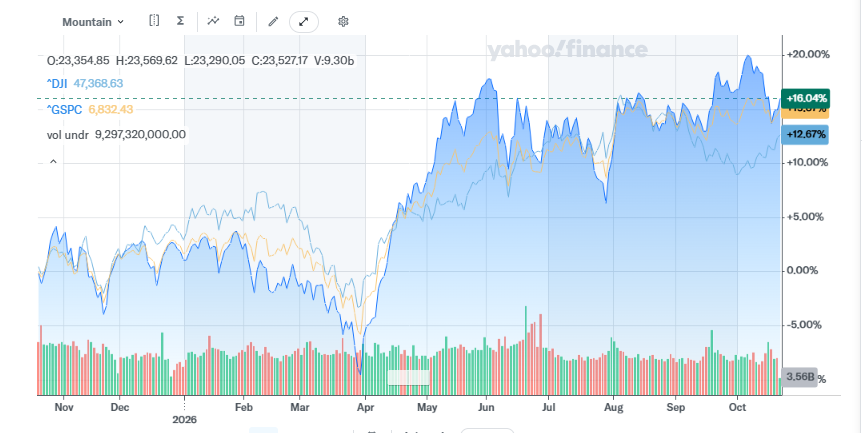
Nasdaq technical outlook: a developing top remains a risk
The chart shows a sharp retreat from the recent peak followed by a recovery that has not yet regained those highs. The earlier October 21 snapshot recorded 26,712.03, approximately 3.6% below the 27,722.75 high listed in that earlier image. This leaves room for a topping or distribution interpretation: buyers are returning, but have not yet demonstrated the strength needed to restore the prior advance.
STA Research assessment: The cautious case is that this week’s rally is a countertrend rebound within October’s correction. That case would strengthen if the index stalls beneath resistance, forms another lower high and subsequently breaks the recent low. Conversely, holding support, establishing higher lows and sustaining a recovery above 27,000 would weaken the immediate bearish interpretation; reclaiming the peak region would provide stronger evidence of repair.
The distinction between time frames matters. The May–October chart also shows a broader advance from its earlier lows. It supports concern about an unresolved correction and a possible developing top, but does not by itself confirm a longer-term weekly downtrend or a completed major-market top. Weekly closes, breadth and trend indicators would be needed to establish that stronger conclusion.
Oil, yields and upcoming earnings still matter
AP’s late-morning report put the U.S. 10-year Treasury yield near 5.10% and Brent crude around US$109 a barrel. Some relief in yields can help growth-stock valuations, while expensive energy continues to challenge margins and household purchasing power. Meta and Tesla’s scheduled after-market results remain important tests for investment spending and demand.
In Canada, AI infrastructure demand remains relevant to technology manufacturers, while energy producers respond to realised oil prices. Banks, consumer businesses and housing-sensitive companies still need evidence that demand and credit performance can withstand elevated costs. A rebound concentrated in a few technology leaders would offer less reassurance than participation across sectors.
Outlook: respect the rebound without assuming the correction is over
SpaceX’s earnings and capex plans strengthen the near-term AI demand narrative. The technical picture remains less settled: the Nasdaq is recovering from its lows, yet the recent peak remains unchallenged. STA Research retains a cautious, selective outlook until improving price structure and broader participation show that the recovery is durable. A failed rally followed by a break of support would increase the risk of a more prolonged decline.
Evidence: October 20 SpaceX earnings and capex reporting; October 21 Reuters early-session market coverage, AP late-morning coverage and StoneX commentary; and the user-supplied Yahoo Finance charts. Index-level references use the earlier intraday snapshot. Market observations refer to different intraday times. Capex guidance is forward-looking. Technical zones, scenarios and sector implications are STA Research interpretations, not guarantees of market direction.
October 20, 2026 — Earnings Face a Tougher Test as Oil Rises and Consumers Tire
Archived report. Figures, forecasts and references to upcoming events belong to October 20, 2026.
STA RESEARCH · U.S. & CANADA
Earnings Face a Tougher Test as Oil Rises and Consumers Tire
Renewed energy inflation and weakening housing activity raise the stakes for corporate guidance and household spending.
Updated October 20, 2026 · Morning outlook · By STA Research
October 20, 2026 · Earnings, energy and household finances
Macro pressures challenge the earnings outlook
Earnings arrive into a less forgiving market
Quarterly results are arriving as investors weigh resilient corporate profits against higher energy costs and pressure on demand. Tuesday morning’s reports were mixed: Reuters reported that Halliburton beat expectations, 3M improved its profit outlook, General Motors reduced its annual earnings forecast and Steel Dynamics missed profit estimates.
The central question is whether companies can sustain earnings as financing and operating costs rise. An earnings beat may offer limited support if management lowers guidance, relies heavily on cost cuts or signals weaker orders. Investors should distinguish stronger sales volumes from price increases, and operating cash generation from accounting gains or buybacks.
Oil gains again, renewing inflation pressure
Oil rebounded Tuesday morning, with AP reporting Brent above $110 a barrel as Middle East supply concerns persisted. The renewed increase reverses some of Monday’s relief and threatens to keep inflation pressure in place.
Fuel costs affect transport, manufacturing, distribution and household budgets. Businesses that cannot pass higher costs to customers face margin compression; those that raise prices risk weakening demand. Sustained energy inflation could complicate monetary easing even if economic growth slows, leaving equities exposed to a difficult combination of weaker spending and restrictive financing conditions.
A financially tired consumer: strain is visible, but uneven
The consumer-fatigue argument is strongest where expensive essentials and debt servicing reduce room for discretionary spending. Housing affordability and fuel costs can squeeze households before aggregate consumption turns negative. Retailers, restaurants, automakers and travel companies therefore face a growing test of pricing power and customer resilience.
Credit data require care. The New York Fed’s latest quarterly report covers the second quarter, not October: household debt totaled $18.8 trillion and 4.7% was in some stage of delinquency, with aggregate delinquency improving slightly. Its subsequent analysis described delinquency rates across most products as fairly stable. These figures support monitoring vulnerable borrowers, but do not establish that all consumers are deteriorating rapidly.
Evidence of a broader slowdown would include weaker spending volumes, more promotional activity, rising new delinquencies and deteriorating employment. A stable rate of new credit problems would temper the more severe interpretation.
Housing: echoes of the crisis era, without proof of another 2008
The housing warning has intensified. The NAHB/Wells Fargo builder-confidence index fell to 29 in October, its lowest since June 2012. The survey also showed 43% of builders cutting prices. Together with September’s 14.5% home-purchase cancellation rate reported by Redfin, the data point to weak buyer commitment and mounting pressure to complete sales.
There are uncomfortable echoes of an earlier housing downturn: affordability stress, incentives, weak confidence and concern about unsold homes. But canceled purchase contracts are different from missed payments on existing mortgages. A 2008-style diagnosis would require evidence of widespread defaults, foreclosures, negative equity and losses spreading through lenders and funding markets.
The Federal Reserve’s commercial-bank mortgage series showed a 1.86% delinquency rate in the second quarter. That measure covers bank-held single-family mortgages and differs from broader mortgage surveys; it should not be compared directly with an all-loan foreclosure statistic. Current housing weakness is a material growth risk, while a systemic mortgage crisis remains a scenario to test rather than an established fact.
Implications for U.S. and Canadian equities
Energy producers may benefit from higher realized oil prices, offering support to parts of Canada’s market. Transportation, consumer discretionary and housing-related businesses face greater cost and demand risks. Banks warrant attention for credit provisions and loan performance, while highly valued growth businesses remain sensitive to funding costs and the credibility of future cash flows.
A longer correction becomes more plausible if persistent oil strength coincides with weaker guidance, softer employment and failed market recoveries. Easing energy costs, stable credit performance and broader earnings strength would weaken that case. The outlook remains cautious, with preference for durable cash generation, manageable leverage and demonstrated pricing power.
Evidence: October 20 morning reporting from Reuters and AP; October 19 reporting on the NAHB survey; Redfin’s September cancellation figures; New York Fed second-quarter household-credit data and August analysis; Federal Reserve mortgage delinquency data via FRED. These releases cover different periods and populations. Market implications are STA Research interpretation; morning prices are dated observations.
October 19, 2026 — Higher Oil Prices and Housing Cancellations Raise Macro Concerns
STA RESEARCH · U.S. & CANADA
Higher Oil Prices and Housing Cancellations Raise Macro Concerns
Elevated energy costs and fragile U.S. housing demand create a difficult mix for inflation, interest rates and corporate earnings.
Updated October 19, 2026 · By STA Research
October 19, 2026 · Macro market outlook
Inflation pressure meets signs of weaker demand
Oil remains a macro risk despite Monday’s pullback
The recent rise in oil prices remains a concern for the broader economy. Reuters reported that Brent eased on Monday after last week’s rally to a five-month high. The daily pullback offers some relief, but elevated energy costs continue to pose an inflation risk.
More expensive fuel raises transportation, distribution and production costs. Companies must absorb those costs through lower margins or pass them on to customers, potentially slowing the decline in inflation. Households paying more for gasoline and heating also have less income available for discretionary purchases.
The duration of the increase matters. A brief oil spike can fade before it materially changes spending or policy; sustained strength could complicate Federal Reserve rate cuts and keep financing costs restrictive. That creates a risk of slower growth alongside stubborn inflation, although this combination alone does not establish a recession.
U.S. housing cancellations highlight fragile demand
According to Redfin data cited by Yahoo Finance on October 19, 14.5% of U.S. home purchase agreements fell through in September—approximately one in seven. The figure refers to contracted deals that did not complete, rather than all prospective buyers abandoning their searches.
Deals can fall apart because of financing difficulties, inspection findings or buyers reconsidering their purchases. Greater inventory and negotiating power also give buyers more opportunities to walk away. The cancellation rate is therefore a warning about transaction uncertainty, rather than proof of a nationwide housing collapse.
For the economy, persistent weakness in completed sales could weigh on brokerage activity, moving services, renovation spending, furniture and appliance purchases. Sellers may need to offer concessions, while builders could face pressure to provide financing incentives. Higher energy bills would add another constraint to already stretched housing budgets.
Sector implications for U.S. and Canadian markets
Energy producers may benefit from stronger realized oil prices, providing potential support to Canada’s resource-heavy market. Airlines, transportation companies and other fuel-intensive businesses face the opposite cost pressure. Consumer discretionary companies and housing-related businesses are exposed if households delay major purchases.
Interest-rate-sensitive property companies, utilities and highly valued growth stocks remain vulnerable if inflation concerns keep bond yields elevated. Banks warrant attention for changes in credit demand and loan performance, but housing cancellations alone do not demonstrate rising mortgage defaults.
What would improve or worsen the outlook?
A sustained retreat in energy prices, steadier bond yields and improving housing completions would ease the macro pressure. Resilient earnings and broader market participation would also support confidence. Persistent oil strength combined with weaker household spending, earnings downgrades and failed market rebounds would strengthen the case for a longer correction.
Source context: Reuters oil-market reporting and Yahoo Finance’s October 19 report citing Redfin’s September housing data. Sector implications and the market outlook are STA Research analysis.
October 15, 2026 — Futures Extend the Market Decline as Inflation Concerns Rise
Archived report. Figures, forecasts and references to upcoming events belong to the original report date.
STA RESEARCH · U.S. & CANADA
Futures Extend the Market Decline as Inflation Concerns Rise
Hotter U.S. inflation pushed stocks lower on Wednesday, and early overnight futures pointed to more pressure on Thursday.
Updated October 15, 2026 · Overnight market outlook
October 15, 2026 · Futures snapshot from approximately 8:20 p.m. ET on October 14
Inflation pressure carries into overnight trading
S&P 500 futuresDown about 0.3%Early overnight snapshotNasdaq 100 futuresDown about 0.8%Early overnight snapshotU.S. September CPI3.7% year over yearUp from 3.4% in AugustTSX Wednesday closeDown 1.11%35,584.46 points
Futures figures are time-stamped indications, not live quotes; prices can change before the opening bell.
U.S. stock futures pointed lower after Wednesday’s inflation-driven selloff. The S&P 500 fell 1.11% and the Nasdaq Composite lost 1.88% during the regular session, while the Dow slipped 0.09%. Canada’s S&P/TSX Composite also declined 1.11%, with weaker metal prices weighing on miners.
Why inflation changed the outlook
The U.S. Consumer Price Index rose 0.6% in September and 3.7% from a year earlier, compared with 3.4% annual inflation in August. Gasoline prices climbed 9.1% for the month and accounted for more than half of the headline increase. Core inflation, excluding food and energy, rose 0.3% for the month and 2.6% year over year. The reading raised concern that the Federal Reserve could keep rates elevated or tighten policy further. The Fed’s October Beige Book also described broader price pressures, including higher oil costs.
Market and sector outlook
Technology led Wednesday’s U.S. losses, and the Philadelphia Semiconductor Index fell about 4.3%. Higher expected borrowing costs put pressure on highly valued growth companies, particularly those with large AI infrastructure spending plans. In Canada, miners were hit by softer metals prices; firmer oil prices provided some support to energy shares. This mix leaves the near-term outlook cautious, with the Nasdaq and other rate-sensitive sectors particularly exposed to changes in bond yields.
What to watch Thursday: Producer inflation, retail sales and weekly jobless claims could shift expectations for rates and growth. A broader rebound with steadier yields would ease pressure. Further technology losses accompanied by weakness in banks, smaller companies and Canadian cyclicals would strengthen the case for a deeper pullback.
STA Research view
Cautious, with confirmation needed
The overnight decline adds to Wednesday’s losses, but futures alone cannot establish a sustained downturn. Watch whether inflation concerns persist in bond yields and whether selling spreads beyond technology and mining.
Earlier analysis · October 12, 2026
Technical Outlook: Is a Downturn Developing Beneath the Surface?
Markets can look resilient at the index level while a growing number of individual stocks struggle. That divergence can mark the transition from a broad advance to a more vulnerable market. The argument for a potential downturn rests on participation, price structure and the strength of recoveries—not on a single red session or the age of the bull market.STA Research’s stance is cautious and conditional. A sustained downturn would become more credible if weakening breadth coincides with broken support and repeated failed rallies. Until those signals align, consolidation and sector rotation remain plausible explanations.
Breadth: The Warning Beneath the Headline Index
A market is generally more resilient when gains extend across sectors and company sizes. If a capitalization-weighted index stays near its highs while fewer stocks trade above their intermediate-term moving averages, leadership is narrowing. Weak equal-weight performance, a falling advance–decline line and expanding new lows would strengthen that warning.
The October 9 breadth snapshot from thetrading.tools showed only 26.3% of eligible U.S. common stocks above their 50-day averages, versus 35.2% of S&P 500 constituents and 49.0% of Nasdaq-100 constituents. Its all-stock universe includes smaller companies and differs from index-member samples. These readings suggest weak intermediate-term participation; they do not establish when an index will fall.
Counter-evidence matters. MarketWatch reported that 64% of S&P 500 constituents were rising during an October 12 intraday snapshot despite a small index decline. One day of improving participation can coexist with weak longer-term breadth. Several weeks of improvement would weaken the downturn argument more meaningfully.
Moving Averages: distinguish a pullback from a trend change
Use daily closing prices for the 50-day and 200-day averages, and weekly bars for longer-term trend assessment. A moving average on an hourly chart is not a 50-day average.
A brief break below the 50-day average can occur within a healthy uptrend. The stronger warning is a sequence: price closes below a flattening or falling 50-day average, a rebound fails to reclaim it, and the index subsequently undercuts its prior swing low. Repeated closes below a falling 200-day average would indicate more extensive damage.
Support should be treated as a zone around prior lows and consolidation areas. A round number alone is not evidence of established support. A downside break followed by an unsuccessful retest is more informative than an isolated intraday breach.
Lower highs and Failed Recoveries
An uptrend produces higher highs and higher lows. If successive recoveries stall below prior peaks and selling pushes through previous lows, that structure begins to reverse. This pattern across the S&P 500, Nasdaq and smaller-company benchmarks would be more consequential than weakness in one sector.
Momentum can provide corroboration. On a daily chart, repeated RSI failures near the midpoint of 50 and a deteriorating MACD can support the case that rallies are losing strength. Neither indicator is sufficient alone, and oversold readings can precede sharp rebounds without ending a downtrend.
Down days accompanied by heavier trading volume, followed by recoveries on lighter volume, can suggest distribution. Compare several sessions and account for earnings, options expiration and index rebalancing before attributing volume to persistent selling.
Canada: test the breadth of any recovery
Apply the same framework to the S&P/TSX Composite, while recognizing its sector mix. Energy or mining gains can support the index even if banks, industrials, consumer businesses and smaller companies lag. A recovery with participation across those groups would provide stronger evidence of stability.
Bank credit quality, commodity-price sensitivity and refinancing costs matter alongside the charts. Higher oil prices can benefit producers while increasing costs elsewhere. Higher bond yields can weigh on utilities, property companies and long-duration growth valuations. These are transmission mechanisms to monitor, not proof that every sector must decline together.
What would confirm—or weaken—the downturn case?
| Signal | Downturn case strengthens when | Downturn case weakens when |
|---|---|---|
| Breadth | Participation contracts and new lows expand | More stocks reclaim intermediate-term averages |
| Price structure | Lower highs lead to breaks of prior lows | Prior resistance is reclaimed and higher lows form |
| Moving averages | Failed retests accompany falling daily averages | Prices regain the averages and their slopes improve |
| Leadership | Weakness spreads across sectors and company sizes | Equal-weight indexes and smaller companies join gains |
| Momentum and volume | Weak rebounds accompany persistent selling pressure | Advances show improving momentum and sustained participation |
Market outlook
The risk is a gradual deterioration that headline indexes initially conceal. Narrow leadership leaves a market more dependent on a small number of large companies, making disappointment in earnings or financing conditions more consequential. But weak breadth can improve without a major index decline, and bearish signals can fail.
The base outlook is a vulnerable, uneven market that requires confirmation rather than a declared cycle top. The bearish scenario becomes stronger if support breaks, rallies fail and weakness spreads. The constructive scenario is a broadening recovery with improving daily trend measures and earnings support. Historical bull-market gains do not provide a reliable percentage ceiling for the next peak.
Portfolio analysis should distinguish durable cash generation and manageable leverage from businesses dependent on optimistic forecasts or repeated financing. Technical deterioration is a reason to reassess exposure and position sizing; it is not a substitute for company valuation or an automatic instruction to sell every holding.
Evidence and methodology
The numerical breadth observations above are dated snapshots, not live readings. The remaining discussion is a reusable analytical framework and conditional STA Research interpretation; it does not assert that every listed confirmation signal is currently present.
October 12, 2026 — Is a Downturn Developing Beneath the Surface?
Archived report. Figures, forecasts and references to upcoming events belong to the original report date.
STA RESEARCH · U.S. & CANADA
Is a Downturn Developing Beneath the Surface?
A durable framework for judging market breadth, trend breaks and failed rallies—and the evidence that would challenge the bearish case.
Updated October 12, 2026 · Technical outlook
Updated October 12, 2026 | STA Research | U.S. and Canadian marketsMarkets can look resilient at the index level while a growing number of individual stocks struggle. That divergence can mark the transition from a broad advance to a more vulnerable market. The argument for a potential downturn rests on participation, price structure and the strength of recoveries—not on a single red session or the age of the bull market.
STA Research’s stance is cautious and conditional. A sustained downturn would become more credible if weakening breadth coincides with broken support and repeated failed rallies. Until those signals align, consolidation and sector rotation remain plausible explanations.
Breadth: The Warning Beneath the Headline Index
A market is generally more resilient when gains extend across sectors and company sizes. If a capitalization-weighted index stays near its highs while fewer stocks trade above their intermediate-term moving averages, leadership is narrowing. Weak equal-weight performance, a falling advance–decline line and expanding new lows would strengthen that warning.
The October 9 breadth snapshot from thetrading.tools showed only 26.3% of eligible U.S. common stocks above their 50-day averages, versus 35.2% of S&P 500 constituents and 49.0% of Nasdaq-100 constituents. Its all-stock universe includes smaller companies and differs from index-member samples. These readings suggest weak intermediate-term participation; they do not establish when an index will fall.
Counter-evidence matters. MarketWatch reported that 64% of S&P 500 constituents were rising during an October 12 intraday snapshot despite a small index decline. One day of improving participation can coexist with weak longer-term breadth. Several weeks of improvement would weaken the downturn argument more meaningfully.
Moving Averages: distinguish a pullback from a trend change
Use daily closing prices for the 50-day and 200-day averages, and weekly bars for longer-term trend assessment. A moving average on an hourly chart is not a 50-day average.
A brief break below the 50-day average can occur within a healthy uptrend. The stronger warning is a sequence: price closes below a flattening or falling 50-day average, a rebound fails to reclaim it, and the index subsequently undercuts its prior swing low. Repeated closes below a falling 200-day average would indicate more extensive damage.
Support should be treated as a zone around prior lows and consolidation areas. A round number alone is not evidence of established support. A downside break followed by an unsuccessful retest is more informative than an isolated intraday breach.
Lower highs and Failed Recoveries
An uptrend produces higher highs and higher lows. If successive recoveries stall below prior peaks and selling pushes through previous lows, that structure begins to reverse. This pattern across the S&P 500, Nasdaq and smaller-company benchmarks would be more consequential than weakness in one sector.
Momentum can provide corroboration. On a daily chart, repeated RSI failures near the midpoint of 50 and a deteriorating MACD can support the case that rallies are losing strength. Neither indicator is sufficient alone, and oversold readings can precede sharp rebounds without ending a downtrend.
Down days accompanied by heavier trading volume, followed by recoveries on lighter volume, can suggest distribution. Compare several sessions and account for earnings, options expiration and index rebalancing before attributing volume to persistent selling.
Canada: test the breadth of any recovery
Apply the same framework to the S&P/TSX Composite, while recognizing its sector mix. Energy or mining gains can support the index even if banks, industrials, consumer businesses and smaller companies lag. A recovery with participation across those groups would provide stronger evidence of stability.
Bank credit quality, commodity-price sensitivity and refinancing costs matter alongside the charts. Higher oil prices can benefit producers while increasing costs elsewhere. Higher bond yields can weigh on utilities, property companies and long-duration growth valuations. These are transmission mechanisms to monitor, not proof that every sector must decline together.
What would confirm—or weaken—the downturn case?
| Signal | Downturn case strengthens when | Downturn case weakens when |
|---|---|---|
| Breadth | Participation contracts and new lows expand | More stocks reclaim intermediate-term averages |
| Price structure | Lower highs lead to breaks of prior lows | Prior resistance is reclaimed and higher lows form |
| Moving averages | Failed retests accompany falling daily averages | Prices regain the averages and their slopes improve |
| Leadership | Weakness spreads across sectors and company sizes | Equal-weight indexes and smaller companies join gains |
| Momentum and volume | Weak rebounds accompany persistent selling pressure | Advances show improving momentum and sustained participation |
Market outlook
The risk is a gradual deterioration that headline indexes initially conceal. Narrow leadership leaves a market more dependent on a small number of large companies, making disappointment in earnings or financing conditions more consequential. But weak breadth can improve without a major index decline, and bearish signals can fail.
The base outlook is a vulnerable, uneven market that requires confirmation rather than a declared cycle top. The bearish scenario becomes stronger if support breaks, rallies fail and weakness spreads. The constructive scenario is a broadening recovery with improving daily trend measures and earnings support. Historical bull-market gains do not provide a reliable percentage ceiling for the next peak.
Portfolio analysis should distinguish durable cash generation and manageable leverage from businesses dependent on optimistic forecasts or repeated financing. Technical deterioration is a reason to reassess exposure and position sizing; it is not a substitute for company valuation or an automatic instruction to sell every holding.
Evidence and methodology
The numerical breadth observations above are dated snapshots, not live readings. The remaining discussion is a reusable analytical framework and conditional STA Research interpretation; it does not assert that every listed confirmation signal is currently present.
October 8, 2026 — TSX selloff and firmer oil test Thursday’s outlook
Archived report. Figures, forecasts and references to upcoming events belong to the original report date.
STA Research · U.S. & Canada
TSX selloff and firmer oil test Thursday’s outlook
North American markets enter Thursday after Wednesday’s retreat. Canada’s decline was considerably sharper, while renewed oil strength and elevated borrowing costs keep the focus on earnings resilience and valuation.
October 8, 2026 | Overnight edition · Eastern time | October 7 closes & early Asian-session reports
Read the analysis ?Stocks to watch ?
U.S. equitiesS&P 500 · ?0.2%October 7 closing change · roundedCanadian equitiesTSX · ?1.7%October 7 closing changeOvernight directionU.S. futures · ?0.1%S&P & Nasdaq · reported Asian-session snapshotNext catalystJobless claims · 8:30 a.m.Thursday, October 8 · Eastern time
Latest analysis · October 8, 2026
A modest U.S. retreat, a broader Canadian warning
Timing: Overnight outlook for Thursday, October 8. The cash-index table contains Wednesday’s closing prices. Futures and commodity figures are separately dated news snapshots; they may have changed since publication. The September Fed minutes have now been released.
STA Research assessment: The contrast between a small U.S. index decline and a heavier Canadian selloff suggests that market risk extends beyond expensive technology shares. Investors should assess whether tighter financing conditions are weakening a wider range of businesses. One session does not establish a sustained downturn, but Thursday’s participation across sectors will help distinguish consolidation from a broader deterioration.
U.S. industrials led sector losses on Wednesday, while healthcare led gains. The Russell 2000 lost approximately 1.3%. Reuters U.S. closing report.
Overnight: pressure returns to oil and financing
Reuters’ early-Asian-session report, published October 8 UTC, showed S&P 500 and Nasdaq futures each down about 0.1%, with the U.S. 10-year yield near 5.30%. Asian shares also weakened as investors weighed borrowing costs and demand for AI financing. Reuters overnight report.
A separate Reuters oil snapshot at 01:16 UTC on October 8 (9:16 p.m. ET on October 7) put Brent at US$101.53 and WTI at US$89.39, both higher, amid renewed shipping and supply concerns. Reuters oil report.
STA Research interpretation: Higher energy costs can reduce margins and household purchasing power, while elevated yields raise financing costs and the discount rate applied to future profits. AI investment can support supplier revenues while also increasing capital requirements. The investment test is whether additional spending produces cash returns that justify its cost.
Canada: financials and materials carry the downside
The TSX closed at 35,041.86, down 607.65 points or 1.7%, its largest decline since June 5. Materials fell 2.9%, financials 2.3%, industrials 1.65% and energy 0.75%. Elevated yields and trade uncertainty weighed on sentiment. Reuters Canadian closing report.
STA Research outlook: Banks warrant attention for credit quality, funding costs and loan demand. For gold miners, separate commodity-price sensitivity from operating execution. Firmer crude can improve energy producers’ revenue outlook, but Wednesday’s sector decline illustrates that commodity strength does not automatically translate into higher share prices. Utilities and REITs remain sensitive to refinancing costs and the relative appeal of their income streams.
Thursday’s checklist
Three signals to follow
- Bond yields: Does the overnight rise settle, or keep valuations under pressure?
- Market breadth: Can banks, miners, industrials and smaller companies join a recovery?
- Oil and earnings: Are businesses able to protect margins as input and financing costs rise?
Current stance: Cautious near term; favor evidence of earnings resilience, manageable leverage and durable free cash flow.
Completed cash session
October 7 closing market snapshot
| Benchmark | Closing level | Daily change | Session |
|---|---|---|---|
| S&P 500 | 7,801.77 | ?0.2% | October 7 close |
| Dow Jones | 51,179.87 | ?0.7% | October 7 close |
| Nasdaq Composite | 27,538.69 | ?0.2% | October 7 close |
| S&P/TSX Composite | 35,041.86 | ?1.7% | October 7 close |
Sources: AP U.S. closing report and Reuters Canadian closing report. Percentage changes are rounded as reported. These are closing cash indexes, separate from overnight futures.
Fed minutes released · October 7
Inflation concerns remain central to the rate outlook
The September 15–16 minutes confirm unanimous support for the quarter-point increase to a 3.75%–4.00% policy range. Officials differed over the rationale, and most considered another increase appropriate by year-end, while emphasizing that future decisions depend on incoming data. The next meeting is October 27–28. Federal Reserve meeting minutes.
STA Research interpretation: The minutes do not commit the Fed to an October hike. They show that persistent inflation and the possibility of broader price pressures remain important risks. Equities need to absorb both the policy outlook and the cost of long-term borrowing; a pause in policy tightening would not by itself guarantee lower bond yields.
Thursday’s weekly jobless claims release is scheduled for 8:30 a.m. ET. Watch the balance between employment resilience and signs that financing costs are slowing activity. Federal Reserve Bank of St. Louis release calendar.
Event watch · October 8
Weekly jobless claims8:30 a.m. ET
Fed minutesReleased October 7
Next FOMC meetingOctober 27–28
Economic outcomes remain unknown until release; assess the market response alongside the data.
U.S. & Canadian sector watch
Stocks and sectors to watch on Thursday
STA Research monitoring priorities, with links to separately dated company coverage.
U.S. · Semiconductors
Micron, Nvidia & AMD
Compare demand visibility with margins, investment needs and valuation. A strong AI spending theme still requires attractive returns for suppliers and customers.
U.S. · Cloud & platforms
Amazon, Alphabet & Meta
Track capital efficiency, operating profitability and free cash flow. Review the latest Amazon, Alphabet and Meta analyst articles.
U.S. · Consumer & healthcare
McDonald’s & Johnson & Johnson
Assess demand resilience and pricing power alongside valuation. Read the separately dated McDonald’s and JNJ coverage.
Canada · Technology
Shopify
Compare commerce growth with cash conversion and sensitivity to higher yields. Shopify analyst update.
Canada · Energy & banks
Suncor & Canadian lenders
For energy, follow realized prices, costs and shareholder returns. For banks, watch credit quality and funding conditions. Suncor outlook.
Canada · Materials & income
Hudbay, miners & REITs
Distinguish commodity exposure from project execution and refinancing risk. Read the Hudbay and Allied Properties articles.
STA Research scenarios
Recovery needs broader participation
Constructive scenario
Oil pressure eases, yields stabilize and buyers return across sectors. A recovery supported by Canadian financials and materials, U.S. cyclicals and smaller companies would offer stronger evidence of stabilization than a rebound concentrated in a few technology names.
Risk scenario
Oil and financing costs remain elevated, earnings expectations soften and selling spreads. Repeated weak sessions and deteriorating breadth would strengthen the case for a wider pullback. Watch the S&P 500 around 7,800 as a round-number reference, rather than assuming it is established support.
Portfolio perspective: Compare earnings resilience, leverage, cash generation and valuation with company-specific risks in the STA Research Portfolio. Analyst price targets are estimates; the scenarios above are conditional STA Research interpretations.
October 7, 2026 — Oil and yields pressure North American stocks
Archived report. Figures, forecasts and references to upcoming events belong to the original report date.
STA Research · U.S. & Canada
Oil and yields pressure North American stocks
Wednesday’s weakness has carried into cash trading. Investors face a fresh test of equity valuations as energy costs and borrowing rates rise ahead of this afternoon’s Federal Reserve minutes.
October 7, 2026Morning edition · Eastern timeEarly-session snapshots
Read the analysis ?Stocks to watch ?
U.S. equitiesS&P 500 · ?0.56%9:43 a.m. ET snapshotCanadian equitiesTSX · ?0.9%9:32 a.m. ET snapshotValuation pressureOil & yields risingInflation and financing costs in focusNext catalystFed minutes · 2 p.m. ETSeptember 15–16 meeting discussion
Latest analysis · October 7, 2026
The rally faces a broader test after the open
Timing: This morning edition replaces the overnight outlook. Market figures below are dated early-session news snapshots, with the observation time shown for each. Prices may have changed since those reports. Fed minutes remain scheduled for this afternoon.
STA Research assessment: Selling after the opening bell gives the overnight caution greater weight. The next question is whether buyers can absorb the decline while financing conditions remain demanding. An intraday pullback alone does not establish a durable change in the market trend.
Market breadth matters as much as the headline indexes. A recovery supported by smaller companies, cyclicals and a wider range of technology shares would carry more conviction than a rebound concentrated in a few large names. Persistent weakness across these groups would make the rally more vulnerable to earnings disappointments.
Oil, yields and the valuation test
AP’s early-session report put Brent crude at US$102.10 and the U.S. 10-year Treasury yield at 5.35%, versus 5.27% late Tuesday. Oil and bond-market report.
STA Research interpretation: When oil and yields rise together, equities can face pressure from both earnings and valuation. Fuel costs can squeeze margins, while higher discount rates reduce the present value of future profits. The effect depends on each company’s pricing power, balance sheet and ability to convert growth into cash.
For technology companies, continued revenue growth needs to translate into durable earnings and free cash flow. Investors should examine returns on AI and cloud investment alongside sales growth. For transport, consumer and industrial businesses, the key issue is whether higher costs can be passed through without damaging demand.
Canada: miners weigh on the opening session
The TSX stood at 35,321.45, down 0.9%, at 9:32 a.m. ET, with miners contributing to the decline. Canadian opening report.
STA Research outlook: Higher crude may improve the revenue outlook for Canadian energy producers, but it does not guarantee that their shares rise in a weaker market. Watch realized prices, operating costs and capital discipline. Utilities and property companies face a different challenge: higher refinancing costs can weaken the appeal of income streams and slow investment.
For miners, distinguish commodity exposure from company execution. Gold producers depend on bullion, currency movements and real yields; industrial-metal producers also depend on demand expectations. Banks warrant attention for credit quality and loan demand if financing conditions tighten further.
Wednesday’s checklist
Three signals to follow
- Bond yields: Does the morning rise settle after the Fed minutes?
- Market breadth: Do buyers return across sectors and company sizes?
- Closing response: Does selling fade, or leave indexes near session lows?
Current stance: Cautious near term; earnings quality and valuation remain central to stock selection.
Reported cash-market snapshots
October 7 morning market snapshot
| Benchmark | Level | Daily change | Observation time |
|---|---|---|---|
| S&P 500 | 7,775.04 | ?0.56% | 9:43 a.m. ET |
| Dow Jones | 51,049.07 | ?0.92% | 9:43 a.m. ET |
| Nasdaq Composite | 27,364.73 | ?0.85% | 9:43 a.m. ET |
| S&P/TSX Composite | 35,321.45 | ?0.9% | 9:32 a.m. ET |
Sources: Reuters U.S. opening report and Reuters Canadian opening report. Observation times differ; these are cash indexes and are not a live quote feed or closing prices.
This afternoon’s scheduled catalyst
Fed minutes: watch the rates response
The September 15–16 meeting minutes are scheduled for October 7 at 2:00 p.m. Eastern, followed by consumer credit at 3:00 p.m. The next FOMC meeting is October 27–28. Federal Reserve October calendar.
STA Research interpretation: The minutes describe an earlier policy discussion. Investors will assess how officials weighed inflation persistence against growth risks. A tougher inflation message could keep upward pressure on yields; evidence of greater caution could help valuations if the bond market stabilizes.
The practical test is the reaction in yields, the dollar and equity participation. The same language can produce different price responses depending on what investors already expected. This edition does not anticipate the contents of unreleased minutes.
Event watch · October 7
FOMC minutes2:00 p.m. ETConsumer credit3:00 p.m. ETKey market responseTreasury yieldsScheduled events. Assess the response when the releases arrive.
U.S. & Canadian sector watch
Stocks to watch through the session
STA Research monitoring priorities; company moves are stated only where reported.
More stock research ?U.S. · Semiconductors
Micron, Nvidia & AMD
Reuters reported Micron down 2.3% and Nvidia down 0.7% in early trading. Watch whether demand confidence can overcome valuation pressure as yields rise.
U.S. · Cloud & platforms
Microsoft, Amazon & Alphabet
Track operating margins, capital-spending returns and free cash flow. Rising financing rates increase the importance of delivering earnings against investment expectations.
U.S. · Power
Constellation Energy
Assess AI electricity demand alongside contract terms, investment needs and financing costs. A strong demand theme still requires attractive project returns.
Canada · Technology
Shopify
Monitor growth-stock sentiment and operating execution. Compare its response with U.S. technology participation and changes in bond yields.
Canada · Energy
Canadian Natural & Suncor
Watch whether firmer crude supports cash-flow expectations and share performance. Production costs, realized price differentials and shareholder returns remain key.
Canada · Gold & income
Agnico Eagle & utilities
For gold producers, follow bullion and real yields. For utilities, assess debt maturities, refinancing costs and the sustainability of dividend growth.
STA Research scenarios
Consolidation or a wider pullback?
Constructive scenario
Yields stabilize, oil pressure eases and buyers return across sectors. A recovery sustained into the close would strengthen the case for consolidation. Watch the S&P 500’s response around 7,800 as a round-number reference, without treating it as established technical support.
Risk scenario
Oil and yields continue climbing, growth shares remain weak and selling extends to cyclicals and smaller companies. A poor closing response followed by further weakness would increase concern about a deeper pullback. Confirmation requires more than one morning’s trading.
Portfolio perspective: Evaluate earnings resilience, leverage, free cash flow and valuation before treating an index dip as a buying opportunity. Compare company-specific risks with the separately dated analysis in the STA Research Portfolio.
September 29, 2026 — Rising yields test the AI rebound ahead of Micron earnings
Archived report. Figures, forecasts and references to upcoming events belong to the original report date.
STA Research · North American markets
Rising yields test the AI rebound ahead of Micron earnings
U.S. chipmakers are recovering, while higher bond yields restrain the wider market. Canadian technology and miners are offsetting weaker energy shares as investors assess flat July GDP.
September 29, 2026U.S. & CanadaMorning market snapshot
Read the analysis ?Stocks to watch ?
U.S. equitiesMixedChip strength meets higher Treasury yieldsCanadian equitiesTSX near flatTechnology and materials offset energyEconomic signalCanada GDP flatJuly output unchanged from JuneNext catalystMicron · WednesdayFiscal Q4 results after the close
Latest analysis · September 29, 2026
The North American market picture
Data and market moves are a late-morning snapshot; prices may change during the session.
North American markets were mixed Tuesday morning as investors weighed renewed interest in artificial intelligence stocks against rising bond yields. U.S. chipmakers rebounded from Monday’s decline, but the broader market showed less strength: the S&P 500 and Nasdaq were near flat in early trading, while the Dow slipped. The Philadelphia Semiconductor Index rose about 2.1%, even as declining stocks slightly outnumbered advancing stocks on both the NYSE and Nasdaq.
The bond market remains the main constraint on a broader rally. Higher Treasury yields raise financing costs and pressure stock valuations, particularly for companies whose expected profits lie further in the future. August U.S. job openings fell to 7.079 million, while September consumer confidence came in below expectations. Investors are looking for evidence that growth can hold up while borrowing costs remain elevated.
Canada: a narrow offset to broad weakness
The S&P/TSX Composite was down about 0.1% in late-morning trading. Technology and materials gained as gold and copper recovered from Monday’s lows, but energy weakened alongside crude oil. Only two of the TSX’s 10 major sectors were higher. Canadian GDP was unchanged in July, reinforcing a cautious outlook for domestic growth.
The session highlights an uneven market. Strength in AI stocks and Canadian miners can support the indexes temporarily, but a more durable advance would require broader participation and less pressure from bond yields.
What is driving the session?
Three forces to follow
- Bond yields: A further rise could weigh on growth stocks and rate-sensitive sectors.
- Oil and metals: Lower crude is dragging on TSX energy, while gold and copper are helping miners recover.
- Market breadth: Watch whether buying extends beyond a small group of AI and chip stocks.
Wednesday’s key earnings report
Why Micron matters beyond Micron
Micron Technology (MU) reports fiscal fourth quarter results after Wednesday’s market close. The company has guided to roughly US$50 billion in revenue, an approximately 86% gross margin, and US$31.00 in non-GAAP earnings per share, each subject to the stated guidance range. Those expectations leave little room for a weak outlook.
Investors will focus on the next quarter’s guidance, memory pricing, margins, and demand for high-bandwidth memory used in AI systems. Strong results and guidance could reinforce the AI infrastructure case across semiconductor stocks. Weak guidance or signs of peaking margins could weigh on the group even if the reported quarter exceeds estimates. The forward outlook will likely matter more than the headline earnings figure.
Read the Micron stock analysis ?
Micron: the setup
ReportSept. 30, after close
Fiscal Q4 revenue guidanceUS$50B ± US$1B
Non-GAAP EPS guidanceUS$31 ± US$1
Gross margin guidanceAbout 86%
Company guidance, not reported Q4 results. Micron’s scheduled call is at 4:30 p.m. Eastern.
Stocks in focus
Top stocks to watch
Company-specific catalysts alongside the broader market themes.
U.S. · Semiconductors
Micron MU
Wednesday’s earnings and guidance will test the durability of AI memory demand and margins.
U.S. · AI hardware
Nvidia & AMD NVDA · AMD
Watch whether the chip rebound broadens and whether Micron’s commentary supports the wider AI hardware outlook.
Canada · Technology
Shopify SHOP:CA
A gauge of whether Canadian growth shares can sustain gains despite elevated yields.
Canada · Gold
Agnico Eagle AEM:CA
Gold’s recovery is helping miners, though higher bond yields remain a potential headwind.
Canada · Energy
Canadian Natural CNQ:CA
Crude prices remain central to the energy sector after oil retreated in Tuesday’s session.
Canada · Industrials
WSP Global WSP:CA
Shares fell about 3% in late morning trading after several brokerages lowered their targets.
U.S. · Consumer
CarMax KMX
Shares rose after increased quarterly profit and revenue; a company-specific bright spot.
U.S. · Financial data
Fair Isaac FICO
Shares fell sharply following proposed changes to mortgage credit-score pricing.
Market outlook
What would change the near-term picture?
Constructive scenario
Micron confirms sustained memory demand with credible forward guidance, bond yields stabilize, and buying spreads beyond the largest AI names into other sectors.
Risk scenario
Micron signals softer pricing or margins while yields climb further. Narrow leadership would leave both the Nasdaq and TSX more exposed to another pullback.
September 23, 2026 — Market Analysis—September 23, 2026
Archived report. Figures, forecasts and references to upcoming events belong to the original report date.
Market Analysis—September 23, 2026
Oil and Yields Interrupt North America’s Rally
North American stocks are retreating after the Nasdaq’s record close and the TSX’s strong gain on Tuesday. The selloff is broad: small caps are falling more than the major U.S. indexes, while Canadian miners and technology stocks are weighing heavily on Toronto. The immediate pressure comes from oil moving back above US$100 a barrel, rising bond yields and a U.S. business survey that points to both stronger growth and higher costs.
Brent crude has pushed back above US$100 after several days of declines. At the same time, the U.S. 10-year Treasury yield has moved above 5%, a level that puts pressure on the valuations of growth stocks and raises borrowing costs across the economy. Canada’s 10-year yield is also rising. Higher oil prices can add to inflation, making it harder for central banks to ease policy and giving bond yields another reason to climb.
Today’s economic data sharpened that concern. The flash U.S. composite PMI rose to 58.4 in September from 56.0 in August, indicating faster business growth. The survey also reported a jump in input costs and worsening supply delays. Strong demand supports corporate revenue, but it may also keep the Federal Reserve focused on inflation and further rate increases.
Has the recent technical advance broken?
The Nasdaq has slipped below 27,000 after closing at a record 27,244 on Tuesday. The TSX has fallen below 36,000, reversing much of its latest push higher. Those moves interrupt the short run upward and make today’s close important: a recovery above those levels would suggest buyers are still defending the advance; a weak close would strengthen the case for a deeper pullback.
The evidence does not yet establish a lasting breakdown in the broader U.S. trend. At midday, the S&P 500 and Nasdaq remain above their September 18 closes. The Russell 2000’s sharper decline is a concern because it shows that smaller, more rate-sensitive companies are absorbing more of the pressure. Traders are watching whether selling broadens further and whether oil and yields remain elevated into the close.
Stocks in focus
Nvidia (NVDA), AMD and Intel (INTC) are testing the durability of the semiconductor rally as chip shares come under pressure. Meta (META) has been comparatively resilient following enthusiasm for its AI assistant, making it a useful gauge of whether investors are still willing to hold the recent AI winners.
In Canada, Shopify (SHOP:CA) is pulling back after its sharp two-day rise tied to an AI shopping partnership with Meta. Endeavour Silver (EDR:CA) is under particular pressure after CIBC downgraded it, while NovaGold (NG:CA) and other miners are falling with precious metals. Suncor (SU:CA) and Canadian Natural Resources (CNQ:CA) remain worth watching for relative strength as crude rebounds, even though stronger oil is creating a tougher backdrop for the overall market.
Today looks like a test of the rally rather than a confirmed change in the longer-term trend. For the market to regain momentum, oil and yields need to settle and buyers need to return beyond a few AI stocks. A close near the day’s lows, particularly with the TSX below 36,000 and the Nasdaq below 27,000, would point to more consolidation ahead.
Market Analysis—September 22, 2026
North American stocks enter Wednesday with a positive but uneven backdrop. The Nasdaq rose 0.45% on Tuesday to a record close of 27,244.28, supported by semiconductor and other AI-related shares. The S&P 500 finished virtually unchanged at 7,764.64, while the Dow fell 0.36%. Investors are still buying growth stocks, but the broader U.S. market has yet to match the Nasdaq’s momentum.
Canadian stocks had a stronger session. The S&P/TSX Composite gained 326 points, or 0.9%, to 36,335.61, its highest close in nearly three weeks. Materials, technology and industrials led the advance, with Shopify rising 7.4%. Financials and energy declined, however, so continued gains will depend on strength extending beyond the day’s leading sectors.
Oil is the market’s immediate test. U.S. crude settled 1.2% lower at $94.59 a barrel as hopes for progress between Washington and Tehran eased supply concerns. A sustained decline could relieve inflation pressure and support growth stocks. A reversal would put bond yields and interest rate expectations back in focus.
The Federal Reserve remains cautious. Richmond Fed President Tom Barkin said Tuesday that U.S. economic activity appears to be firming and that inflation pressures extend beyond energy and tariffs. That leaves investors weighing resilient demand against the prospect of further rate increases. Wednesday’s flash U.S. manufacturing and services PMI readings, due at 9:45 a.m. Eastern, may offer the next indication of whether growth is holding up without another acceleration in prices.
The near-term trend remains positive, led by AI shares in the U.S. and technology and miners in Canada. The rally would look stronger if U.S. financials stabilized and TSX gains broadened further. If oil stays contained and the PMI readings show steady growth, stocks could extend their advance. If crude and yields rise together, both the Nasdaq’s record and the TSX’s rebound may face a tougher test.
September 21, 2026 — Market Analysis – September 21st
Archived report. Figures, forecasts and references to upcoming events belong to the original report date.
Market Analysis – September 21st
The North American market delivered a strong rebound today, although the performance was notably different across the major indexes. The Nasdaq was the clear leader, rising approximately 2.3% and moving into record territory, while the S&P 500 gained about 1.5%, the Dow Jones rose roughly 0.7%, and the TSX remained comparatively subdued. The divergence is important because it shows that today’s rally was driven primarily by growth and technology stocks rather than being an equally strong move across every major sector.
Nasdaq Composite
The Nasdaq had the strongest technical setup today. The index gained approximately 2.3% and closed around 27,122, moving above its previous record closing high of 27,093.90. The breakout was supported by strong semiconductor and technology performance, with major chip stocks leading the advance. The Nasdaq therefore enters a price-discovery phase in which previous resistance levels become potential support.
Technically, the important area to monitor is now approximately 27,000–27,100. If the Nasdaq remains above this region during the next several sessions, today’s breakout would receive stronger confirmation. A move toward 27,200 and eventually 27,500 would represent continuation of the current momentum. However, after a gain of more than 2% in one session, a modest pullback or sideways consolidation would be normal. A decline back below 27,000 would weaken the immediate breakout, while a deeper move toward the 20-day moving average would represent a more meaningful technical test.
Fundamentally, the Nasdaq continues to benefit from strong AI investment, semiconductor demand, cloud computing, data-center spending and expectations for continued technology earnings growth. The primary risks remain elevated valuations, Federal Reserve policy, Treasury yields and the possibility that earnings expectations surrounding artificial intelligence become too aggressive.
S&P 500
The S&P 500 also produced a strong technical improvement today, rising approximately 1.5% and moving close to its record levels. Reuters’ technical analysis before today’s advance identified 7,677.02 as an important resistance level, followed by the 7,756–7,772 region. A move above the August intraday record around 7,816.70 would place the index firmly into new-high territory, with 8,000 becoming an important psychological level.
The S&P 500’s technical structure is therefore improving substantially. Last week, the index had fallen below its 50-day moving average and approached its 100-day moving average following the Federal Reserve’s rate increase. It subsequently recovered above the 50-day average, and today’s rally further strengthened that recovery. As long as the index remains above its important moving-average support levels, the medium-term structure remains constructive.
The S&P 500 also provides a broader representation of today’s rally than the Nasdaq because it contains significant exposure to financials, industrials, healthcare, consumer companies and energy in addition to technology. Today’s gain therefore indicates that the improvement in sentiment was not limited exclusively to technology.
The key levels to watch are approximately 7,677 on the upside, followed by 7,756–7,772, and then the previous record area around 7,800–7,817. On the downside, approximately 7,617 represents an important support area, followed by approximately 7,520 and 7,508.
Dow Jones Industrial Average
The Dow Jones produced a more moderate advance of approximately 0.7% today. Its relative underperformance compared with the Nasdaq is significant because the Dow has much less direct exposure to the high-growth technology and semiconductor companies that drove today’s rally.
The Dow’s behavior therefore suggests that today’s market strength is still heavily tilted toward growth and technology rather than representing a uniform rotation into every area of the market. Nevertheless, the Dow’s positive performance confirms that the rally was not confined entirely to technology stocks.
Fundamentally, the Dow is more sensitive to industrial activity, financial conditions, consumer demand, healthcare and large established corporations. Consequently, it can behave differently from the Nasdaq when interest rates and economic-growth expectations change. With the Federal Reserve having recently raised rates, the Dow’s performance will continue to depend heavily on whether higher borrowing costs begin to slow economic activity.
The Dow’s more moderate advance can therefore be interpreted as evidence of a risk-on environment with a strong preference for growth stocks, rather than an across-the-board surge in every segment of the market.
TSX Composite
The Canadian market presented a noticeably different picture. The S&P/TSX Composite was approximately flat during the morning and was around 35,815–35,829, while U.S. markets were rising sharply, with six of the TSX’s ten major sectors were in negative territory early in the session.
The primary reason for the TSX’s relative weakness was the decline in crude oil prices. Oil fell more than 3% toward the US$100 level, putting pressure on Canada’s large energy sector. Energy stocks are heavily represented in the Canadian index, so a sharp decline in crude can offset gains elsewhere in the market.
The TSX nevertheless received support from financials and technology, as financials gained approximately 0.9% while information technology increased about 1.1%, helping offset weakness in energy and mining.
The TSX also remains sensitive to gold and mining prices. Precious-metals stocks weakened alongside lower gold prices today, which limited the contribution from Canada’s large materials sector. This is particularly important because gold and mining companies have been major contributors to the TSX’s broader performance this year so far.
Interest Rates and the Federal Reserve
Interest rates remain the most important macroeconomic factor across all four indexes. The Federal Reserve just raised its policy rate to approximately 3.75%–4.00%, and policymakers have indicated that another increase could occur before the end of 2026. This creates a significant tension for equity markets because higher rates can pressure valuations, particularly among high-growth technology companies.
Today’s market received some relief because the 10-year U.S. Treasury yield declined to approximately 4.97% from 5.01%. Lower Treasury yields reduce some of the immediate valuation pressure on growth stocks and helped support today’s technology-led rally.
As a consequence he market will therefore continue to react strongly to Treasury yields. If yields continue falling while corporate earnings remain strong, the environment could remain supportive for stocks. If yields return sharply above 5%, particularly alongside stronger inflation, technology and growth valuations could come under renewed pressure.
Oil and Commodities
Oil was one of the biggest differentiators between the U.S. and Canadian markets today. Brent crude fell approximately 3.4% to around US$100.29, while the November U.S. crude contract was around US$91.85 during the Canadian session. The decline followed hopes for diplomatic progress involving Iran and expectations for improved oil supply conditions.
Lower oil prices are generally supportive for inflation-sensitive equity markets because they can reduce input costs and inflationary pressure. However, they are less favorable for Canada’s energy-heavy TSX because energy companies represent a significant portion of the index.
This creates an interesting divergence. Lower oil can be positive for the Nasdaq and S&P 500 through lower inflation expectations, while simultaneously creating a headwind for the TSX through weaker energy-sector earnings expectations.
Fundamental Outlook
Fundamentally, the U.S. market continues to receive support from corporate earnings, AI investment, semiconductor demand and expectations for continued productivity growth. The decline in oil prices and Treasury yields also provided additional support today. However, the Federal Reserve’s renewed tightening cycle remains the largest macroeconomic counterweight.
The Canadian market has a different set of drivers. Financials remain important sources of support, while energy and materials are highly sensitive to oil and precious-metals prices. The Bank of Canada’s policy outlook is therefore particularly important, especially as investors assess Canadian economic growth and inflation.
Market Analysis – September 17th
U.S. markets are trading sharply higher Thursday, with the Nasdaq Composite gaining roughly 1.6% as technology stocks lead a broad recovery following Wednesday’s Federal Reserve-driven selloff. The rally has pushed the Nasdaq back toward the upper end of its recent trading channel, raising an important technical question: how much further can the market move without a new catalyst?
The Nasdaq is now trading around 26,400, placing the index close to the upper portion of the sideways range that has developed over the past several weeks. The Nasdaq has shown repeated attempts to push above this area, followed by periods of consolidation rather than a sustained breakout. This makes the current level important from a technical perspective because another failure near the top of the channel could reinforce the existing range-bound pattern.
Today’s rally is being supported by several factors, however. Treasury yields have moved lower after briefly reaching around 5%, while oil prices have also retreated from their recent highs. Both developments are providing relief for growth and technology stocks, which are particularly sensitive to changes in interest rates and inflation expectations.
The Federal Reserve’s decision to raise its benchmark interest rate by 25 basis points to a range of 3.75% to 4% also remains central to the market outlook. Although the rate increase initially pressured stocks, investors have subsequently focused on the decline in bond yields and oil prices. The Fed’s projections still indicate the possibility of another rate increase this year, leaving monetary policy as an important source of uncertainty.
From a technical perspective, the Nasdaq is approaching a critical area. Analysts have identified 26,000 as an important support level, with the 50-day and 100-day moving averages converging around that level. On the upside, technical resistance has been identified around 26,725 to 26,875, followed by the record high near 27,190.
This creates an interesting setup. The market has recovered quickly, but the Nasdaq is now moving toward resistance rather than breaking into clearly uncharted territory. A sustained move above the upper channel and the 26,725–26,875 area would provide stronger evidence that the market is beginning another leg higher. Conversely, another rejection near resistance could leave the Nasdaq trapped in its existing trading range.
The key issue for investors is therefore not simply whether the market can move higher today, but whether there is enough follow-through to produce a genuine breakout. With the Nasdaq already near the upper portion of its recent channel, further gains may require continued declines in yields and oil, stronger technology-sector earnings expectations, or another significant macroeconomic catalyst.
For now, the technical picture suggests that the market as a whole, and in particular, the Nasdaq is approaching a inflection point. The market has demonstrated strong short-term momentum, but the next move above resistance could be more important than today’s rally itself.
Top Stocks to Watch for Today
| Company Name | Symbol | Price | Change | Why Watch Today |
|---|---|---|---|---|
| Advanced Micro Devices, Inc. | AMD | US$548.76 | +7.0% | Strong semiconductor and AI momentum |
| AtkinsRéalis Group Inc. | ATRL:CA | C$86.66 | -0.30% | Nuclear and infrastructure growth |
| Barrick Mining Corporation | ABX:CA | C$61.20 | +2.91% | Gold strength supporting miners |
| Cargojet Inc. | CJT:CA | C$81.60 | +0.34% | Analyst support and upside potential |
| Celestica Inc. | CLS:CA | C$452.70 | +3.12% | AI data-center demand |
| Canadian Natural Resources Ltd. | CNQ:CA | C$70.68 | +0.81% | Oil prices and energy-sector volatility |
| Dollarama Inc. | DOL:CA | C$172.09 | -1.41% | Strong earnings and sales momentum |
| Generac Holdings Inc. | GNRC | US$205.15 | ~+20% | Amazon data-center power agreement |
| Hudbay Minerals Inc. | HBM:CA | C$36.73 | +4.08% | Copper strength and rising analyst target |
| NVIDIA Corporation | NVDA | US$219.69 | +2.71% | AI demand and chip-sector rebound |
| Suncor Energy Inc. | SU:CA | C$97.10 | +0.66% | Crude oil movements and energy outlook |
| Wheaton Precious Metals Corp. | WPM:CA | C$212.52 | +3.58% | Gold strength and royalty exposure |
September 17, 2026 — Market Analysis – September 17th
Archived report. Figures, forecasts and references to upcoming events belong to the original report date.
Market Analysis – September 17th
U.S. markets are trading sharply higher Thursday, with the Nasdaq Composite gaining roughly 1.6% as technology stocks lead a broad recovery following Wednesday’s Federal Reserve-driven selloff. The rally has pushed the Nasdaq back toward the upper end of its recent trading channel, raising an important technical question: how much further can the market move without a new catalyst?
The Nasdaq is now trading around 26,400, placing the index close to the upper portion of the sideways range that has developed over the past several weeks. The Nasdaq has shown repeated attempts to push above this area, followed by periods of consolidation rather than a sustained breakout. This makes the current level important from a technical perspective because another failure near the top of the channel could reinforce the existing range-bound pattern.
Today’s rally is being supported by several factors, however. Treasury yields have moved lower after briefly reaching around 5%, while oil prices have also retreated from their recent highs. Both developments are providing relief for growth and technology stocks, which are particularly sensitive to changes in interest rates and inflation expectations.
The Federal Reserve’s decision to raise its benchmark interest rate by 25 basis points to a range of 3.75% to 4% also remains central to the market outlook. Although the rate increase initially pressured stocks, investors have subsequently focused on the decline in bond yields and oil prices. The Fed’s projections still indicate the possibility of another rate increase this year, leaving monetary policy as an important source of uncertainty.
From a technical perspective, the Nasdaq is approaching a critical area. Analysts have identified 26,000 as an important support level, with the 50-day and 100-day moving averages converging around that level. On the upside, technical resistance has been identified around 26,725 to 26,875, followed by the record high near 27,190.
This creates an interesting setup. The market has recovered quickly, but the Nasdaq is now moving toward resistance rather than breaking into clearly uncharted territory. A sustained move above the upper channel and the 26,725–26,875 area would provide stronger evidence that the market is beginning another leg higher. Conversely, another rejection near resistance could leave the Nasdaq trapped in its existing trading range.
The key issue for investors is therefore not simply whether the market can move higher today, but whether there is enough follow-through to produce a genuine breakout. With the Nasdaq already near the upper portion of its recent channel, further gains may require continued declines in yields and oil, stronger technology-sector earnings expectations, or another significant macroeconomic catalyst.
For now, the technical picture suggests that the market as a whole, and in particular, the Nasdaq is approaching a inflection point. The market has demonstrated strong short-term momentum, but the next move above resistance could be more important than today’s rally itself.
Top Stocks to Watch for Today
| Company Name | Symbol | Price | Change | Why Watch Today |
|---|---|---|---|---|
| Advanced Micro Devices, Inc. | AMD | US$548.76 | +7.0% | Strong semiconductor and AI momentum |
| AtkinsRéalis Group Inc. | ATRL:CA | C$86.66 | -0.30% | Nuclear and infrastructure growth |
| Barrick Mining Corporation | ABX:CA | C$61.20 | +2.91% | Gold strength supporting miners |
| Cargojet Inc. | CJT:CA | C$81.60 | +0.34% | Analyst support and upside potential |
| Celestica Inc. | CLS:CA | C$452.70 | +3.12% | AI data-center demand |
| Canadian Natural Resources Ltd. | CNQ:CA | C$70.68 | +0.81% | Oil prices and energy-sector volatility |
| Dollarama Inc. | DOL:CA | C$172.09 | -1.41% | Strong earnings and sales momentum |
| Generac Holdings Inc. | GNRC | US$205.15 | ~+20% | Amazon data-center power agreement |
| Hudbay Minerals Inc. | HBM:CA | C$36.73 | +4.08% | Copper strength and rising analyst target |
| NVIDIA Corporation | NVDA | US$219.69 | +2.71% | AI demand and chip-sector rebound |
| Suncor Energy Inc. | SU:CA | C$97.10 | +0.66% | Crude oil movements and energy outlook |
| Wheaton Precious Metals Corp. | WPM:CA | C$212.52 | +3.58% | Gold strength and royalty exposure |
September 14, 2026 — Market Analysis – September 14th
Archived report. Figures, forecasts and references to upcoming events belong to the original report date.
Market Analysis – September 14th
Canadian stocks started the week under pressure as renewed geopolitical tensions pushed oil prices sharply higher and rising bond yields increased concerns about inflation and interest rates. The initial weakness reflects a difficult combination for investors: higher energy prices are supportive for Canada’s large energy sector, but the resulting inflationary pressure can weigh on the broader economy and increase the likelihood of tighter monetary policy.
The biggest market driver today is the renewed surge in crude oil. Brent crude climbed above US$108 per barrel, while WTI moved above US$102, following disruptions involving a key Saudi pipeline and continued tensions around the Middle East and Strait of Hormuz. The increase in oil prices is particularly important because the market is already concerned that higher energy costs could keep inflation elevated. Any sustained disruption to global oil supplies could therefore create another wave of inflation expectations and keep pressure on both equities and bonds.
For Canada, the impact is mixed. Energy producers and other commodity-sensitive companies remain relatively well positioned if crude prices stay elevated, while gold and defensive commodities could continue to attract interest during periods of geopolitical uncertainty. At the same time, higher inflation expectations create challenges for financial, consumer and other interest-rate-sensitive sectors. Canadian equities therefore face a tug-of-war between the positive earnings impact of stronger commodity prices and the negative valuation impact of higher interest rates.
The U.S. market is facing similar pressures. Wall Street opened lower Monday, with technology and industrial shares among the weakest areas. AI-related stocks were particularly vulnerable after prominent industry executives called for greater caution around the pace of AI development, adding another source of uncertainty to a market that has relied heavily on technology and AI-related earnings growth. Broader U.S. losses were more contained as the session progressed, but technology remains a key area of weakness.
The bond market is arguably the most important warning signal today. The U.S. 10-year Treasury yield briefly moved above 5%, reaching approximately 5.01% before retreating toward 4.95%. This was the first move above 5% since 2023 and highlights how quickly investors are repricing inflation and monetary-policy risks. Higher long-term yields increase borrowing costs and raise the discount rate applied to future corporate earnings, creating additional pressure on highly valued growth and technology stocks.
The Federal Reserve is now the central focus for markets. Investors are widely expecting a rate increase at Wednesday’s meeting, with the probability of a hike approaching 90% as persistent inflation and higher energy prices complicate the policy outlook. The key issue is whether the Fed views the current oil shock as temporary or as a risk that could become embedded in broader inflation. A more hawkish message could push Treasury yields higher and extend pressure on equities, while any indication that policymakers expect inflation to moderate could provide significant relief to stocks and bonds.
For Canadian investors, today’s market environment is therefore becoming increasingly selective. Energy remains one of the strongest areas, supported by elevated crude prices, while precious metals and other defensive commodities may benefit from geopolitical uncertainty. Conversely, technology and other long-duration growth stocks face greater valuation pressure as yields rise. Financials could also remain sensitive to the direction of bond yields and expectations for economic growth.
Today’s weakness appears more consistent with a risk-off consolidation phase than a fundamental breakdown in the longer-term market trend. However, the combination of oil above US$100, the 10-year Treasury yield testing 5%, geopolitical uncertainty and renewed pressure on technology shares creates a significantly more challenging backdrop. The market’s next major direction will likely depend on whether oil prices stabilize and Treasury yields retreat, or whether energy inflation forces central banks to maintain a more restrictive policy stance.
For now, investors should expect higher volatility and greater sector dispersion. A decline in oil prices and stabilization in bond yields would create room for stocks to recover, particularly technology and other rate-sensitive sectors. Conversely, another sustained move higher in crude and Treasury yields could lead to additional valuation compression. The immediate focus remains on the Federal Reserve’s decision, developments in the Middle East and the direction of the 10-year Treasury yield, with the 5% yield level emerging as an important psychological threshold for global markets.
Market Analysis – September 11th: Markets Rebound as Oil Pulls Back, but Rising Yields Keep Investors Cautious
Canadian stocks rebounded Friday as easing oil prices and a recovery in technology shares helped the TSX break a four-session losing streak. The S&P/TSX Composite Index gained approximately 0.5% to close around 35,697, recovering from Thursday’s move to its lowest closing level in nearly six weeks. The rebound came as crude prices pulled back sharply from their recent surge above US$100 per barrel, reducing some of the immediate inflation concerns that had pressured Canadian and global equities throughout the week.
The decline in oil prices was particularly important for the broader market because crude had become the primary driver of inflation and interest-rate concerns. Brent crude had surged above US$107 per barrel on Thursday before retreating on Friday as reports emerged that Middle Eastern governments were exploring an arrangement with Iran that could help restore shipping through the Strait of Hormuz. WTI also moved back toward US$100 after settling above US$102 on Thursday. While the pullback provided relief for equity markets, the underlying geopolitical situation remains unresolved, meaning the oil market could remain highly volatile.
The Canadian market continues to reflect this tension. Energy stocks have benefited enormously from the recent oil rally, but the same increase in crude prices has raised concerns about inflation, higher interest rates and slower economic growth. Financial stocks and interest-rate-sensitive companies have therefore faced additional pressure, while technology shares participated in Friday’s rebound. This creates a difficult environment for investors because the TSX benefits from Canada’s large energy and materials exposure when commodity prices rise, but sustained energy inflation could ultimately become negative for the broader economy and equity valuations.
In the United States, markets also staged a significant rebound after four consecutive sessions of declines. The S&P 500 gained approximately 0.9%, the Dow rose about 1%, and the Nasdaq advanced roughly 0.9% as investors responded positively to the latest inflation data and the decline in crude prices. However, Friday’s rally did not erase the week’s weakness, with the S&P 500, Dow and Nasdaq all still finishing the week lower. The Nasdaq’s recent weakness remains particularly important because technology and artificial-intelligence stocks have been major drivers of the broader bull market.
The biggest concern for investors remains the bond market. Although stocks rallied Friday, Treasury yields remain elevated, with the 10-year yield close to 5% and the 30-year yield around 5.3%. This is a significant warning sign because higher long-term yields increase the discount rate applied to future corporate earnings and can put pressure on high-growth technology stocks and other richly valued areas of the market. The bond market is effectively signaling that investors remain concerned about inflation, government borrowing and the possibility that monetary policy may need to remain restrictive for longer.
The Federal Reserve has consequently become an increasingly important risk factor for the market. The combination of elevated oil prices, geopolitical uncertainty and persistent inflation has increased expectations for another rate increase, with markets now pricing in a meaningful probability of a hike at the upcoming Federal Reserve meeting. The key question is whether the recent increase in energy prices represents a temporary geopolitical shock or develops into a broader inflationary problem. If oil remains around US$100 or higher for an extended period, the market could face a substantially more difficult interest-rate environment.
Overall, today’s rebound is encouraging, but it does not necessarily signal that the recent correction is over. The TSX and U.S. markets remain [Truncated]