

Tariff Impact
(About StockTargetAdvisor.com (STA Research) is a Canadian investment research company specializing in advanced stock research and analysis. Our research team comprises of Financial Professionals).
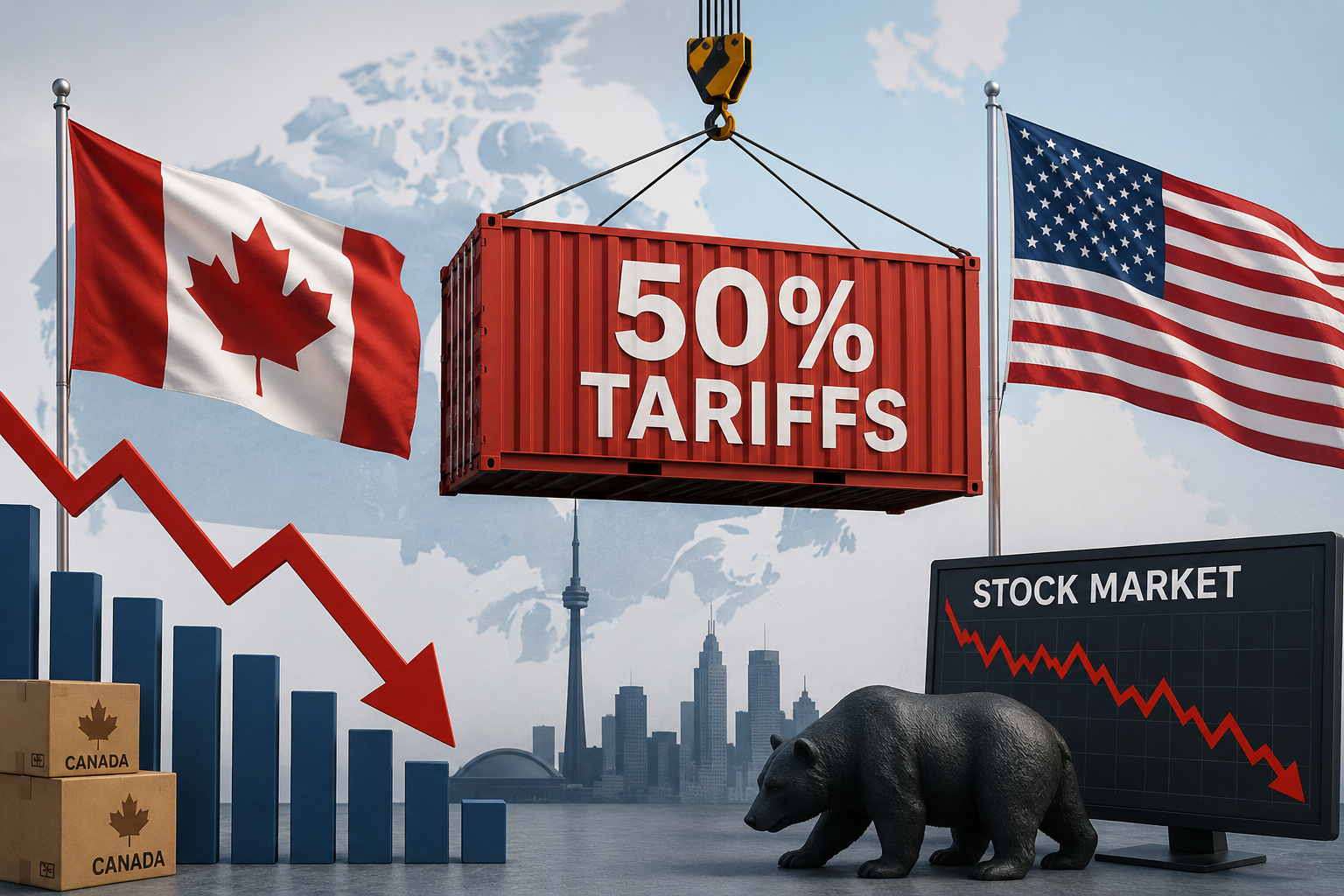
The recent news of the American administration’s introduction of 50% tariffs on various Canadian exports represents a significant economic shock to the Canadian economy, with broad implications for Canada’s growth outlook, corporate profitability, inflation expectations, and stock market performance.
From a macroeconomic perspective, such a substantial increase in trade barriers would likely reduce Canada’s export competitiveness, particularly affecting industries with high exposure to international markets and integrated North American supply chains. Given that trade represents a significant component of Canadian economic activity, higher tariffs would likely create downward pressure on economic growth, business investment, and consumer confidence.
From a GDP perspective, the immediate impact would likely be a slowdown in export-driven sectors as companies face higher costs, reduced demand, or the need to absorb tariff-related expenses. Manufacturing, automotive, energy-related industries, agriculture, and resource producers would likely experience the greatest pressure due to their dependence on cross-border trade. Companies facing higher export costs could respond by reducing production, delaying capital investment, or passing additional costs onto consumers, creating a negative impact on corporate earnings and economic activity.
From a corporate earnings perspective, the Canadian stocks would likely experience increased volatility as investors reassess earnings forecasts and valuation multiples. Companies with significant U.S. exposure or reliance on cross-border supply chains could see margin compression as tariffs increase input costs and reduce competitiveness. Export-oriented industrial companies, manufacturers, and certain commodity producers would likely face the greatest earnings risk. However, companies with primarily domestic revenue streams, regulated business models, or pricing power may demonstrate greater resilience.
The energy sector would face a mixed impact. Canadian oil and gas producers could experience pressure if tariffs reduce access to key export markets or create pricing discounts for Canadian commodities. However, integrated producers and pipeline companies with long-term contracts and diversified operations may be better positioned to withstand trade disruptions. Infrastructure companies could potentially benefit over the longer term if trade tensions accelerate investment in domestic energy security and supply chain independence.
The Canadian dollar would likely face downward pressure following the implementation of significant tariffs, as markets price in weaker economic growth and reduced foreign investment flows. A weaker Canadian dollar could provide some support to exporters by improving international competitiveness, but it would also increase the cost of imported goods, potentially contributing to inflationary pressures. This creates a challenging environment for the Bank of Canada, as policymakers would need to balance slowing economic growth against potential inflation risks.
From a monetary policy perspective, weaker economic conditions could increase expectations for interest rate cuts as the Bank of Canada attempts to support growth and employment. Lower interest rates could provide some support for interest-sensitive sectors, including real estate, utilities, infrastructure, and financial markets. However, prolonged trade uncertainty could limit business confidence and reduce the effectiveness of monetary stimulus.
For the Canada’s stock market, the initial reaction would likely be negative, with increased volatility and downward pressure on sectors most exposed to trade disruptions. The TSX could underperform global markets due to its concentration in resources, financials, and industrial companies. Investors would likely rotate toward defensive sectors such as utilities, telecommunications, consumer staples, and infrastructure companies with stable cash flows and lower sensitivity to global trade.
From a valuation perspective, a 50% tariff environment would likely result in a multiple compression environment, as investors demand higher risk premiums for Canadian stocks. Companies with strong balance sheets, predictable earnings, and low leverage would likely outperform, while highly cyclical businesses could experience larger valuation declines.
Over the longer term, the economic impact would depend on how businesses and governments adapt. Companies could diversify supply chains, increase domestic production, negotiate alternative trade agreements, or invest in automation to offset higher costs. Certain industries could benefit from increased domestic investment if Canada accelerates efforts to strengthen local manufacturing capacity and resource infrastructure.
This new tariff scenario would create a significant near-term headwind for the Canadian economy and stock market by reducing export competitiveness, pressuring corporate earnings, and increasing economic uncertainty. The most vulnerable sectors would likely include manufacturing, automotive, exporters, and cyclical industries, while defensive sectors with stable cash flows would likely provide relative protection. From an analytical perspective, investors would likely favour companies with strong balance sheets, pricing power, diversified revenue streams, and limited dependence on cross-border trade. Although the initial market reaction would likely be negative, longer-term opportunities could emerge in companies positioned to benefit from supply chain restructuring, domestic investment, and economic adaptation.

STA Research (StockTargetAdvisor.com) is a independent Investment Research company that specializes in stock forecasting and analysis with integrated AI, based on our platform stocktargetadvisor.com, EST 2007.