

STA RESEARCH · U.S., CANADA & GLOBAL MARKETS
Wall Street Futures Rally as Semiconductors and Canadian Resources Recover
AI shares rebound ahead of Black Friday trading, while rising metals and oil prices support the Canadian market and revive inflation concerns.
November 27, 2026 · Morning premarket edition
NOVEMBER 27 · TECHNOLOGY, COMMODITIES AND HOLIDAY TRADING
Global risk appetite improves, but the recovery remains unconfirmed
U.S. figures are reported futures changes as of 6:43 a.m. ET, not cash-index returns. The Canadian figure is Thursday’s completed-session close.
United States: AI stocks lead the Black Friday rebound
U.S. equity futures rose following the Thanksgiving closure, led by growth stocks. Nvidia (NVDA) gained approximately 4% in early premarket reporting, while Micron (MU) advanced approximately 6%. The rebound offers relief after a difficult November for AI-related equities, although it does not resolve questions surrounding capital spending, future margins and cash generation.
U.S. equity exchanges close at 1 p.m. ET today and the bond market closes at 2 p.m. ET. Reduced holiday liquidity can magnify market movements. Investors should look for follow-through during next week’s full sessions rather than extrapolate a single morning’s gains.
Canada: stronger commodity prices support the TSX
Canadian equity futures were higher in early trading, supported by improving gold, copper and crude oil prices. The TSX closed higher on Thursday despite the U.S. holiday. Materials and energy may offer support to the benchmark, while Celestica (CLS:CA) and Shopify (SHOP:CA) remain useful gauges of the recovery in growth shares.
The next major domestic macroeconomic catalyst is Canada’s third-quarter GDP release, expected Monday. Stronger growth could reinforce restrictive rate expectations; weaker growth could instead raise concerns around corporate revenues, loan demand and credit quality. Canadian banks face a balance between lending profitability and borrower resilience.
Europe and Asia: international markets participate
European equities advanced around 0.8% in early reporting, while Japan’s Nikkei gained approximately 2.1% overnight. The international recovery indicates renewed appetite for risk assets beyond North America. However, European exporters remain exposed to trade policy uncertainty, and higher energy prices may pressure industrial operating costs.
Commodities: gold rebounds as crude strengthens
Gold recovered around 3% in early Friday reporting after touching a more-than-one-year low earlier this week. Copper also strengthened, creating a more supportive near-term environment for Canadian miners. Brent crude approached US$92 per barrel as concerns over Middle Eastern energy supplies resurfaced. These are reported morning observations rather than closing prices.
Higher oil prices can improve producer revenues but also constrain household purchasing power and increase transport and manufacturing costs. Gold miners’ earnings sensitivity depends on production costs, realized prices and currency exposure as well as bullion itself.
Macro and technical outlook: inflation remains the limiting factor
Persistent U.S. inflation and resilient economic activity leave further Federal Reserve tightening a material risk. The next U.S. employment report is scheduled for December 4, followed by the Fed’s policy decision on December 9. Bond yields and credit conditions will help determine whether the equity rebound can persist.
From a technical perspective, a sustained recovery requires higher lows and broader participation across financials, industrials and technology. A sharp reversal after the holiday would suggest the correction has not yet run its course. We do not assign unverified numerical support, resistance or indicator readings.
Constructive scenario
Semiconductor buying broadens, Canadian resource gains hold and bond yields stabilize. Stronger participation next week supports a more sustained recovery into December.
Cautious scenario
Holiday-driven gains fade, increasing crude prices revive inflation concerns and restrictive financing pressures weigh on growth valuations. A return to recent lows would increase downside risk.
STA Research outlook
We remain cautiously selective despite Friday’s encouraging premarket recovery. A durable advance requires credible earnings growth, sustainable free cash flow and reasonable valuations, not simply a reversal in sentiment. Canada’s resource exposure provides selective support, but domestic economic data and interest-rate risks remain important. Next week’s normal trading volumes and macroeconomic releases should provide a clearer assessment of whether the rebound marks stabilization or temporary relief within a broader correction.
STA RESEARCH · CANADA & GLOBAL MARKETS
Canadian and European Stocks Rally as Wall Street Pauses for Thanksgiving
Energy, materials and European technology shares recover, while investors await Friday’s shortened U.S. session.
November 26, 2026 · Thanksgiving market update
NOVEMBER 26 · CANADA, EUROPE AND GLOBAL MARKETS
International markets recover as U.S. trading pauses
Canadian figures reflect reported intraday trading; European broad-market and Japanese readings are reported closes. U.S. futures are not cash-market returns.
Canada: energy and materials lead the TSX recovery
The S&P/TSX Composite rose 0.6% in early trading, with energy up 1.9% and materials up 1.3%. Canadian Press subsequently reported the index at 34,399.45, up 219.46 points in late morning. Recovering base metals and higher crude prices supported resource shares, while technology rebounded after Wednesday’s weakness. January crude traded at US$84.86 and February gold at US$3,601.10 in that later report. The Canadian dollar eased to US$0.7018. These are intraday observations, not closing prices.
Canadian Natural Resources (CNQ:CA) and Suncor (SU:CA) remain useful energy sentiment gauges, while Celestica (CLS:CA) and Shopify (SHOP:CA) offer insight into growth-stock appetite. Banks face a more complex outlook as domestic demand, mortgage affordability and credit quality interact with inflation and interest-rate expectations. Holiday-thinned trading makes broad participation more significant than individual price spikes.
Europe: tariff relief and broad sector buying
The STOXX 600 closed 1.8% higher at 636.98, with German, Spanish and Italian benchmarks each gaining more than 2%. Miners, automakers and defence shares advanced more than 3%, alongside a technology recovery. Investors welcomed indications that proposed U.S. duties on EU goods may be limited to previously negotiated levels. The prospect of Pablo Hernández de Cos succeeding Christine Lagarde at the ECB also reinforced expectations of policy continuity.
European exporters still face uncertain demand and trade costs, while energy importers are vulnerable to renewed crude-price increases. The rally improves sentiment but does not eliminate those earnings risks.
Asia: technology sentiment improves
Japan’s Nikkei closed 0.9% higher and South Korea’s KOSPI gained 0.3%, while Taiwan’s benchmark advanced 2.5% in the reported Asian market snapshot. Semiconductor buying provided some relief after recent heavy selling, although a durable AI-sector recovery still depends on earnings and returns on infrastructure spending.
United States: eyes on Friday’s shortened session
U.S. exchanges are closed today for Thanksgiving and reopen Friday, November 27, closing at 1 p.m. ET. S&P 500 and Nasdaq futures were reported approximately 0.7% higher in Thursday trading. Wednesday’s mixed Wall Street finish and continued Nvidia governance concerns remain important context. Tomorrow’s reduced liquidity may amplify price movements; broader participation next week would provide a stronger test of recovery.
Macro outlook: inflation and financing risks remain
Persistent U.S. inflation, potential Federal Reserve tightening, trade uncertainty and renewed oil supply concerns remain significant risks. Higher energy prices can support Canadian producers but squeeze consumer budgets and raise costs for European manufacturers. Investors should distinguish improved sentiment from a genuine improvement in earnings expectations, especially for capital-intensive AI businesses.
Constructive scenario
Canadian and European gains hold, U.S. buying broadens Friday and yields stabilize. Earnings visibility and sustained market participation reinforce the recovery.
Cautious scenario
Thin holiday trading exaggerates gains that subsequently reverse as tariff, inflation and AI valuation concerns return. Renewed energy inflation could intensify financing pressure.
STA Research outlook
Today’s Canadian and European rallies are encouraging, particularly the participation of resources and industrial shares. However, the absence of normal U.S. trading limits the strength of the signal. We remain cautiously selective, focusing on reasonable valuations, balance-sheet quality and sustainable free cash flow. Friday’s reopening offers an initial test of market confidence, with next week’s full trading sessions likely to provide better confirmation.
STA RESEARCH · U.S. & CANADA
Nasdaq Slides as AI Selling Deepens and Weaker Metals Hit the TSX
Chip stocks lead a pre-Thanksgiving selloff as investors weigh firmer U.S. inflation, tariff uncertainty and weaker metals prices.
November 25, 2026 · Opening market edition
NOVEMBER 25 · AI STOCKS, INFLATION AND CANADIAN MATERIALS
Selling resumes after Monday’s relief rally
Cash-index changes at the 9:30 a.m. ET opening bell, measured against the previous close.
U.S. markets: technology leads the decline
The Nasdaq Composite opened down 3.31%, nearly three times the Dow’s decline, as selling in AI-linked stocks continued. Nvidia (NVDA), Micron (MU) and Marvell (MRVL) remain useful gauges of whether buyers are returning to chip stocks. For suppliers, the earnings test is whether orders translate into durable margins. For cloud and data-centre operators, the test is whether utilization and pricing can cover rising capital and financing costs.
Canada: weaker metals weigh on the TSX
The S&P/TSX Composite opened 1.29% lower as softer metals prices pressured materials stocks. Gold and silver weakened in morning trading, while WTI crude was modestly higher in a premarket snapshot. That divergence matters for Canadian earnings. Lower gold prices can squeeze miners’ cash flow, while firmer crude may cushion oil producers depending on realized pricing and hedges. Watch Agnico Eagle (AEM:CA) for gold exposure, Celestica (CLS:CA) for AI infrastructure sentiment and Canadian Natural Resources (CNQ:CA) for crude exposure.
Inflation and tariffs complicate the rate outlook
U.S. inflation rose further in October on the Federal Reserve’s preferred PCE measure. Persistent price pressure gives policymakers less room to ease if growth weakens. New U.S. tariff proposals add uncertainty around input costs and pricing. For Canadian exporters, the effect depends on which goods are covered, when changes take effect and how much of the cost businesses can pass through.
Technical perspective: watch market breadth into the close
Watch whether the Nasdaq recovers part of its opening loss and whether a rebound extends to financials and industrials. If rallies fade and indexes test fresh lows, Monday’s rebound will have offered only brief relief. Several sessions of higher lows and stronger participation would provide better evidence of stabilization.
Constructive scenario
Chip stocks stabilize, yields settle and buying broadens. Firmer metals prices give Canadian materials stocks room to recover.
Cautious scenario
Technology losses deepen, weaker metals pressure Canadian miners and tariff uncertainty weighs on earnings expectations. Selling spreads to financials and industrials.
STA Research outlook
We remain cautious heading into the U.S. Thanksgiving break. Monday’s rally showed how quickly sentiment can turn, while Wednesday’s opening losses show how quickly those gains can unwind. Durable free cash flow and manageable financing needs carry more weight in this environment. A broader recovery supported by stable earnings expectations would improve the near-term outlook.
STA RESEARCH · U.S. & CANADA
AI Rally Faces a Follow-Through Test as Futures Ease and Commodities Weaken
Chip shares give back part of Monday’s rebound, while Canadian investors assess softer resources, retail earnings and the next inflation and policy signals.
November 24, 2026 · Morning premarket edition · Individually timed observations below
NOVEMBER 24 · SEMICONDUCTORS, COMMODITIES AND CONSUMER DEMAND
A pause after the rebound puts earnings quality back in focus
These are reported early premarket futures, not live prices, cash-index returns or closing levels. The Canadian contract uses a separate observation time. Monday’s completed TSX session is discussed separately below.
American markets: semiconductor enthusiasm meets profit-taking
Early Tuesday reporting showed Nvidia (NVDA) down 4.4% in premarket trading, following its roughly 31.5% Monday surge after Jensen Huang’s reinstatement. Micron, AMD and Marvell were down between 3.3% and 4.3%, while CoreWeave fell 5.4%. Those individual moves belong to the early report, not the current cash session.
STA Research interpretation: leadership clarity can reduce a governance discount without immediately increasing expected earnings. After a large repricing, investors should reassess prospective returns using the new share price, rather than assume that yesterday’s upside remains available. Demand visibility, margins and cash returns after capital expenditure remain the stronger measures of business value.
Canada: Monday’s recovery was broader than technology alone
TMX’s official November 23 report places the S&P/TSX Composite close at 34,082.12, up 2.69%. It records 161 advancing constituents and 50 declining constituents. Shopify, Royal Bank, Agnico Eagle and TD were among the largest positive index contributors, while Canadian Natural Resources and Suncor detracted. These are Monday’s completed-session observations, not Tuesday’s returns.
Our assessment is that participation from lenders and miners makes the rebound more informative than an isolated technology rally. Tuesday’s test is whether those groups retain support as resource prices soften. Celestica (CLS:CA) and Shopify (SHOP:CA) remain technology watchlist names; no new cash-session percentage changes are assigned to them here.
Oil and gold: different pressures on Canadian earnings
The early Canadian market report showed Brent down 0.3%, near a three-month low, and spot gold down 0.2%, with silver also weaker. Rising crude supplies were weighed against continuing risks to shipping through the Strait of Hormuz.
For producers, weaker realized prices can reduce operating cash flow even if production is steady. Lower fuel costs may benefit transport businesses and consumers, but the size of that benefit depends on hedging and pricing. Gold-miner analysis should compare bullion sensitivity with production costs, debt and the Canadian dollar; a change in the metal price does not translate mechanically into the same equity return.
Best Buy offers a stronger consumer signal
Best Buy (BBY) reported fiscal third-quarter revenue of US$10.236 billion, comparable-sales growth of 6.1% and adjusted diluted EPS of US$1.62. GAAP diluted EPS was US$1.66. The company raised its full-year comparable-sales outlook to 3.4%–4.0% and adjusted EPS guidance to US$6.90–US$7.05.
STA Research sees evidence of company-level demand and execution strength heading into holiday trading. That does not establish equal resilience across all discretionary spending. Compare sales growth with inventory requirements, promotional activity and cash conversion before extending one retailer’s performance to the wider consumer economy.
Macro events: inflation and Canadian policy communication
The BEA lists November 25 as the next Personal Income and Outlays release, making Wednesday’s inflation detail an important upcoming valuation test. Today, the Bank of Canada schedules Governor Tiff Macklem’s economic-outlook speech for 12:40 p.m. ET, with the text available at 12:25 p.m. ET. This morning edition does not anticipate his remarks.
Persistent inflation can keep discount rates and financing costs elevated even when equities rebound. Softer growth may reduce inflation pressure while simultaneously weakening revenue expectations. Canadian banks, REITs and utilities therefore need to be assessed against credit quality and refinancing needs, rather than a single assumed direction for interest rates.
Technical perspective: judge the pullback by structure and breadth
A smaller retreat after a strong rebound can be consistent with stabilization if buyers defend higher lows and participation improves. A rally that rapidly loses its gains, followed by breaks of recent lows, would leave the correction unresolved. Compare closing price structure, turnover and participation across several sessions. No new RSI, moving-average or numerical support readings are asserted without a verified daily-price calculation.
Constructive scenario
Profit-taking remains contained, technology holds higher lows and buying extends to lenders and industrials. Stable yields and credible earnings support a more durable recovery.
Cautious scenario
AI gains unwind, weaker commodities pressure Canadian cash-flow forecasts and restrictive financing conditions prevent buying from broadening. Failed rebounds increase downside risk.
STA Research outlook
STA Research remains selective. Monday improved the starting point for a recovery, but Tuesday brings a fresh test of valuation and follow-through. Favor sustainable free cash flow, manageable funding needs and earnings expectations supported by operating evidence. Neither one strong session nor an early futures decline settles the longer-term trend.
STA RESEARCH · U.S. & CANADA
Nasdaq Futures Surge as Nvidia Reinstates Jensen Huang
Huang’s return restores a key source of AI-sector confidence, while earnings, financing costs and broader participation remain the tests for a lasting recovery.
November 23, 2026 · Morning premarket update · U.S. futures snapshot at 9:02 a.m. ET
NVIDIA LEADERSHIP · AI RECOVERY · CANADIAN SECTOR OUTLOOK
A major sentiment catalyst changes Monday’s outlook
The U.S. figures below are premarket futures, not cash-index gains or closing returns. Nvidia’s move is the premarket share-price change reported alongside that snapshot. Canadian futures use an earlier, separately identified time.
Nvidia confirms Jensen Huang’s immediate return
Nvidia’s board unanimously reinstated Jensen Huang as president, CEO and a board director, effective immediately. Harvey Jones remains board chair, while Colette Kress continues as chief financial officer after serving as interim CEO. The company said its independent investigation will continue and outlined additional compliance oversight.
STA Research interpretation: the return of a founder closely associated with strategy and customer relationships can reduce uncertainty about execution. It does not independently establish that orders, margins or cash-flow forecasts have improved. Investors should separate the benefit of leadership continuity from the operating evidence needed to support valuation.
American markets: technology leads the relief rally
The larger Nasdaq-100 futures gain relative to the Dow points to a technology-led response. An important next step is whether buyers sustain the recovery after the opening bell and extend it beyond AI-sensitive shares. Premarket strength can reverse quickly as cash trading brings greater volume and new information.
Watch Nvidia alongside AMD, Broadcom and Micron for semiconductor participation. Cloud platforms, networking suppliers and data-centre businesses provide additional checks on whether confidence is improving across the AI investment chain. These are monitoring priorities; this edition does not assign unverified individual returns to those companies.
Canada: an earlier rebound had already begun
December S&P/TSX 60 futures were up 1.89% at 6:18 a.m. ET, before the reinstatement announcement. That earlier move was supported by recovering gold and improved AI sentiment. It should not be attributed entirely to Huang’s return or presented as the TSX Composite’s cash-session performance.
Canadian technology exposure, including Celestica (CLS:CA) and Shopify (SHOP:CA), offers a useful sentiment check, although their businesses and valuation drivers differ. Financials and industrials need to participate for a broader Canadian recovery. For gold miners, compare the metal-price rebound with actual equity follow-through, costs and currency effects.
Fundamentals: the AI spending test remains
Leadership clarity can improve confidence in the delivery of products and long-term plans. The investment case still depends on whether customer spending produces durable revenues and cash returns. Suppliers need profitable orders, while customers need sufficient utilization and pricing to cover infrastructure, depreciation and financing costs.
A large share-price rebound can reduce apparent upside to unchanged analyst targets without changing underlying business forecasts. Reassess valuation against earnings estimates and balance-sheet capacity rather than assuming the previous investment case offers the same return after a sharp rally.
Interest rates and technical confirmation
Huang’s return does not resolve inflation or determine either central bank’s next policy decision. Long-term yields and credit conditions remain relevant to growth-stock valuations, utilities, property companies and leveraged businesses.
Technically, distinguish a relief rally from a sustained reversal. A stronger closing response, higher lows and improving market breadth over subsequent sessions would strengthen the constructive case. A rapid fade followed by renewed weakness would leave the correction unresolved. Refer to the separately dated technical dashboard when comparing momentum and trend measures.
Constructive scenario
Leadership confidence supports sustained buying, financial conditions remain orderly and recovery spreads across sectors. Improving earnings expectations and higher lows reinforce the rebound.
Cautious scenario
The initial rally fades as investors reassess valuations, capital requirements and unresolved uncertainty. Narrow leadership or renewed selling would weaken the recovery case.
STA Research outlook
Huang’s reinstatement materially improves the sentiment backdrop compared with the earlier overnight edition. STA Research sees a stronger basis for a recovery attempt, while remaining selective about valuation, sustainable free cash flow and debt. The most persuasive signal would be a broad, sustained cash-market recovery supported by operating evidence.
STA RESEARCH · U.S. & CANADA
U.S. Futures Recover as Investors Test the Aftermath of the AI Selloff
Monday’s overnight outlook: a rebound in futures meets uneven Asian trading, softer oil and a continuing test of earnings quality.
November 23, 2026 · Overnight edition · Before North American cash trading
OVERNIGHT DEVELOPMENTS · RECOVERY NEEDS CONFIRMATION
A better opening indication, with market risk still elevated
Reported overnight snapshots below are not live quotes, Monday cash-market returns or closing prices. The S&P futures observation was reported at 12:53 p.m. Tokyo time on November 23, equivalent to 10:53 p.m. Eastern on November 22. Other figures are separately reported observations from the same overnight market wrap, updated at 04:56 UTC on November 23.
Overnight developments: the recovery remains uneven
U.S. equity futures advanced after Friday’s technology-led selloff. Asian trading offered a mixed picture: Taiwan recovered, while South Korean equities remained lower; Japanese markets were closed for a holiday. Treasury futures weakened as some demand for safety eased. These observations show a shift in sentiment, with substantial uncertainty about whether buying will persist.
Friday’s losses remain the starting point
The Nasdaq Composite fell approximately 5.3% on November 20, compared with losses of 3.7% for the S&P 500 and 1.9% for the Dow. Those are completed Friday cash-session changes. They should be distinguished from overnight futures, which can move sharply before the opening bell.
AI fundamentals: assess the cash return on investment
STA Research’s assessment remains selective. A lower share price improves prospective value only if future earnings and cash generation justify the investment. For semiconductor suppliers, assess orders, customer concentration and margins. For cloud and AI businesses, compare revenue growth with infrastructure commitments, depreciation and financing requirements. Growth in computing demand can coexist with disappointing shareholder returns when capital costs or valuations are too high.
Nvidia, AMD, Micron and Broadcom remain useful research watchlist names for assessing sector participation. A rebound across several businesses would carry more information than a recovery concentrated in a single large stock. This edition assigns no unverified Monday share-price changes to individual companies.
Canada: gold and oil point to different sector effects
The overnight rise in bullion could support sentiment toward Canadian gold producers, while softer crude presents a less supportive revenue signal for energy companies. These are conditional earnings implications, not reported TSX or individual-stock moves. Currency changes, hedging, production costs and company execution can alter the outcome.
For a more durable Canadian recovery, watch financials and industrials alongside resource shares. Banks provide evidence about credit conditions and confidence in domestic demand. Utilities and property companies remain sensitive to refinancing costs, while growth businesses need operating cash flow to support their valuations. No current TSX cash-index reading is available in this overnight edition.
Rates and macro: distinguish market relief from policy change
A rise in equity futures does not establish that inflation risk has passed or that central banks will ease policy. Assess subsequent inflation releases, employment conditions and the response in bond yields. Canadian policy expectations also depend on domestic conditions. Lower borrowing costs would help valuations, but weakening growth can simultaneously reduce earnings expectations.
Technical outlook: judge the quality of follow-through
After a steep decline, short covering and oversold conditions can produce large rebounds. Confirmation requires the cash indexes to hold gains, form higher lows and attract wider participation over subsequent sessions. A failed opening rally followed by renewed selling would strengthen the cautious case. This edition does not assert fresh RSI readings, moving averages or support levels without a verified daily-price calculation.
Constructive scenario
Technology stabilizes, credit conditions remain orderly and buying broadens. A sequence of stronger closes and higher lows would make the recovery more credible.
Cautious scenario
Futures gains fade in cash trading, rallies stall and weakness spreads across sectors. Further deterioration in earnings expectations or financing conditions would increase downside risk.
STA Research outlook
The overnight improvement offers an opportunity to assess stabilization. Our stance remains cautious and selective: prioritize durable cash generation, manageable leverage and a reasonable valuation. A rebound becomes more compelling when improving price structure is supported by earnings and broad participation.
STA RESEARCH · U.S. & CANADA
Futures Rebound Overnight After Friday’s Technology Crash
Wall Street attempts a recovery ahead of Monday, but AI valuations, financing demands and market breadth remain the tests for a durable rebound.
November 22, 2026 · Sunday-night update · Outlook for Monday, November 23
OVERNIGHT MARKETS · FUTURES RECOVERY AFTER A SHARP SELLOFF
Buyers return to futures, with confirmation still needed
The figures below are reported futures changes at 9:32 p.m. Eastern on Sunday, November 22. They are not Monday’s cash-index returns or a live quote feed.
Overnight: a recovery attempt after heavy selling
U.S. equity futures advanced Sunday evening following a bruising week for technology and AI-related shares. Nasdaq-100 contracts led the reported rebound, suggesting renewed willingness to take risk ahead of Monday’s opening session. Futures can reverse before the opening bell, and the Nasdaq-100 futures contract differs from the Nasdaq Composite cash index.
Friday’s crash leaves substantial damage to repair
On November 20, the Nasdaq Composite fell approximately 5.3% to 22,617.73, the S&P 500 dropped 3.7% to 6,910.39, and the Dow lost 1.9% to 48,147.33. These are Friday’s closing cash-index readings, separate from Sunday-night futures.
The scale of the decline means that even a strong rebound would recover only part of the damage. A gain in futures should be assessed as an early change in sentiment rather than evidence that selling pressure has ended.
AI fundamentals: investment returns remain central
STA Research’s focus remains the conversion of AI demand into sustainable earnings and free cash flow. Large commitments to chips, data centres and power capacity can support suppliers while increasing customers’ financing requirements. The investment case depends on utilization, pricing, margins and the cash returns generated after capital spending. A sharp price decline can improve prospective value without removing those operating risks.
Canada: watch whether participation broadens
A steadier U.S. technology market could help sentiment toward Canadian growth companies, but the TSX also needs support from financials, industrials, energy and materials. Banks provide a check on credit confidence, while miners and energy producers remain sensitive to commodity prices and operating costs. No overnight TSX futures percentage is asserted here.
For Canadian investors, a recovery involving several sectors would carry more conviction than one driven by a small number of AI-linked shares. Watch the Canadian dollar, bond yields and resource prices alongside the equity indexes.
More constructive scenario
Technology shares stabilize, buying spreads across sectors and indexes hold their recovery through subsequent sessions. Improving participation strengthens confidence in the rebound.
More cautious scenario
Opening gains fade, AI financing concerns persist and selling spreads beyond technology. A failed rebound followed by fresh lows would reinforce the defensive market picture.
STA Research outlook
The overnight rebound is encouraging, but it does not confirm a market bottom. STA Research remains cautious and selective, emphasizing sustainable free cash flow, manageable debt and valuations supported by credible earnings. A durable recovery requires confirmation from actual cash trading, broader participation and improving price structure across several sessions.
STA RESEARCH · U.S. & CANADA
AI Selling Resumes as Anthropic Retreats and Canadian Retail Data Signals Fragile Demand
Wall Street opens lower after Thursday’s reversal, while weaker commodities and a cautious consumer outlook keep the Canadian market under pressure.
November 20, 2026 · Morning market update
NOVEMBER 20, 2026 · AI VALUATIONS, CANADIAN CONSUMERS AND INTEREST RATES
A new listing cannot resolve the market’s earnings and valuation test
U.S. figures are cash-index snapshots at the November 20 opening bell, 9:30 a.m. ET. The Canadian reading below is a separately timed premarket futures observation. These are not live quotes or closing prices.
American markets: AI sentiment remains fragile
The Nasdaq led opening losses as Anthropic shares retreated in their second session. The Dow’s smaller decline showed a different sector response, rather than a uniform market recovery.
STA Research sees the central question as the return on AI investment. Demand for computing can support chip and infrastructure suppliers while substantial spending absorbs customers’ cash flow. Investors need to distinguish commercial adoption from the earnings and financing assumptions embedded in share prices. A successful IPO does not establish that the broader sector is attractively valued.
Canada: resource exposure adds to the pressure
Canada’s benchmark finished Thursday at 34,028.73, down 549.32 points, after a sixth consecutive decline. That is the November 19 close, not today’s cash-index reading. Friday’s early TSX 60 futures loss reflected weaker gold and oil sentiment.
For the TSX, a durable recovery needs participation from banks, industrials and consumer companies alongside resource shares. Falling metals can weaken miners’ revenue expectations. Cheaper crude can reduce producer cash flow while helping fuel-intensive businesses and household budgets. The net effect depends on company costs, debt and realized selling prices.
Canadian retail sales: headline growth masks modest volumes
Statistics Canada reported that September retail sales rose 0.8% to C$75.3 billion. Core sales, excluding fuel vendors and motor-vehicle dealers, increased just 0.1%; total sales volumes also rose 0.1%. Fuel-station sales increased 6.9% in dollar terms. The advance estimate points to a 1.5% October decline, which remains preliminary and subject to revision.
Our interpretation is that stronger nominal spending does not imply equally strong underlying demand. Retailers need pricing power and inventory discipline to protect margins. Banks face a balance between loan growth, funding costs and credit quality. The October estimate increases the importance of subsequent consumer data without independently proving a recession or determining the Bank of Canada’s next decision.
Intuit: current earnings and the forward outlook diverge
Intuit (INTU) reported quarterly revenue of US$4.354 billion, up 12%, and GAAP diluted EPS of US$2.59. Non-GAAP EPS was US$2.91. The company agreed to sell Mailchimp to Bending Spoons for approximately US$3.68 billion, with completion expected in early 2027 subject to approvals and customary conditions.
Intuit updated its full-year revenue outlook to US$23.081-US$23.365 billion while reiterating its operating-income and EPS guidance. Its guidance excludes the pending disposal. STA Research would assess the ongoing business, transaction proceeds and future margins separately; an earnings beat alone does not settle the valuation question.
Interest rates: lower yields are not the same as policy relief
At 9:13 a.m. ET, a bond-market report placed the U.S. 10-year Treasury yield at 4.972% as investors sought safer assets. That market yield is distinct from the Federal Reserve’s policy rate.
A decline in yields can ease valuation pressure, but it can also reflect concern about growth and risk. Utilities, REITs and growth companies may benefit from cheaper financing only if earnings and credit conditions remain supportive. Assess the reason for a bond rally alongside its size rather than treating every fall in yields as an all-clear signal for equities.
Stocks and sectors to monitor
Anthropic (ANT), Nvidia (NVDA), AMD (AMD) and Micron (MU) offer gauges of AI sentiment. In Canada, watch Celestica (CLS:CA) for technology exposure, Agnico Eagle Mines (AEM:CA) for gold sensitivity, and Suncor Energy (SU:CA) for crude-price exposure. These are research watchlist names; no current-session percentage changes are assigned to them here.
More constructive scenario
Technology selling moderates, yields stabilize and buying broadens. Companies demonstrate durable cash generation, while commodity prices find firmer footing.
More cautious scenario
AI valuations continue to compress, consumer volumes weaken and commodity losses spread through Canadian earnings expectations. Defensive bond demand accompanies further equity selling.
STA Research outlook
STA Research remains cautious and selective. Today’s renewed technology weakness shows why a strong opening or high-profile listing needs confirmation from subsequent trading and business performance. Focus on cash generation after capital spending, manageable refinancing needs and valuations supported by credible earnings. For Canada, the combination of resource sensitivity and modest retail volumes makes wider sector participation particularly important. A sustained recovery requires evidence across several sessions, not an isolated rebound.
STA RESEARCH · U.S. & CANADA
AI Optimism Lifts Wall Street as Walmart Raises Its Outlook and the TSX Edges Higher
Anthropic’s anticipated debut supports technology sentiment, while energy shares help Canada and hawkish Fed minutes keep financing risks in focus.
November 19, 2026 · Morning market update
NOVEMBER 19, 2026 · AI, RETAIL EARNINGS AND INTEREST RATES
A stronger opening faces tests of breadth and earnings quality
Reported cash-index snapshots at the November 19 opening bell, 9:30 a.m. Eastern. These are not live quotes or closing prices. Commodity observations below use their separate stated time.
American markets: AI sentiment improves ahead of Anthropic’s debut
Reuters reported all three major U.S. indices opening higher, led by the Nasdaq, after Anthropic priced its IPO above the marketed range. The anticipated debut is a fresh test of investor appetite for AI exposure.
STA Research will distinguish enthusiasm for a new listing from evidence of durable returns across the sector. Demand for computing capacity can support suppliers while heavy infrastructure spending constrains customers’ free cash flow. A stronger opening becomes more convincing if buying extends beyond the largest technology companies and persists through the session.
Walmart: stronger guidance provides a consumer check
Walmart (WMT) reported fiscal third-quarter revenue of US$188.8 billion, up 5.2%, and adjusted EPS of US$0.65. Global e-commerce sales rose 17%. The company increased its full-year outlook to 4.9%–5.2% net sales growth in constant currency and US$2.84–US$2.89 adjusted EPS.
Our interpretation is that value-focused retail and digital execution can support individual businesses even when household budgets face pressure. Walmart’s performance does not establish that discretionary spending is equally strong across the economy. Investors should compare sales growth with margins, inventories and cash generation as holiday trading develops.
Canadian markets: energy supports a modest recovery
Reuters reported the TSX up 0.16% at 34,633.72 at 9:30 a.m. ET, with stronger oil prices supporting energy shares.
Canada’s smaller opening gain highlights a different sector mix from the technology-heavy Nasdaq. Suncor Energy (SU:CA) and Canadian Natural Resources (CNQ:CA) are useful energy watchlist names, while Agnico Eagle Mines (AEM:CA) provides a precious-metals gauge. Banks and industrials will help show whether the recovery broadens beyond resource exposure. No current-session changes are asserted for these individual stocks.
Commodities: early stabilization after recent weakness
TMX Money’s 7:21 a.m. ET commodity snapshot showed NYMEX crude at US$82.67, up 0.437%, and COMEX gold at US$3,719.90, up 0.588%. These are the provider’s contract quotes, not spot prices or opening cash-index observations.
A sustained oil recovery could support producer cash flow while increasing fuel costs for transport companies and consumers. Gold miners remain sensitive to metal prices, the Canadian dollar and operating costs. A short rebound in commodities should be tested against subsequent prices and company-level economics.
Fed minutes: the pause did not remove tightening risk
The October 27–28 FOMC minutes, released November 18, show that almost all participants considered further rate increases likely appropriate under their baseline outlooks for inflation and employment. That is a policy assessment, not a confirmed decision to raise rates at the next meeting.
Higher discount rates can offset earnings growth in equity valuations and make infrastructure financing more demanding. Utilities, REITs, indebted consumers and leveraged businesses remain sensitive to borrowing costs. Canadian rate expectations also depend on domestic inflation and growth; a U.S. policy signal does not by itself determine the Bank of Canada’s next decision.
Nvidia and the quality of the AI recovery
Nvidia (NVDA) reported US$115.8 billion in fiscal third-quarter revenue on November 17. Its official release identifies Colette Kress as interim CEO as well as finance chief. Strong demand and leadership continuity therefore remain separate issues for investors to assess.
Our focus remains product execution, customer funding, cash conversion and margin durability. Micron (MU), Broadcom (AVGO) and Celestica (CLS:CA) offer additional ways to monitor AI infrastructure demand. These are research watchlist names rather than claims about today’s individual share-price movements.
More constructive scenario
Technology buying broadens, retail guidance supports earnings expectations and commodity prices stabilize. A calmer bond market helps confidence extend beyond the opening rebound.
More cautious scenario
IPO excitement fades, financing costs remain restrictive and AI margins or customer funding disappoint. Resource gains fail to offset weakness elsewhere in Canada.
STA Research outlook
STA Research remains cautiously selective. Today’s opening improvement is encouraging, but a durable recovery requires broader participation, sustainable cash generation and earnings that justify the cost of capital. Favor clear balance-sheet capacity and credible investment returns when assessing the opportunities created by recent declines. A single positive session or high analyst target is insufficient evidence that market risk has passed.
Reporting: Reuters U.S. opening report and TSX opening report, November 19; Walmart Q3 FY2027 release, November 19; TMX Money commodity snapshot, November 19 at 7:21 a.m. ET; Federal Reserve October 27–28 meeting minutes released November 18; Nvidia fiscal Q3 release, November 17. Figures retain their stated observation times. Interpretations, watchlists and scenarios are STA Research analysis.
STA RESEARCH · U.S. & CANADA
Nvidia Lifts U.S. Technology Stocks as Falling Metals Weigh on the TSX
Stronger AI guidance supports the Nasdaq, while commodity weakness and interest-rate expectations keep the broader outlook selective.
November 18, 2026 · Morning market update
NOVEMBER 18, 2026 · NVIDIA EARNINGS, COMMODITIES AND FED MINUTES
Technology rebounds, but the recovery remains uneven
These are reported opening cash-index snapshots at 9:30 a.m. ET, not live quotes or closing prices. Commodity observations below retain their separate reporting times.
American markets: Nvidia restores some AI confidence
The S&P 500 and Nasdaq opened higher following Nvidia’s upbeat forecast, while the Dow declined. The split points to a technology-led improvement rather than uniform strength across Wall Street.
Nvidia earnings: strong demand meets a margin test
Nvidia (NVDA) reported fiscal third-quarter revenue of US$115.8 billion, up 103% year over year, with Data Center revenue of US$107.6 billion. GAAP diluted earnings were US$2.70 per share. Fourth-quarter revenue guidance is US$130 billion, plus or minus 3%, with an additional reporting week. Management forecasts gross margins of 71%–72%, compared with 74.8% GAAP gross margin in the reported quarter, and assumes no Data Center compute revenue from China.
STA Research sees two separate investment tests: the durability of customer demand and the profitability of delivering that growth. Strong sales do not remove valuation, cash-conversion or leadership-transition risks.
Canadian markets: mining weakness offsets the technology rebound
The TSX opened down 0.85% at 35,016.64 as weaker precious metals pressured miners. Canada’s resource exposure is producing a different opening pattern from the Nasdaq.
STA Research is watching whether financials and industrials can offset resource-sector selling. Lower commodity prices can reduce producer earnings while easing costs for some transport and consumer businesses.
Gold and oil: pressure on resource earnings
Spot gold fell 2.1% to US$3,769.68 an ounce at 5:50 a.m. ET, pressured by a firm U.S. dollar and expectations of further Fed tightening. At 8:10 a.m. ET, Brent was US$93.10 a barrel and WTI US$85.54, with U.S. inventory builds weighing against Middle East shipping risks.
For Canadian miners and oil producers, realised prices, operating costs and debt commitments matter more than commodity direction alone. Geopolitical supply disruption remains a potential source of renewed volatility.
Fed minutes and the next AI financing test
Minutes of the Fed’s October meeting are due at 2 p.m. ET. Their interpretation could affect bond yields and equity valuations. Anthropic’s expected IPO pricing today and anticipated Thursday debut provide another test of investor appetite for AI financing.
STA Research will distinguish demand for a new listing from evidence that established AI businesses can generate sustainable returns on capital.
Stocks and sectors to monitor
Nvidia (NVDA), AMD (AMD), Broadcom (AVGO) and Celestica (CLS:CA) offer gauges of AI infrastructure sentiment. Agnico Eagle Mines (AEM:CA), Suncor Energy (SU:CA) and Canadian Natural Resources (CNQ:CA) provide resource-sector exposure to monitor. These are analytical watchlist names; no current-session share-price changes are asserted.
More constructive scenario
AI demand reassures investors, yields stabilise and buying broadens beyond semiconductor shares. Resource prices find support.
More cautious scenario
Higher yields overwhelm the earnings rebound, margin concerns intensify and weaker commodities compound Canadian equity losses.
STA Research outlook
STA Research remains selective. Nvidia’s results strengthen the demand case, but a durable market recovery also needs broader participation, sustainable free cash flow and manageable financing costs. Assess corporate earnings against valuation and balance-sheet capacity rather than treating one positive catalyst as an all-market signal.
Reporting: Reuters U.S. and Canadian opening reports, gold and oil reports and Anthropic IPO coverage, November 18, 2026; Nvidia fiscal third-quarter results, November 17. Index snapshots are from the opening bell; commodity figures use their stated observation times. Sector implications, watchlists and scenarios are STA Research analysis.
STA RESEARCH · U.S. & CANADA
Markets Edge Lower Ahead of Nvidia Earnings as Canadian Deal News Draws Focus
Technology steadies after Monday’s selloff, while financials weigh on the TSX and investors assess corporate results.
November 17, 2026 · Morning market update
NOVEMBER 17, 2026 · EARNINGS, TECHNOLOGY AND CANADIAN CORPORATE NEWS
Nvidia’s outlook becomes the next test for the AI trade
These are reported opening cash-index snapshots, with each observation time shown. They are not closing prices or a live quote feed.
American markets: AI shares stabilise before results
AP’s morning report showed Nvidia (NVDA) down 0.2%, Broadcom (AVGO) up 1.8% and CoreWeave (CRWV) up 0.4%. Nvidia reports after today’s close.
STA Research is watching guidance, customer spending and cash generation. A steadier opening does not yet establish a durable recovery. Evidence that demand supports margins and investment returns would carry more weight than a short-lived rebound.
Canadian markets: financials lead the opening decline
Reuters reported the TSX down 0.49% to 35,548.44 at 9:31 a.m. ET, with financials leading losses.
For Canadian equities, the next test is whether weakness remains concentrated or broadens into industrials, resources and consumer businesses. Banks remain sensitive to credit demand, funding costs and loan quality. A sustained recovery would benefit from participation across several sectors.
Home Depot offers a consumer and housing check
Home Depot (HD) reported fiscal third-quarter sales of US$43.4 billion, up 4.9% year over year. Its results provide a useful view of home-improvement demand alongside the technology earnings cycle.
STA Research’s focus is whether sales growth produces stronger operating earnings and cash flow. Housing activity, affordability and financing costs can affect renovation spending, making retailer guidance relevant to consumer and building-products businesses.
TELUS reviews Quebecor’s unsolicited proposal
TELUS (T:CA) confirmed on November 16 that an independent special committee is reviewing an unsolicited, non-binding and conditional proposal from Quebecor (QBR.B:CA). TELUS identified significant regulatory and execution risks and is also exploring strategic alternatives. No transaction decision has been made.
The investment question extends beyond any proposed premium to financing, leverage, approvals and the value ultimately received. A proposal should be assessed as a conditional corporate development rather than a completed acquisition.
Bird Construction expands its maintenance platform
Bird Construction (BDT:CA) agreed to acquire Kel-Gor for C$200 million and announced a C$200 million bought-deal share offering. The November 16 announcement puts acquisition execution and financing in focus today.
STA Research will watch integration, recurring service revenue and returns on the capital raised. Additional shares can fund expansion while changing per-share economics; management’s projected benefits still depend on execution.
Interest rates remain a valuation constraint
AP reported the U.S. 10-year Treasury yield at 5.15%, compared with 5.12% late Monday. Higher yields can pressure growth-stock valuations and increase financing costs for property, utility and leveraged businesses.
More constructive scenario
Earnings guidance reassures investors, bond yields stabilise and buying broadens across sectors.
More cautious scenario
Disappointing guidance renews technology selling while higher financing costs weigh on consumers and corporate investment.
STA Research outlook
STA Research remains cautious and selective. Prioritise sustainable earnings, free cash flow, manageable debt and reasonable valuations. Today’s corporate developments offer company-specific catalysts, but a stronger overall market requires improving participation and evidence that growth can justify the cost of capital.
Reporting: AP U.S. morning market report and Reuters TSX opening report, November 17, 2026; Home Depot quarterly results, November 17; TELUS and Bird Construction announcements, November 16. Snapshots retain their individual reporting times. Sector implications and scenarios are STA Research analysis.
STA RESEARCH · U.S. & CANADA
AI Stocks Lead Wall Street Lower as Canadian Inflation Holds at 3.1%
Semiconductor selling pressures U.S. equities, while weaker commodities weigh on the TSX.
November 16, 2026 · Morning market update
NOVEMBER 16, 2026 · TECHNOLOGY, INFLATION AND COMMODITIES
Opening losses put earnings and interest rates in focus
These are reported morning cash-index snapshots, not closing prices or a live feed. Reporting times differ by market.
American markets: semiconductor selling continues
AP’s opening report showed Nvidia (NVDA) down 2.4%, Broadcom (AVGO) down 5.1% and Advanced Micro Devices (AMD) down 4%. Technology weakness drove the Nasdaq’s larger decline, while the Dow held up better.
STA Research sees a test of whether investors distinguish individual company execution from the wider AI spending cycle. Revenue growth needs to translate into cash returns after investment and financing costs. The divergence between the Dow and Nasdaq also makes participation outside technology particularly useful to monitor.
Canadian markets: resource shares weigh on the TSX
Reuters reported the TSX at 35,944.76, down 0.4%, at 9:32 a.m. ET. Materials and energy weakened alongside commodity prices.
For Canada, cheaper oil can reduce producer revenue while easing fuel costs for transport businesses and households. Gold miners remain sensitive to metal prices, exchange rates and operating expenses. Banks and industrials will help determine whether weakness stays concentrated in resources or spreads across the benchmark.
Canadian inflation: softer than forecast, but policy remains uncertain
Reuters reported October CPI inflation of 3.1% year over year, versus a 3.2% forecast, with prices rising 0.2% monthly. Excluding energy, inflation eased to 2.0%. CPI-median was 2.0% and CPI-trim 1.8%. Following the release, the Canadian dollar weakened to C$1.4293 per U.S. dollar and two-year government yields fell to 2.700%.
STA Research’s interpretation is that softer underlying inflation offers some relief for rate-sensitive valuations. One release does not settle the Bank of Canada’s next decision. REITs, utilities and indebted businesses still depend on borrowing costs, while banks face a balance between lending margins, credit demand and loan losses.
Oil and the interest-rate outlook
In Reuters’ earlier 5:42 a.m. ET market report, Brent crude was US$95.63 a barrel, down 0.2%. Before Canada’s inflation release, LSEG pricing implied a 60.2% probability of a December Bank of Canada hike. That probability is a pre-release reading, not an updated post-CPI estimate.
Canadian stocks to monitor
Celestica (CLS:CA) offers a Canadian gauge of AI infrastructure sentiment. Canadian Natural Resources (CNQ:CA) and Suncor Energy (SU:CA) are sensitive to crude, while Agnico Eagle Mines (AEM:CA) reflects gold-market conditions. These are analytical watchlist names; no current-session share-price changes are asserted.
More constructive scenario
Yields settle, technology selling moderates and buying broadens. Lower input costs support margins beyond the resource sector.
More cautious scenario
AI earnings expectations weaken, financing pressure persists and resource declines compound Canadian equity losses.
STA Research outlook
STA Research maintains a cautious, selective near-term outlook. Focus on earnings quality, sustainable free cash flow, debt obligations and reasonable valuations. Today’s softer Canadian inflation reading is encouraging, but a durable equity recovery also needs broader participation and evidence that corporate investment can generate adequate returns.
Reporting: AP U.S. opening market report; Reuters Canadian opening report, Canadian CPI report and early commodity report, November 16, 2026. Figures retain their individual reporting times. Sector implications, watchlists and scenarios are STA Research analysis.
STA RESEARCH · U.S. & CANADA
Nvidia CEO Transition Unsettles AI Stocks as the TSX Opens Lower
Leadership change at Nvidia tests technology confidence, while miners weigh on Canada’s benchmark.
November 12, 2026 · Morning market update · By STA Research
NOVEMBER 12, 2026 · NVIDIA, TECHNOLOGY AND INTEREST RATES
AI leadership and financing costs dominate the outlook
Thursday brings a fresh test for the AI trade after Wednesday’s recovery. The U.S. figures below are Reuters’ earlier futures snapshot. The Canadian figure is the cash index at the opening bell.
Nvidia confirms a leadership transition
Nvidia announced Jensen Huang’s resignation on November 12 and appointed CFO Colette Kress interim CEO. Harvey C. Jones becomes board chair. Reuters reported Nvidia shares falling more than 12% in early trading.
STA Research’s focus is execution. Customers will look for continuity in product deliveries, supplier coordination and service. The next management update will help investors assess whether the transition changes operating expectations or primarily affects the valuation they assign to future earnings.
Canadian markets face pressure from miners and technology
The TSX opened at 36,221.85, down 0.5%, with mining and technology shares weighing on the benchmark. Reuters’ earlier commodity report showed oil down 0.6% and spot gold down 1%.
For Canadian producers, sustained commodity weakness can pressure revenue and cash flow. Lower fuel costs can help transport businesses and consumers over time. The balance between resource shares, financials and industrials will determine how broadly the pressure spreads through the session.
Interest rates remain a second test
Reuters’ global report placed the U.S. 10-year Treasury yield around 5%. Friday’s producer-price report is the next scheduled U.S. inflation catalyst identified in the morning market coverage.
Higher long-term yields raise financing costs and reduce the value investors may assign to distant profits. A technology recovery would gain support from steadier yields and evidence that customer spending is producing cash returns.
Stocks and sectors in focus
Nvidia (NVDA) remains the key leadership and execution story. CoreWeave (CRWV) offers a separate test of AI infrastructure financing after its results. AMD (AMD) and Broadcom (AVGO) are useful gauges of whether investors rotate within semiconductors. In Canada, watch Celestica (CLS:CA) for AI infrastructure exposure and gold miners for sensitivity to metals and the U.S. dollar. These watchlist names reflect STA Research’s sector analysis.
More constructive scenario
Management reassures customers, AI orders remain intact and buying broadens while yields settle.
More cautious scenario
Leadership uncertainty spreads into customer spending decisions, higher yields pressure valuations and resource weakness broadens Canadian losses.
STA Research outlook
STA Research retains a cautious, selective near-term outlook. Earnings quality, cash collections and balance-sheet capacity remain central to assessing companies through a period of leadership and financing uncertainty. A durable recovery would benefit from wider participation and clearer operating guidance.
Sources · Nvidia CEO transition · Reuters Nvidia report · Reuters U.S. futures · Reuters Canadian market report · Reuters global markets. Snapshots retain their reporting times. Scenarios and sector implications are STA Research analysis.
STA RESEARCH · U.S. & CANADA
CoreWeave Revives the AI Trade as Canadian Futures Rise with Gold and Oil
Technology sentiment improves after strong AI cloud results, while inflation and financing costs remain a test for the recovery.
November 11, 2026 · Morning market update · By STA Research
NOVEMBER 11, 2026 · AI EARNINGS, COMMODITIES AND MONETARY POLICY
A technology rebound faces an interest-rate test
U.S. stock futures advanced after CoreWeave’s outlook helped ease concerns about returns on AI investment. Canadian futures also rose. The following are timed premarket futures readings, with different reporting times shown.
CoreWeave puts AI demand back in focus
CoreWeave (CRWV) gained more than 13% in Reuters’ early premarket report after management projected adjusted profitability in the first half of 2028. That forecast helped reassure investors concerned about debt-funded data-centre expansion. The reaction also creates a test for sentiment across chipmakers, networking suppliers and cloud infrastructure companies.
STA Research’s focus is on the conversion of contracted demand into revenue and cash flow after investment. A stronger outlook can support suppliers, but investors still need to assess the cost and timing of building capacity.
Canadian markets find support in commodities
Reuters’ early snapshot showed spot gold up 0.5% and crude more than 1% higher after sharp declines. Those moves provide a more supportive starting point for Canadian resource shares. Energy and mining participation will help determine whether the TSX can build on the improvement in futures.
A sustained rise in oil has competing effects. It can support producer revenue while lifting transport and household costs, making the inflation outlook more difficult.
Barrick’s proposed North American IPO
Barrick Mining (ABX:CA) announced on November 10 that American Barrick Gold Corporation had filed an S-1 for a proposed IPO of its North American gold business. The new company intends to seek a New York listing under ABGC. Pricing and the number of shares remain undetermined, and the transaction is subject to regulatory review and market conditions.
Inflation still constrains the policy outlook
The Bank of Canada’s November 10 deliberations summary described resilient U.S. consumption and AI investment alongside elevated inflation. For Canadian businesses, the combination means external demand can remain supportive even while borrowing costs pressure margins and investment decisions.
U.S. equities trade today, while the U.S. bond market observes Veterans Day. TMX confirms Canadian equity exchanges are open on Remembrance Day, with Canadian clearing and settlement paused for the banking holiday.
More constructive scenario
Positive company guidance supports buying across technology, industrials and resource shares. Stronger cash generation improves confidence in investment plans.
More cautious scenario
Early gains fade as investors reassess funding requirements and persistent inflation. Renewed oil strength raises cost concerns beyond the energy sector.
STA Research outlook
CoreWeave’s update improves the tone around AI demand, but a durable recovery needs evidence from earnings, financing and wider sector participation. In Canada, resource prices and company-specific developments such as Barrick’s proposed offering offer distinct catalysts. We remain selective, watching whether businesses can turn revenue growth into cash available after capital spending and interest costs.
Sources · Reuters U.S. morning report · Reuters Canadian morning report · Barrick IPO announcement · Bank of Canada deliberations · TMX holiday notice
STA RESEARCH · U.S. & CANADA
Hot Inflation Checks the Market Rebound as Nvidia Slides and the TSX Retreats
Higher consumer prices put interest rates back at the centre of the outlook, while CoreWeave’s results offer a fresh test of AI demand and financing costs.
November 10, 2026 · Closing market update · By STA Research
NOVEMBER 10, 2026 · INFLATION, INTEREST RATES AND AI EARNINGS
Stocks give back part of Monday’s gains
U.S. benchmarks closed lower Tuesday as investors reassessed the interest-rate outlook. The figures below are closing cash-index readings.
U.S. inflation keeps financing costs in focus
The Bureau of Labor Statistics reported that October consumer prices rose 0.4% month over month, following 0.6% in September. Core CPI increased 0.3% for a third consecutive month. Shelter rose 0.3%, food increased 0.5% and energy gained 0.7%. Annual headline and core comparisons were unavailable because the October 2025 collection gap prevented a comparable reading.
STA Research’s interpretation is that persistent monthly price pressure makes a quick easing in financing conditions harder to rely on. Higher discount rates can reduce the value investors assign to distant earnings, particularly in growth businesses with substantial funding needs.
Nvidia weighs on technology
Nvidia (NVDA) fell 5.47% in regular trading. Its weakness added pressure to the technology sector as investors absorbed the inflation release. Watch whether subsequent buying extends across semiconductor suppliers and customers. A recovery supported by several companies would carry more information about demand than a bounce in one large stock.
Canadian markets retreat from Monday’s high
The TSX lost 275.81 points, with metal mining shares weighing on the benchmark. The decline followed Monday’s strongest closing level since September 4. Canadian equities remain sensitive to U.S. policy expectations through trade, funding costs and commodity demand.
CoreWeave reports after the closing bell
CoreWeave (CRWV) reported third-quarter revenue of US$3.661 billion, compared with US$1.365 billion a year earlier, and raised its 2026 revenue guidance to US$13.0–13.3 billion. Its GAAP net loss was US$709 million, with net interest expense of US$846 million. Revenue backlog reached approximately US$132.5 billion, subject to delivery and service requirements.
The company expects US$37–39 billion of capital spending this year. STA Research sees the combination as evidence of strong demand alongside a demanding funding burden. The figures were released after the regular session and are separate from Tuesday’s index closes.
More constructive scenario
Yields stabilise and earnings guidance supports renewed buying across technology and other sectors. Improving cash generation strengthens confidence in AI investment plans.
More cautious scenario
Persistent inflation pushes financing costs higher while earnings expectations weaken. Pressure spreads from growth stocks into economically sensitive sectors.
STA Research outlook
Tuesday’s retreat leaves the rebound facing a funding-cost test. Our focus is on earnings revisions, cash flow after capital expenditure and participation beyond the largest technology shares. For Canadian companies, commodity prices and exposure to U.S. demand will help distinguish individual opportunities from a broad index recovery.
Sources · AP index closes · BLS October CPI · Reuters Canadian close · U.S. session coverage · CoreWeave results
STA RESEARCH · U.S. & CANADA
Wall Street and the TSX Open Higher as Nvidia Lags and Oil Falls
North American stocks rose at the opening bell, while Nvidia came under pressure before the open and investors looked ahead to U.S. inflation data.
November 9, 2026 · Morning update · By STA Research
NOVEMBER 9, 2026 · TECHNOLOGY, OIL AND INFLATION
Stocks rebound at the opening bell
The Dow led the U.S. opening gains after last week’s AI-related selloff. Canada’s benchmark also opened higher as weaker crude eased some concerns about energy-driven inflation. The index readings below are from 9:30 a.m. ET.
U.S. markets: Nvidia diverges from the Nasdaq
Nvidia (NVDA) fell about 6% in premarket trading after the company disclosed a board investigation involving CEO Jensen Huang, Investopedia reported. The Nasdaq’s higher open despite Nvidia’s premarket weakness makes semiconductor participation worth watching. Gains across other chipmakers and sectors would suggest the rebound has support beyond a handful of AI stocks.
Canadian markets: Lower oil puts producers in focus
Reuters reported that Brent crude fell 1.8% to about US$96 a barrel in its early snapshot, while gold rose 0.9%. Sustained declines in crude could relieve cost pressure for fuel-intensive businesses and weigh on revenue for Canadian producers. Investors are watching this week’s U.S. inflation data for clues about the Federal Reserve’s next move.
Canadian stocks in focus
Barrick Mining (ABX:CA) reported higher third-quarter profit as stronger gold prices offset lower reported production. The miner reiterated its full-year production guidance. Strathcona Resources (SCR:CA) agreed to acquire Greenfire Resources (GFR:CA) in a proposed deal that Reuters valued at C$2.7 billion to C$2.9 billion including debt. The acquisition would expand Strathcona’s Alberta oil sands operations.
More constructive scenario
Gains broaden into financials and industrials, chip shares stabilise and easing crude helps contain inflation concerns.
More cautious scenario
Selling spreads from Nvidia to other chipmakers, or a rebound in oil pushes yields higher and pressures growth stocks.
STA Research outlook
STA Research remains selective after last week’s selloff. Follow-through across sectors and steadier Treasury yields would make the opening gains more durable. In Canada, Barrick’s results and the proposed Greenfire acquisition give investors company-specific developments to assess alongside moves in gold and crude.
Sources · Reuters U.S. open · Reuters TSX open · Reuters commodities snapshot · Investopedia premarket report · Barrick results · Reuters Strathcona deal report
STA RESEARCH · U.S. & CANADA
Nasdaq Attempts a Rebound as Strong U.S. Jobs Revive Rate Concerns
Technology shares seek stability after Thursday’s selloff, while weaker Canadian employment highlights a widening economic divide.
November 6, 2026 · Morning update · By STA Research
NOVEMBER 6, 2026 · JOBS, TECHNOLOGY AND INTEREST RATES
A rebound faces a tougher interest-rate test
North American markets enter Friday with investors weighing a possible technology recovery against resilient U.S. employment and softer Canadian conditions. Reuters’ 8:31 a.m. ET snapshot showed Nasdaq-100 futures up 1.37%, S&P 500 futures up 0.11% and Dow futures down 0.96%. These are premarket indications, not cash-index returns or closing prices.
U.S. employment strengthens the policy debate
The Bureau of Labor Statistics reported October payroll growth of 165,000 and unemployment of 4.1%. Average hourly earnings increased 0.4% on the month and 3.1% over the year. Revisions added 84,000 jobs to August and September combined. Employment growth was led by professional and business services, health care, and transportation and warehousing.
STA Research’s interpretation is that a resilient labour market supports household income and corporate demand, but gives the Federal Reserve less reason to ease policy quickly. Rising financing costs would make an equity recovery harder to sustain, particularly for businesses whose valuations depend heavily on profits expected far into the future. Strong employment does not, by itself, determine the next rate decision.
Technology rebounds from a confirmed correction
Reuters reported that Thursday’s Nasdaq decline confirmed a correction, as chipmakers faced concerns over potential AI regulation following the midterm elections. Friday’s early Nasdaq futures recovery suggests some willingness to revisit the sector after heavy selling. The next test is whether buying survives the opening session and broadens beyond a small group of technology leaders.
For companies such as Nvidia (NVDA), Advanced Micro Devices (AMD) and Celestica (CLS:CA), our analytical focus remains on earnings expectations, customer capital spending and the conversion of demand into cash flow. These are stocks to monitor for the AI theme; no current-session price moves are asserted here.
Canadian employment points to softer domestic demand
Statistics Canada reported employment was little changed in October, down 4,700, while unemployment rose to 6.7% from 6.5%. Private-sector employment fell 53,000, largely offset by a 50,000 increase in public-sector jobs. Wholesale and retail trade lost 29,000 positions, while construction added 16,000 and educational services added 15,000. Annual hourly wage growth slowed to 2.2% from 2.3%.
For the TSX, this suggests continued sensitivity in consumer businesses, credit demand and loan quality. U.S. rate pressure alongside Canadian labour-market slack could complicate the domestic policy outlook. Banks, property companies and indebted businesses warrant close attention to funding costs and cash generation.
Oil and sector participation remain central
Reuters’ early Canadian market report showed TSX 60 futures down 0.3% at 5:42 a.m. ET and Brent crude down 0.4%. Those readings preceded the employment releases. Lower sustained energy prices could ease costs for consumers and transport businesses, while reducing revenue support for Canadian producers. Subsequent commodity and currency movements will help determine whether the TSX can stabilise.
More constructive scenario
Technology stabilises, yields settle and earnings expectations hold. Broader participation would provide stronger evidence of recovery than an isolated premarket bounce.
More cautious scenario
Higher yields and renewed selling in AI shares overwhelm bargain hunting. Softer Canadian demand adds pressure to earnings and credit quality.
STA Research outlook
STA Research retains a cautious, selective near-term outlook. The U.S. jobs report offers evidence of economic resilience, while Canada’s figures point to more slack. This combination favours careful assessment of valuations, balance sheets and sustainable free cash flow. A durable recovery requires evidence from actual trading, earnings revisions and wider sector participation; early futures gains alone do not establish a market bottom.
STA RESEARCH · U.S. & CANADA
Technology Selloff Reverses the Midterm Rally as Oil Rebounds
U.S. and Canadian equities retreat as chip earnings and AI infrastructure concerns unsettle investors.
November 5, 2026 · Intraday market update · By STA Research
NOVEMBER 5, 2026 · TECHNOLOGY, ENERGY AND EARNINGS
A sharp reversal tests confidence in the rebound
North American markets fell Thursday after Wednesday’s post-election gains. In a late-morning report published at 11:38 a.m. ET, the Dow stood at 52,219.14, down 1,136.98 points. The S&P 500 fell 212.50 points to 7,476.12, and the Nasdaq Composite lost 1,019.48 points to 24,717.03. The TSX declined 476.02 points to 35,865.38.
Intraday figures from November 5 reports, rather than closing prices. Individual stock moves below reflect the separately identified reporting times.
U.S. stocks face renewed pressure
Weak smartphone chip sales at Qualcomm added to concerns about technology demand. Reuters reported that the stock fell 13.5% in its 10:46 a.m. ET market snapshot. Nvidia and Meta were also among the prominent shares under pressure. For investors, the reversal raises questions about the durability of the relief rally.
Canadian stocks follow technology lower
Canadian technology shares fell 5.4% in the same Reuters snapshot, with Celestica down 14.6% and BlackBerry down 7.2%. Gildan Activewear dropped 24.7% after quarterly sales missed expectations. Energy rose 0.4%, providing some support as crude recovered. Friday’s Canadian employment report is the next domestic catalyst, with a Reuters poll anticipating 13,600 additional jobs and unemployment of 6.5%.
Oil rebounds after its steep decline
Crude recovered more than US$2 a barrel as investors assessed the future of the Iran conflict and renewed tanker incidents. The rebound followed a decline of more than 8% on Wednesday. Lower energy costs had supported the inflation outlook, but renewed supply concerns show how quickly that support can change.
Stocks in focus beyond the technology selloff
ConocoPhillips (COP) raised its dividend after beating adjusted profit expectations. Canadian Natural Resources (CNQ:CA) also beat quarterly profit estimates, supported by higher crude prices and production. Nutrien (NTR:CA) missed profit estimates as sulfur costs and lower nitrogen sales volumes weighed on results.
More constructive scenario
Oil stabilises, earnings expectations hold up and buying broadens across sectors. Technology shares begin to establish support as investors reassess valuations.
More cautious scenario
Disappointing forecasts and persistent concerns about AI spending extend the selloff. Renewed energy inflation adds pressure to margins and financing conditions.
STA Research outlook
STA Research maintains a cautious, selective near-term outlook. Today’s reversal suggests election clarity alone is insufficient to sustain the rebound. Earnings quality, cash generation, debt obligations and the price paid for future growth remain central to assessing opportunities. A stabilisation in technology and broader sector participation would improve confidence.
MARKET ANALYSIS | NOVEMBER 4, 2026
U.S. and Canadian Stocks Rally After Midterms as Gold Rises and Oil Falls
By STA Research · Wednesday morning update
U.S. Markets
U.S. stocks opened higher after Democrats won control of both chambers of Congress. Investors appeared to welcome the prospect that divided government could limit major policy shifts. At the opening bell, the Dow gained 1.93%, the S&P 500 rose 1.14%, and the Nasdaq Composite advanced 1.07%. Some data centre stocks came under pressure as investors weighed the possibility of tighter AI oversight.
Canadian Markets
The S&P/TSX Composite rose 1.29% to 35,990.05 by 10:36 a.m. ET, led by miners. December gold futures traded above US$4,000 an ounce in the morning, while December WTI crude fell below US$93 a barrel. Higher gold supported miners, while weaker crude weighed on the outlook for oil producers.
Stock in Focus
Advanced Micro Devices (AMD) jumped 7.3% in premarket trading after quarterly data centre revenue rose 97% to US$8.55 billion. Management said it expects total revenue growth of more than 80% in 2027. AMD’s early gain stood out against weakness in some other data centre stocks.
MARKET ANALYSIS | NOVEMBER 3, 2026
Nasdaq and S&P 500 Rebound as Oil Eases Ahead of Midterm Results
By STA Research · Tuesday morning update
U.S. Markets: Chipmakers Lead the Rebound
The Nasdaq Composite rose 0.62% and the S&P 500 gained 0.29% by 9:57 a.m. ET Tuesday, while the Dow fell 0.49%. The technology rebound followed several turbulent sessions and came a day after the Nasdaq-100 closed more than 10% below its record closing high. Investors were awaiting U.S. midterm election results.
Canadian Markets: Shopify Weighs on the TSX
The S&P/TSX Composite fell about 0.3% by 10:46 a.m. ET, giving back part of Monday’s 0.5% gain. Shopify slipped after reporting results and weighed on Canadian technology shares. On Monday, industrials and miners led the Canadian rebound while the energy sector fell 4.8%.
Oil Pullback Eases Inflation Concerns
WTI settled 7.4% lower at US$96.46 a barrel on Monday, and Brent extended its decline Tuesday morning. Easing crude prices helped support U.S. sentiment by easing concern about energy-driven inflation. In Canada, lower oil prices also weighed on producers, limiting the benefit for the TSX.
Stocks in Focus
- Nvidia (NVDA) rose 2.7% as semiconductor shares rebounded.
- Advanced Micro Devices (AMD) gained 4% ahead of earnings after the close.
- Apple (AAPL) fell 2% after warning that higher memory-chip costs would pressure holiday-quarter gross margins.
- Palantir Technologies (PLTR) slid 4.9% despite a stronger-than-expected revenue forecast.
- Shopify (SHOP:CA) declined after results, putting pressure on the Canadian technology sector.
STA Research Outlook
AMD’s earnings and the midterm results are the next tests for the rebound. With the Dow and TSX lower in morning trading, watch whether buying broadens beyond chipmakers and whether crude holds its recent decline.
Sources · Reuters U.S. market report · Reuters Canadian market report
STA RESEARCH | U.S. & CANADA
Is the Stock Market Heading for a Correction? Nasdaq Selloff Raises Warning Signs
Technology stocks retreat as investors reassess AI spending, earnings expectations and the prospect of prolonged restrictive interest rates.
October 31, 2026 | Weekend Market Outlook | By STA Research
Friday’s Market Close: The Selloff Broadens
U.S. stocks ended Friday, October 30, sharply lower. The Nasdaq Composite fell 2.86% to 25,437.00, the S&P 500 lost 1.82% to 7,580.07, and the Dow Jones Industrial Average declined 1.09% to 51,770.31. Canada’s S&P/TSX Composite slipped 1.74% to 35,620.03.
| Index | Change | Close |
|---|---|---|
| Nasdaq Composite | -2.86% | 25,437.00 |
| S&P 500 | -1.82% | 7,580.07 |
| Dow Jones | -1.09% | 51,770.31 |
| S&P/TSX Composite | -1.74% | 35,620.03 |
Is a Market Correction Beginning?
STA Research’s assessment: correction risk is elevated, but a broad-market correction is not yet confirmed.
The Nasdaq has declined approximately 7.8% from its October 6 closing high, placing it closer to the conventional 10% correction threshold. Semiconductor shares have experienced even sharper selling, reflecting concerns about stretched valuations and the sustainability of AI-related capital spending.
Investors are increasingly questioning whether exceptionally large infrastructure investments can produce sufficient earnings growth and free cash flow to justify current market valuations.
A technology-led pullback could remain contained. However, if weakness spreads to financials, industrials and consumer-oriented companies, the risk of a broader correction would increase.
Five Warning Signals Investors Should Monitor
- Nasdaq drawdown: A decline of 10% or more from the recent peak would meet the conventional definition of a market correction.
- Market breadth: Weakness extending beyond technology into other major sectors would indicate broader selling pressure.
- Earnings revisions: Deteriorating corporate forecasts could place additional pressure on elevated equity valuations.
- Interest rates: Restrictive monetary policy and persistent inflation could limit support for growth stocks.
- Credit conditions and volatility: Rising volatility and tighter financing conditions could signal increasing investor risk aversion.
Canadian Markets: Global Weakness Reaches the TSX
Canada’s benchmark index declined 1.74% on Friday as technology and materials stocks faced selling pressure. Weakness in gold mining shares and broader concerns about global growth added to the market’s decline.
Canadian equities remain exposed to fluctuations in commodity prices, international investor sentiment and monetary policy. Energy producers may benefit from stronger oil prices, while financial and economically sensitive companies face a more challenging environment.
Canada’s Economy Stalls for a Second Consecutive Month
Statistics Canada reported on October 30 that real gross domestic product remained essentially unchanged in August, marking the second consecutive month of stagnant economic growth. July also recorded no growth, following a 0.4% expansion in June.
The latest figures indicate that Canadian economic momentum weakened during the third quarter after the second-quarter rebound. Preliminary estimates suggest that GDP declined 0.1% in September, although the figure remains subject to revision.
Available monthly data suggest third-quarter economic growth of approximately 0.3% quarter over quarter, indicating a relatively subdued pace of expansion.
Economic performance remained uneven across industries. Retail trade advanced 1.2% and manufacturing increased 0.3% in August, while wholesale trade declined 1.4%.
For investors, slower economic growth raises concerns about corporate earnings, household spending, credit demand and business investment. Combined with persistent inflation and elevated borrowing costs, the weakening economic backdrop increases downside risks for Canadian equities.
STA Research believes that Canada’s slowing economy strengthens the case for a cautious and selective investment approach. However, two consecutive months of stagnant GDP do not independently confirm a recession or an impending market correction.
Interest Rates and Inflation Remain Important Risks
The Federal Reserve’s decision to maintain its policy rate at 3.75%–4.00% reinforces concerns that restrictive financing conditions could persist longer than investors previously anticipated.
In Canada, higher interest rates and slowing domestic growth create a difficult environment for interest-rate-sensitive sectors, particularly real estate, consumer discretionary businesses and heavily indebted companies.
Renewed energy inflation could further complicate the outlook by increasing costs for households and businesses while reducing the flexibility of central banks to support economic growth.
STA Research Market Outlook: Cautious, Not Yet Outright Bearish
STA Research believes the probability of a broader equity-market correction has increased as elevated technology valuations confront weaker earnings expectations, substantial AI infrastructure spending, restrictive monetary policy and slowing economic growth.
A further 10%–15% equity-market decline remains a plausible risk scenario if earnings forecasts deteriorate and selling pressure spreads beyond technology. However, this is not a confirmed forecast, and stronger earnings, stabilizing bond yields and improving market participation could support a recovery.
In Canada, stagnant economic growth and persistent inflation introduce additional vulnerabilities. Although energy and resource companies may provide selective opportunities, broader market conditions remain sensitive to international volatility and domestic economic weakness.
STA Research recommends a disciplined investment strategy focused on capital preservation, earnings quality, sustainable cash flow, reasonable valuations and strong balance sheets.
Investors should monitor whether market rebounds are supported by improving fundamentals and broad sector participation or represent temporary recoveries within a developing correction.
Market data through October 30, 2026. STA Research commentary is provided for informational and educational purposes and does not constitute personalized investment advice.
STA RESEARCH | U.S. & CANADA
AI Earnings Selloff Hits Nasdaq as Oil Surges and Inflation Risks Intensify
Technology stocks face renewed selling pressure as investors reassess AI spending, while rising energy prices and restrictive monetary policy complicate the outlook.
Friday, October 30, 2026 | By STA Research
Morning market analysis. Figures do not represent final closing prices.
U.S. Market Overview: AI Investment Comes Under Scrutiny
U.S. equities faced pronounced selling pressure Friday morning, led by the technology-heavy Nasdaq. Nasdaq-100 futures declined approximately 2% ahead of the opening bell, while S&P 500 futures fell approximately 1% as investors reacted to disappointing earnings and guidance from major technology companies.
Amazon and Alphabet faced increased scrutiny over AI-related capital expenditures, while Intel’s outlook also disappointed investors. The market’s focus is shifting from the growth potential of artificial intelligence to whether exceptionally large infrastructure investments can produce sustainable profits and free cash flow.
Elevated technology valuations leave little room for disappointing results, increasing the possibility of continued volatility across the Nasdaq and semiconductor sector.
Federal Reserve: Interest Rates Remain Restrictive
On October 28, the Federal Reserve maintained its federal funds target range at 3.75%–4.00%. The decision reinforced concerns that elevated inflation and resilient economic activity could keep borrowing costs higher for longer.
Higher interest rates increase financing costs and place additional pressure on highly valued growth companies. Investors are increasingly prioritizing companies with reliable earnings, strong balance sheets, sustainable margins and positive free cash flow.
Energy Markets: Oil Prices Rise
Oil prices advanced amid renewed geopolitical uncertainty and concerns surrounding shipping disruptions in the Strait of Hormuz. Higher crude prices could benefit energy producers while increasing costs for transportation, manufacturing and consumers.
Persistently elevated energy prices could complicate the inflation outlook and reduce the flexibility of central banks to lower interest rates.
Energy equities may offer relative resilience, although the strength and duration of the oil rally remain important variables.
Canadian Market Outlook: Higher Rates Reshape Sector Leadership
The Bank of Canada increased its overnight policy rate by 25 basis points to 2.50% on October 28, highlighting persistent inflation pressures and the potential for rising energy costs to affect broader consumer prices.
Canadian energy companies could benefit from higher crude prices, while financial institutions, utilities, real estate companies and consumer-sensitive businesses face a more challenging interest-rate environment.
The TSX’s significant exposure to natural resources provides some diversification from U.S. technology weakness, although Canadian equities remain vulnerable to broader global market volatility.
Stocks in Focus
| U.S. Stocks | Canadian Stocks |
|---|---|
| Alphabet (GOOGL) — AI spending and earnings | Celestica (CLS:CA) — AI infrastructure demand |
| Amazon (AMZN) — Capital intensity and cash flow | Shopify (SHOP:CA) — Growth valuations |
| Intel (INTC) — Semiconductor outlook | Agnico Eagle (AEM:CA) — Gold and mining |
| Microsoft (MSFT) — Cloud and AI earnings | Canadian Natural Resources (CNQ:CA) — Oil prices |
| Nvidia (NVDA) — AI demand and valuations | Royal Bank (RY:CA) — Rates and credit conditions |
Stocks in focus reflect current market themes and are not investment recommendations.
STA Research Market Outlook
STA Research maintains a cautious near-term outlook as elevated technology valuations confront an increasingly demanding earnings environment. Substantial AI infrastructure investment, restrictive interest rates and renewed energy inflation introduce meaningful downside risks for growth-oriented equities.
While longer-term AI demand remains constructive, investors are becoming more selective, emphasizing profitability, sustainable free cash flow and balance-sheet strength rather than revenue growth alone.
Canadian energy producers may provide relative resilience if oil prices remain firm, although elevated borrowing costs and global equity volatility could pressure the broader TSX.
STA Research believes investors should prioritize earnings quality, reasonable valuations, financial strength and disciplined risk management during the current period of market uncertainty.
Key indicators to monitor: Technology earnings revisions, Treasury yields, crude oil prices, central bank commentary and semiconductor sector performance.
STA RESEARCH · U.S. & CANADA
Fed Holds Rates as Persistent Inflation Keeps Tightening Risk Alive
The Federal Reserve holds its benchmark range at 3.75%–4.00%, but a split vote and elevated inflation keep the prospect of further tightening in focus.
October 28, 2026 · Post-FOMC market update · By STA Research
October 28, 2026 · Federal Reserve, inflation and market volatility
Fed holds rates as inflation remains elevated
The Federal Reserve held its federal funds target range at 3.75%–4.00% on October 28, following September’s quarter-point increase. The FOMC voted 10–2 to hold; Lisa D. Cook and Beth M. Hammack preferred another 25-basis-point increase. The statement described economic activity as expanding at a strong pace, resilient domestic spending, robust capital investment and little change in unemployment. The central bank also stressed that inflation remains elevated and that further information will guide the appropriate policy stance. This was a pause in tightening, not a signal that rate cuts are imminent.
Updated after the Federal Reserve’s October 28 policy announcement. The decision and dissenting votes are confirmed; sector implications and future policy scenarios are STA Research analysis, not guaranteed outcomes.
What the Fed’s hawkish hold means
The hold was broadly expected, but the two votes for an increase underline the inflation risk within the Committee. The Fed did not commit to another hike, and the meeting provided no assurance of a near-term cut. Strong output, robust investment and a stable unemployment rate give policymakers scope to wait for more inflation evidence. For markets, the important distinction is between a steady policy rate and genuinely easier financial conditions: long-term Treasury yields and credit costs may remain high even while the Fed pauses.
Inflation, oil and bond yields shape the risk
Energy costs, wage pressure and other persistent price increases can make the inflation outlook harder to manage. Bond markets are especially important: rising longer-term yields increase borrowing costs for businesses and households and can reduce the valuation investors assign to future profits. Housing, real estate investment trusts, utilities and highly leveraged companies are often more sensitive to that shift.
A stronger U.S. dollar and higher yields could pressure some commodity prices and global risk assets, although the direction of any one asset is not guaranteed. Traders should watch the market’s response to the Fed, not simply the words in the announcement.
AI stocks face a demanding earnings test
Artificial intelligence remains a major driver of technology and semiconductor shares, but high expectations create vulnerability to even modest earnings disappointments. Large investments in data centres, chips, networks and power infrastructure can support suppliers while reducing buyers’ free cash flow. STA Research is watching whether this spending translates into durable revenue, margins and cash generation.
Higher interest rates raise the cost of funding ambitious expansion and can put greater pressure on richly valued growth companies. A strong earnings report may still support an individual stock, but a durable market advance generally benefits from broader participation beyond a handful of AI leaders.
Canadian stocks face a parallel policy decision
The Bank of Canada’s October 28 decision brings an additional domestic catalyst. Rate expectations influence mortgage costs, credit demand, consumer spending and the Canadian dollar. Canadian banks could benefit from some lending margins while facing weaker borrowing demand or higher credit losses. Property and consumer-sensitive businesses remain vulnerable to prolonged tight financial conditions.
Energy and materials can respond differently: oil producers may benefit from stronger realised crude prices, while mining shares reflect commodity prices, currency movements and operating costs. Investors should avoid treating the TSX as a single interest-rate trade.
More constructive scenario
Inflation improves, policymakers avoid a fresh tightening surprise, bond yields settle and corporate earnings support current valuations. Wider market participation would strengthen confidence in the rally.
More cautious scenario
Policy guidance stays restrictive, yields rise and expensive AI shares struggle to justify their valuations. Weak consumer demand or deteriorating credit conditions could broaden selling pressure.
STA Research outlook
STA Research retains a cautious, selective outlook after the Fed’s hold. The central bank’s emphasis on elevated inflation, paired with two dissenters favouring an increase, means investors should not mistake a pause for the start of an easing cycle. Resilient growth and corporate profits can support equities, but expensive financing and stretched AI valuations leave markets sensitive to bond yields. Persistent price pressure alongside slowing future demand would increase stagflation and recession risk, though neither outcome is inevitable. Focus on earnings quality, balance-sheet strength, cash flow and broader market participation.
Source: Federal Reserve October 28, 2026 FOMC statement. Fed decision and vote are official; sector implications and scenarios are STA Research analysis. For information only; not personal investment advice.
Earlier coverage
October 27 Market Analysis
October 27, 2026 — Celestica Leads Canada’s AI Trade as U.S. Earnings Drive Big Moves
STA RESEARCH · U.S. & CANADA
Stocks in Focus: Celestica Leads Canada’s AI Trade as U.S. Earnings Drive Big Moves
A simple guide to today’s market drivers, five Canadian stocks to watch and five American stocks making headlines.
October 27, 2026 · Intraday update · By STA Research
Today’s market outlook
AI rebounds, but earnings and interest rates still matter
U.S. stocks advanced in late-morning trading, with technology leading. Canada’s market was more subdued: gains in mining and technology competed with weaker energy shares. Celestica was a standout following its quarterly report.
This is an intraday report, not a closing summary. “In focus” means selected for news, earnings or sector relevance; it is not an exchange-wide ranking by trading volume or a buy recommendation. Canadian upcoming-event and sector watches are identified below.
What this means for investors
STA Research’s assessment is that a strong company report can lift an individual stock without confirming a broad market recovery. Investors should distinguish improving business performance from a temporary increase in enthusiasm. For AI suppliers, the key question is whether new orders become profitable sales and cash flow. For their customers, it is whether the revenue earned justifies the cost of building capacity.
Wednesday’s Federal Reserve and Bank of Canada decisions are the next major policy tests. A Fed hold is widely expected, while markets anticipate a possible Canadian rate increase. Neither outcome is decided. Higher borrowing costs would make debt-funded expansion harder and could restrain consumer spending.
Market context: Reuters U.S. intraday report and Reuters Canadian intraday report. Canadian observations are from 10:28 a.m. ET; U.S. observations from 11:52 a.m. ET.
Five Canadian stocks to watch
| Company | Why it is in focus | What to watch / main risk |
|---|---|---|
| Celestica (CLS:CA) Today’s earnings mover |
Quarterly results and today’s investor day put its data-centre business in the spotlight. Shares rose about 10% in Reuters’ morning report. | Watch the outlook for customer demand and margins. Rapid expansion brings execution and customer-concentration risk. |
| Shopify (SHOP:CA) Upcoming earnings |
Results are scheduled for November 3 before markets open. | Watch merchant sales, payments growth and cash generation. A strong business can still disappoint if expectations are too high. |
| Agnico Eagle (AEM:CA) Upcoming earnings |
Third-quarter results are due October 28 after markets close. | Compare gold production, operating costs and guidance. Higher gold prices do not guarantee stronger margins. |
| Teck Resources (TECK.B:CA) Operational news |
Teck confirmed strike action at Highland Valley Copper, with the operation running at reduced capacity. | The duration and production impact matter. Copper strength may be offset by disrupted output. |
| Canadian Natural Resources (CNQ:CA) Energy-sector watch |
Our selected producer to monitor as oil weakness weighs on Canadian energy shares. | Watch realised oil prices, operating costs and cash available after capital spending. This is a sector-based watch, not a verified top-volume ranking. |
Company sources: Celestica results; Shopify earnings date; Agnico Eagle earnings notice; Teck operations update. CNQ selection and risk assessments are STA Research analysis.
Five American stocks making headlines
| Company | Today’s catalyst | What to watch / main risk |
|---|---|---|
| Broadcom (AVGO) | AI-chip financing tied to Anthropic supported the shares. | Watch how financing translates into orders and customer payments. Funding availability and concentration remain risks. |
| Tesla (TSLA) | Shares extended their rally to a more than three-month high. | Watch whether earnings and cash generation support the share-price recovery. Momentum can reverse quickly. |
| Boeing (BA) | A slower 737 production recovery and weaker-than-expected cash-flow outlook pressured the stock. | Aircraft deliveries, supplier performance and cash consumption are central to the recovery. |
| UPS (UPS) | The delivery company raised annual profit and revenue forecasts. | Watch profit per shipment and holiday execution. Better margins need to offset any volume weakness. |
| PayPal (PYPL) | An increased annual profit outlook highlighted progress on costs and margins. | Watch whether payment growth supports the improvement. Cost reductions alone cannot replace lasting customer growth. |
Sources: Reuters’ U.S. market report above, plus its October 27 reports on Boeing, UPS and PayPal. Watch points and risks are STA Research analysis.
STA Research outlook
The constructive case is straightforward: companies deliver better earnings, spending produces cash returns, and interest-rate guidance avoids a new shock. The cautious case is that prices recover faster than fundamentals, leaving investors exposed to disappointing guidance or more expensive financing. For beginners, focus on three questions: what does the business earn, what could go wrong, and how much are you paying for that earnings potential?
For informational and educational purposes. This research does not constitute personalised investment advice. Intraday moves can change before the close.
Earlier coverage
Previous Market Analysis
22 archived daily reports · April 6–October 26, 2026 · Newest first
Original analyses recovered from saved WordPress versions. Dates follow the report text rather than later editing timestamps. Historical prices and outlooks are preserved for context.
October 26, 2026 — Anthropic IPO Revives the AI Trade as Markets Brace for Central Banks
Archived October 26 report. Market observations and forecasts reflect that date.
STA RESEARCH · U.S. & CANADA
Anthropic IPO Revives the AI Trade as Markets Brace for Central Banks
Renewed AI enthusiasm meets financing concerns, while softer oil, firmer gold and weaker Bitcoin frame a pivotal policy week.
Updated October 26, 2026 · Intraday market outlook · By STA Research
October 26, 2026 · AI, central banks and macro risk
A fresh AI catalyst faces a financing and interest-rate test
General market outlook: AI enthusiasm returns, but conviction remains conditional
North American equities found support on Monday as Anthropic’s IPO filing revived interest in artificial intelligence and oil retreated from recent highs. The combination offers relief after a difficult stretch for technology shares: a prominent new offering draws attention back to AI growth, while lower crude eases immediate inflation and margin concerns. Canada’s technology sector also benefited from the renewed interest.
STA Research views this as an improvement in sentiment rather than proof that the recent correction is finished. A recovery supported by broader market participation, credible earnings guidance and stable financing conditions would be more durable than a rally driven principally by one IPO headline. Traders are also positioning ahead of Wednesday’s central-bank decisions, leaving prices sensitive to policy language and changes in bond yields.
Anthropic’s IPO brings the AI trade back to life
Anthropic’s public filing creates a fresh catalyst for AI-linked shares and a significant test of investor appetite for the sector. The proposed flotation could fund further expansion and bring more public scrutiny to the economics of frontier AI. It is a filing for a planned offering, rather than a completed listing or a confirmed final valuation.
The potential benefit extends to chipmakers, networking suppliers and data-centre infrastructure companies if new capital translates into funded orders. However, raising capital is only the first step. The longer-term investment case depends on revenue quality, customer retention, computing costs and whether growth produces an adequate return on invested capital.
Chip financing: orders can grow while financial risk rises
Large AI infrastructure commitments continue to depend on borrowing, equipment financing and equity issuance. SpaceX’s roughly US$40 billion Apollo-managed equipment-finance arrangement for AI hardware illustrates the scale of the funding requirement. The structure is more accurately described as equipment financing or leasing than simply cash borrowed outright. Musk’s warning about a possible neocloud shakeout reinforces concern about which operators can finance capacity and win enough customers to sustain it.
For suppliers such as Nvidia and other semiconductor companies, funded purchases can support demand. For buyers, debt service, lease obligations and repeated capital raising increase the pressure to turn computing capacity into cash flow. Equity financing can also dilute existing shareholders. These risks can coexist with strong chip sales; they do not establish that every AI customer is overleveraged or that industry demand is artificial.
STA Research analysis: Monitor operating cash flow after capital expenditure, debt and lease commitments, interest coverage, customer concentration, utilisation and the durability of contracted revenue. Financing-linked demand deserves particular scrutiny when investors, suppliers and customers have overlapping commercial relationships. If funding becomes more expensive or projects are delayed, order timing and valuations can adjust quickly.
Fed positioning: the message may matter as much as the decision
Investors are preparing for the Federal Reserve’s October 28 decision, with a hold widely anticipated in Monday’s reporting. Attention is therefore on its assessment of inflation persistence, growth and the conditions that could justify further tightening. A pause should not automatically be interpreted as the start of an easing cycle.
Higher yields would put renewed pressure on the present value of distant earnings and on businesses funding expansion externally. Calmer yields and reassurance on inflation could support growth stocks. With major technology earnings also in focus, sharp swings around policy commentary remain plausible even if the headline decision matches expectations.
Bank of Canada: a hike is expected, not yet decided
Reuters reports that markets and a majority of surveyed economists expect the Bank of Canada to raise its benchmark rate by 25 basis points to 2.50% on Wednesday, October 28. The concern is that elevated energy costs could spread into broader prices and inflation expectations. The accompanying Monetary Policy Report will be important for understanding the Bank’s inflation and growth assessment.
The decision remains uncertain: 19 of 34 economists in the Reuters poll favoured a hike, while others pointed to weak growth and subdued underlying inflation. For Canadian equities, tighter policy could weigh on housing, discretionary demand and indebted businesses. Banks face a balance between interest income, borrowing demand and credit quality.
Oil falls, gold rises and Bitcoin weakens as traders assess macro risks
Monday’s retreat in oil offers some relief from the recent energy-driven inflation scare. Gold recovered, while Bitcoin weakened as investors assessed policy and geopolitical risks. These are intraday directional observations, rather than closing prices or live quotes, and different assets can move for different reasons.
Lower oil can help airlines, transport businesses and household purchasing power, while tempering near-term revenue expectations for energy producers. Gold’s recovery supports attention to precious-metals exposure, although gold miners also face operating-cost and execution risks. Bitcoin’s weakness highlights its sensitivity to liquidity and risk appetite; it should not be assumed to provide the same defensive behaviour as gold.
A single decline in crude does not remove the risk of renewed supply disruptions or persistent inflation. The more constructive combination would be sustained energy relief alongside stable yields and resilient earnings. Another oil surge before policy decisions would make that balance more difficult.
Canada–U.S. trade: optimism still needs a concrete agreement
President Donald Trump said at Sunday’s Michigan rally that the tariff dispute with Canada could be resolved soon, without presenting specific terms. The remarks offer a potential sentiment boost for exporters and cross-border businesses, but do not constitute an agreed tariff settlement. Actual scope, implementation dates and reciprocal measures will determine the economic effect.
Corporate developments: gas consolidation, retail expansion and copper disruption
EQT / RRC — EQT and Range Resources: EQT agreed to acquire Range in an all-stock transaction worth approximately US$12.8 billion, or about US$13 billion. The combined company’s enterprise value would exceed US$50 billion; that is different from the acquisition consideration. The deal links natural-gas consolidation to demand from LNG, power generation and data centres. Expected benefits still depend on approvals, integration and realised gas prices.
ATD — Alimentation Couche-Tard: Reuters, citing The Times, reported a proposed US$7.5–8 billion offer for Cumberland Farms, below the reported US$9 billion valuation sought for an IPO. This remains a reported proposal, rather than a completed acquisition. Investors will assess funding requirements, the purchase multiple and integration potential.
TECK / TECK.B — Teck Resources: Strike action has begun at Highland Valley Copper in British Columbia, with operations continuing at reduced capacity. The production effect depends on the duration of the labour disruption. The immediate issue is operational execution and output, rather than evidence of weaker underlying copper demand.
Canadian analyst actions to watch
| Symbol / company | Broker update | Rationale |
|---|---|---|
| AC — Air Canada | CIBC target C$36, previously C$40 | Fuel costs threaten fourth-quarter consensus expectations. |
| RCI.B — Rogers Communications | JPMorgan target C$63, previously C$65 | Weaker market-growth assumptions after third-quarter results. |
| TSAT — Telesat | CIBC initiation: Outperformer; target C$105 | Transition toward a low-Earth-orbit network serving enterprise and government customers. |
Analyst actions and rationales above are from the supplied October 26 market briefing; original broker research was not independently available for verification. Targets are broker opinions, not STA forecasts.
More constructive scenario
Oil stays lower, policy guidance avoids an inflation surprise, and AI companies demonstrate credible funding and improving cash returns. A rally that broadens beyond a handful of technology names would strengthen confidence.
More cautious scenario
Energy prices rebound, yields rise or financing becomes harder to obtain. Weak guidance, delayed AI projects or failed market rebounds would increase the risk of another valuation reset.
STA Research outlook: Sentiment has improved, but the market remains selective and highly sensitive to this week’s catalysts. The strongest case for sustained recovery combines earnings delivery, manageable financing, easing energy pressure and wider participation. IPO enthusiasm alone cannot establish those conditions.
Source context: October 26 reporting from AP on Anthropic; Bloomberg’s market wrap via SWI; Reuters on Bank of Canada expectations, EQT/Range, Canada tariff comments and Couche-Tard; Teck’s operations update; and the supplied market briefing. Observations reflect intraday reports, not a closing-market summary. Sector implications and scenarios are STA Research analysis.
October 22, 2026 — AI Stocks Retreat as Earnings and Rising Oil Weigh on Sentiment
Archived report. Figures, forecasts and upcoming events belong to October 22, 2026.
STA RESEARCH · U.S. & CANADA
AI Stocks Retreat as Earnings and Rising Oil Weigh on Sentiment
Tesla, Meta and IBM sharpen the focus on investment returns, while renewed energy inflation adds to market uncertainty.
Updated October 22, 2026 · Market outlook · By STA Research
October 22, 2026 · Technology earnings, oil and volatility
Earnings face a tougher test as confidence weakens
General market outlook: optimism gives way to scrutiny
Markets are facing renewed pressure as investors reassess technology earnings alongside rising oil prices. Weakness across semiconductor and AI-related shares highlights a more demanding environment for growth stocks. Our assessment is that headline earnings beats are becoming less persuasive when accompanied by substantial funding needs or uncertainty over future cash generation.
Tesla: investment plans and profitability shape sentiment
Tesla reported adjusted earnings of US$0.48 per share, slightly ahead of expectations, while quarterly net income fell 44% to US$787 million. Revenue was approximately US$28 billion and free cash flow reached US$1.5 billion. The company reduced its full-year capital expenditure outlook from US$25 billion to US$20 billion. The combination leaves investors weighing improved cash generation against a more restrained pace of investment in its longer-term ambitions.
For AI infrastructure suppliers, lower spending plans at a major customer can raise questions about the timing of demand. It does not establish that AI demand is declining across the industry. Tesla’s automotive performance and its AI and robotics plans also need to be assessed separately.
Meta: strong sales do not remove the cost question
Meta’s stronger-than-expected revenue was overshadowed by concern about the financing of its AI expansion. Its proposed non-voting share class brought funding commitments back into focus. The market reaction spread to semiconductor shares as investors reassessed the returns and timing of the wider infrastructure buildout.
STA Research’s interpretation is that heavy spending can support chip orders while simultaneously pressuring the buyer’s cash flow. The important questions are whether capacity is used efficiently, whether AI products generate additional revenue, and whether those returns justify the capital deployed.
IBM: software improvement meets a cautious enterprise outlook
IBM reported third-quarter revenue of approximately US$17.1 billion, up 4.7% year over year. Software revenue increased to approximately US$7.8 billion, while consulting revenue was broadly unchanged. These results provide evidence of software demand, but do not point to an equally strong expansion across every enterprise technology business.
IBM’s earnings discussion also highlighted customers’ attention to measurable returns from AI spending. For the wider sector, this reinforces the distinction between experimenting with AI and deploying it profitably at scale. Investors will look for repeatable revenue, stronger customer adoption and cash conversion.
Chip and AI stocks: valuation risk extends beyond one earnings report
Semiconductor companies, server manufacturers and data-centre businesses are exposed to both the pace of customer investment and the price investors will pay for future growth. Large spending commitments can sustain demand without guaranteeing attractive returns for every supplier. Financing constraints, project delays, power availability and customer concentration remain important risks.
The current weakness increases the importance of distinguishing companies with established cash generation and firm orders from those dependent on optimistic projections or repeated capital raising. A sustained recovery would be more convincing if it included broader participation across technology and other sectors.
Rising oil revives inflation concerns
Renewed oil-price strength adds a separate challenge. Sustained increases in energy costs can lift transport and production expenses, squeeze household purchasing power and pressure business margins. If companies pass those costs on, inflation could prove more persistent; if they absorb them, profitability may suffer.
This creates a difficult growth–inflation balance for central banks. Higher oil does not automatically mean bond yields must rise: demand for safer assets can pull yields lower even as energy inflation concerns increase. The market outlook depends on the interaction of growth expectations, policy and financing conditions.
Volatility: use the VIX as a risk signal
A sharp increase in the VIX would indicate that S&P 500 options are pricing greater expected near-term volatility. It would not, on its own, confirm a bear market or predict the size of the next decline. Earnings uncertainty, oil-price swings and rapid changes in positioning can produce sharp moves in both directions.
Confirmation matters more than a single volatility reading. Persistent weakness in market breadth, failed recoveries and breaks of recent support would strengthen the case for a longer correction. Stabilising oil prices, calmer volatility and improving participation would offer evidence that selling pressure is easing.
Canada and the broader outlook
Higher realised oil prices can support Canadian energy producers, while fuel-intensive businesses and consumers face higher costs. Technology remains exposed to global AI sentiment, and banks, housing-related companies and discretionary businesses require close attention to demand and credit performance.
STA Research outlook: The near-term outlook remains cautious, with a risk of further declines interrupted by sharp rebounds. A durable recovery requires more than an isolated earnings beat: stabilising energy prices, credible guidance, sound financing and broader market participation would improve confidence. Continued AI-sector weakness alongside persistent energy inflation would increase the risk of a more prolonged correction.
October 21, 2026 — SpaceX Fuels a Chip Rebound, but Nasdaq Topping Risks Remain
Archived report. Figures, forecasts and references to upcoming events belong to October 21, 2026.
STA RESEARCH · U.S. & CANADA
SpaceX Fuels a Chip Rebound, but Nasdaq Topping Risks Remain
Strong earnings and an ambitious AI spending outlook are lifting technology shares. The recovery still needs to repair the damage left by October’s pullback.
Updated October 21, 2026 · Intraday edition · By STA Research
October 21, 2026 · SpaceX earnings, AI capital spending and the Nasdaq
An earnings-led rebound meets an unresolved technical correction
SpaceX earnings restore confidence in AI demand
SpaceX’s results have provided a fresh catalyst for technology shares after the recent AI-related selloff. Third-quarter revenue reached approximately US$14.6 billion, an increase of about 161% from a year earlier, while net income was approximately US$4.4 billion. The figures support the argument that demand for computing infrastructure remains substantial, even as investors question the cost of building it.
Capex supports suppliers, but spending must earn a return
SpaceX reported approximately US$19.6 billion of third-quarter capital expenditure, including about US$16.4 billion related to AI. Management indicated that fourth-quarter capex could reach US$35 billion to US$40 billion. The latter is spending guidance, not money already deployed, and the total includes infrastructure beyond semiconductor purchases.
STA Research interpretation: Such a large investment programme can support demand for accelerators, memory, networking, servers, cooling and electrical equipment. However, customers must finance that expansion and ultimately generate cash returns from it. Strong supplier orders can coexist with pressure on the buyer’s free cash flow. The key tests are utilisation, customer demand, financing costs and whether new capacity earns an adequate return.
Chip stocks rebound, while the quality of the AI trade matters more
The Philadelphia Semiconductor Index was up approximately 1.2% in Reuters’ early-session report, following an eight-session losing streak earlier this month. Super Micro’s stronger preliminary revenue and margin outlook also helped sentiment toward AI infrastructure.
For Nvidia, AMD, memory suppliers and semiconductor-equipment businesses, sustained investment is a supportive demand signal. It does not establish the size of any individual company’s orders or guarantee higher margins. Power constraints, project delays, customer concentration and a shift toward custom chips can change which suppliers benefit. Today’s recovery is encouraging, but earnings visibility and cash generation remain more useful than assuming every AI-linked stock will advance together.
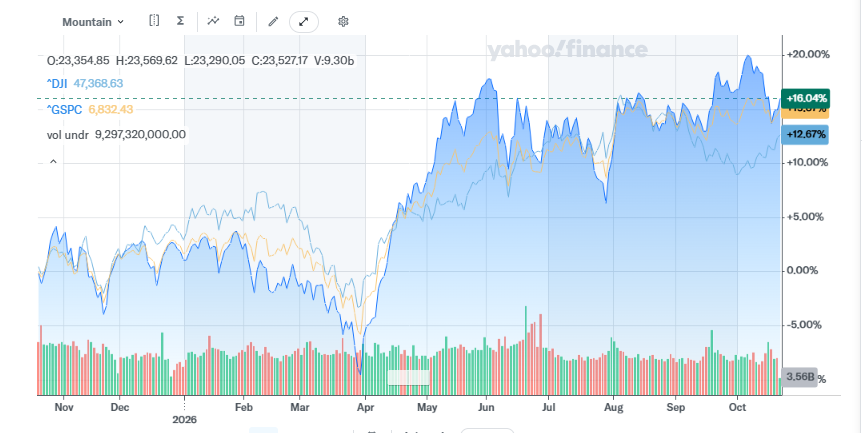
Nasdaq technical outlook: a developing top remains a risk
The chart shows a sharp retreat from the recent peak followed by a recovery that has not yet regained those highs. The earlier October 21 snapshot recorded 26,712.03, approximately 3.6% below the 27,722.75 high listed in that earlier image. This leaves room for a topping or distribution interpretation: buyers are returning, but have not yet demonstrated the strength needed to restore the prior advance.
STA Research assessment: The cautious case is that this week’s rally is a countertrend rebound within October’s correction. That case would strengthen if the index stalls beneath resistance, forms another lower high and subsequently breaks the recent low. Conversely, holding support, establishing higher lows and sustaining a recovery above 27,000 would weaken the immediate bearish interpretation; reclaiming the peak region would provide stronger evidence of repair.
The distinction between time frames matters. The May–October chart also shows a broader advance from its earlier lows. It supports concern about an unresolved correction and a possible developing top, but does not by itself confirm a longer-term weekly downtrend or a completed major-market top. Weekly closes, breadth and trend indicators would be needed to establish that stronger conclusion.
Oil, yields and upcoming earnings still matter
AP’s late-morning report put the U.S. 10-year Treasury yield near 5.10% and Brent crude around US$109 a barrel. Some relief in yields can help growth-stock valuations, while expensive energy continues to challenge margins and household purchasing power. Meta and Tesla’s scheduled after-market results remain important tests for investment spending and demand.
In Canada, AI infrastructure demand remains relevant to technology manufacturers, while energy producers respond to realised oil prices. Banks, consumer businesses and housing-sensitive companies still need evidence that demand and credit performance can withstand elevated costs. A rebound concentrated in a few technology leaders would offer less reassurance than participation across sectors.
Outlook: respect the rebound without assuming the correction is over
SpaceX’s earnings and capex plans strengthen the near-term AI demand narrative. The technical picture remains less settled: the Nasdaq is recovering from its lows, yet the recent peak remains unchallenged. STA Research retains a cautious, selective outlook until improving price structure and broader participation show that the recovery is durable. A failed rally followed by a break of support would increase the risk of a more prolonged decline.
Evidence: October 20 SpaceX earnings and capex reporting; October 21 Reuters early-session market coverage, AP late-morning coverage and StoneX commentary; and the user-supplied Yahoo Finance charts. Index-level references use the earlier intraday snapshot. Market observations refer to different intraday times. Capex guidance is forward-looking. Technical zones, scenarios and sector implications are STA Research interpretations, not guarantees of market direction.
October 20, 2026 — Earnings Face a Tougher Test as Oil Rises and Consumers Tire
Archived report. Figures, forecasts and references to upcoming events belong to October 20, 2026.
STA RESEARCH · U.S. & CANADA
Earnings Face a Tougher Test as Oil Rises and Consumers Tire
Renewed energy inflation and weakening housing activity raise the stakes for corporate guidance and household spending.
Updated October 20, 2026 · Morning outlook · By STA Research
October 20, 2026 · Earnings, energy and household finances
Macro pressures challenge the earnings outlook
Earnings arrive into a less forgiving market
Quarterly results are arriving as investors weigh resilient corporate profits against higher energy costs and pressure on demand. Tuesday morning’s reports were mixed: Reuters reported that Halliburton beat expectations, 3M improved its profit outlook, General Motors reduced its annual earnings forecast and Steel Dynamics missed profit estimates.
The central question is whether companies can sustain earnings as financing and operating costs rise. An earnings beat may offer limited support if management lowers guidance, relies heavily on cost cuts or signals weaker orders. Investors should distinguish stronger sales volumes from price increases, and operating cash generation from accounting gains or buybacks.
Oil gains again, renewing inflation pressure
Oil rebounded Tuesday morning, with AP reporting Brent above $110 a barrel as Middle East supply concerns persisted. The renewed increase reverses some of Monday’s relief and threatens to keep inflation pressure in place.
Fuel costs affect transport, manufacturing, distribution and household budgets. Businesses that cannot pass higher costs to customers face margin compression; those that raise prices risk weakening demand. Sustained energy inflation could complicate monetary easing even if economic growth slows, leaving equities exposed to a difficult combination of weaker spending and restrictive financing conditions.
A financially tired consumer: strain is visible, but uneven
The consumer-fatigue argument is strongest where expensive essentials and debt servicing reduce room for discretionary spending. Housing affordability and fuel costs can squeeze households before aggregate consumption turns negative. Retailers, restaurants, automakers and travel companies therefore face a growing test of pricing power and customer resilience.
Credit data require care. The New York Fed’s latest quarterly report covers the second quarter, not October: household debt totaled $18.8 trillion and 4.7% was in some stage of delinquency, with aggregate delinquency improving slightly. Its subsequent analysis described delinquency rates across most products as fairly stable. These figures support monitoring vulnerable borrowers, but do not establish that all consumers are deteriorating rapidly.
Evidence of a broader slowdown would include weaker spending volumes, more promotional activity, rising new delinquencies and deteriorating employment. A stable rate of new credit problems would temper the more severe interpretation.
Housing: echoes of the crisis era, without proof of another 2008
The housing warning has intensified. The NAHB/Wells Fa[Truncated]