

Canadian Banks and CUSMA
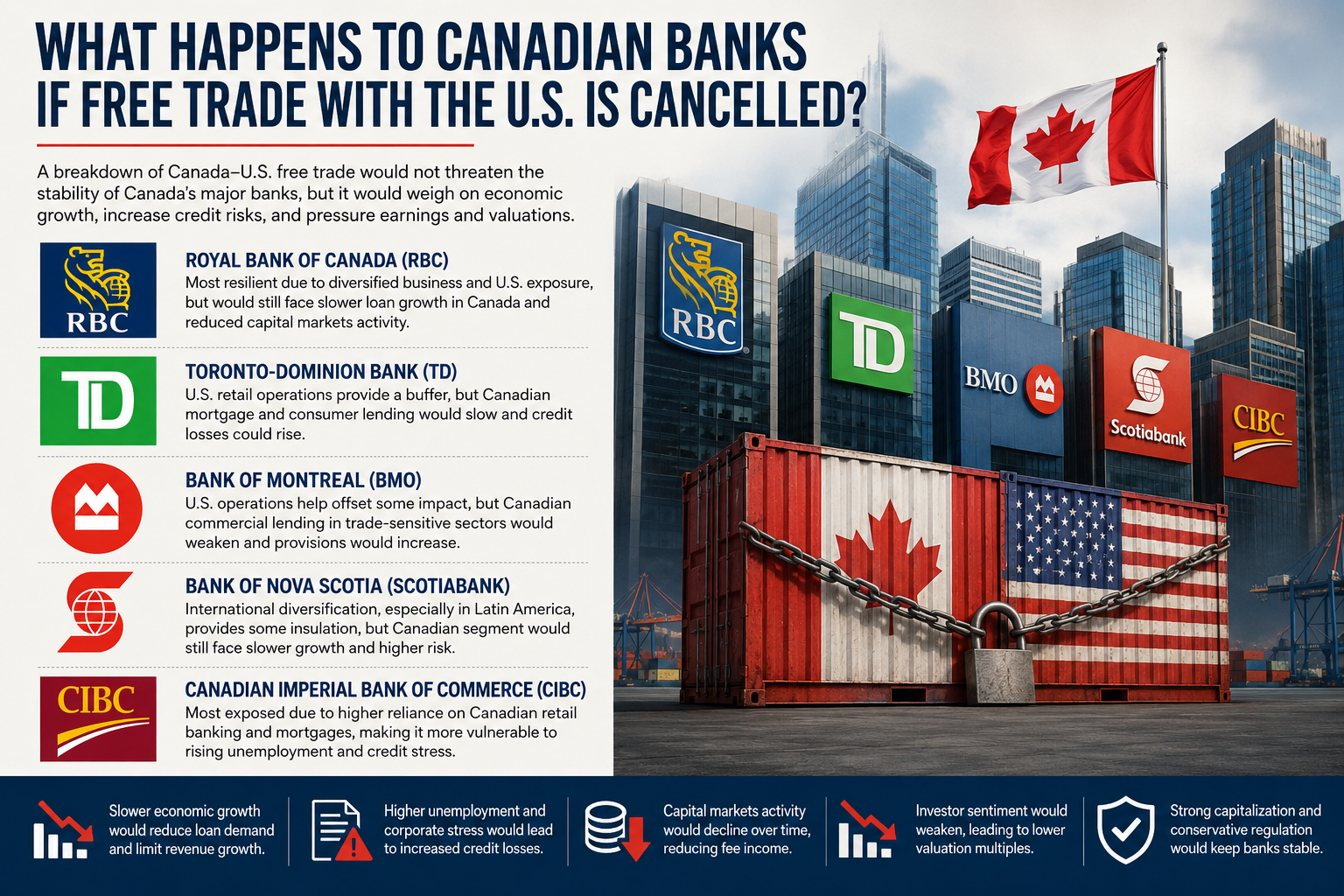
If a Canada–U.S. free trade agreement were cancelled or significantly weakened, Canadian banks would not face existential risk, but they would likely experience a clear deterioration in earnings growth, credit quality, and valuation multiples due to slower economic activity, weaker trade flows, and higher macroeconomic uncertainty. The banks would likely remain financially stable even in a sustained breakdown of the free trade conditions because they operate with strong capitalization levels, conservative risk management practices, and strict regulatory oversight that reduce the probability of solvency issues even during significant macroeconomic shocks.
However, despite this structural resilience, the earnings profile of the banking sector would likely weaken meaningfully because slower economic growth would reduce demand for credit across households and businesses, while also limiting mortgage expansion and corporate loan origination, particularly in export-sensitive regions and industries that depend heavily on U.S. trade.
At the same time, credit quality would likely deteriorate because higher unemployment, reduced business investment, and weaker cash flows in trade-exposed sectors would lead to an increase in loan defaults and force banks to raise provisions for credit losses, which would directly reduce net income and earnings stability.
In addition, capital markets activity would likely become more volatile and less predictable, as initial spikes in uncertainty could temporarily increase trading revenue, but sustained trade disruption would typically reduce mergers and acquisitions, equity issuance, and cross-border financing activity, thereby weakening fee-based income streams over time.
Royal Bank of Canada (RY:CA) would likely be the most resilient among the major Canadian banks because its diversified business model, including a meaningful U.S. footprint and strong wealth and capital markets divisions, would partially offset weaker domestic loan growth, although it would still face slower Canadian corporate lending and reduced fee income tied to lower cross-border investment activity.
Toronto-Dominion Bank (TD:CA) would likely be moderately insulated because its large U.S. retail banking operations would provide a buffer against Canadian economic weakness, although its domestic mortgage and consumer lending portfolios would still experience slower growth and higher credit provisioning if unemployment rises in export-sensitive industries.
Bank of Montreal (BMO:CA) would likely experience a mixed impact because its U.S. operations through BMO Harris would soften the downturn, but its Canadian commercial lending book, particularly in manufacturing, agriculture, and trade-linked sectors, would face slower growth and higher credit losses under weaker trade conditions.
Bank of Nova Scotia (BNS:CA) would likely be partially diversified due to its Latin American operations, which could reduce its dependence on Canada–U.S. trade flows, although its Canadian banking segment would still face slower loan growth, higher provisions, and reduced capital markets activity in a weaker domestic economic environment.
Canadian Imperial Bank of Commerce (CM:CA) would likely be the most negatively affected because of its higher concentration in Canadian retail banking and mortgages, which would make it more sensitive to rising unemployment, weaker housing demand, and increased credit stress in a prolonged trade disruption scenario.
Furthermore, investor sentiment toward the banking sector would likely deteriorate in a prolonged trade conflict scenario, leading to higher risk premiums, lower price-to-earnings multiples, and overall valuation compression even if the banks continue to generate positive earnings and maintain strong balance sheets.

STA Research (StockTargetAdvisor.com) is a independent Investment Research company that specializes in stock forecasting and analysis with integrated AI, based on our platform stocktargetadvisor.com, EST 2007.
Related research

How Trump’s Tariffs Could Shake Up Magna International’s Auto Parts Business

STA Research (Rank#25) Maintained “Hold” Rating on Starbucks, $110 target (SBUX:NSD)

Bank of Canada Looks to Pause rates as Recession Looms

Alimentation Couche-Tard Inc. (ATD:CA) Strong Momentum with Attractive Long-Term Fundamentals

Are Chip Stocks About to Crash the Market?

Bombardier Inc. (BBD-B:CA) Faces Valuation Test Despite Bullish Technical Signals
A monthly perspective in your inbox.
Five research sections in the STA Research Professional Newsletter.