

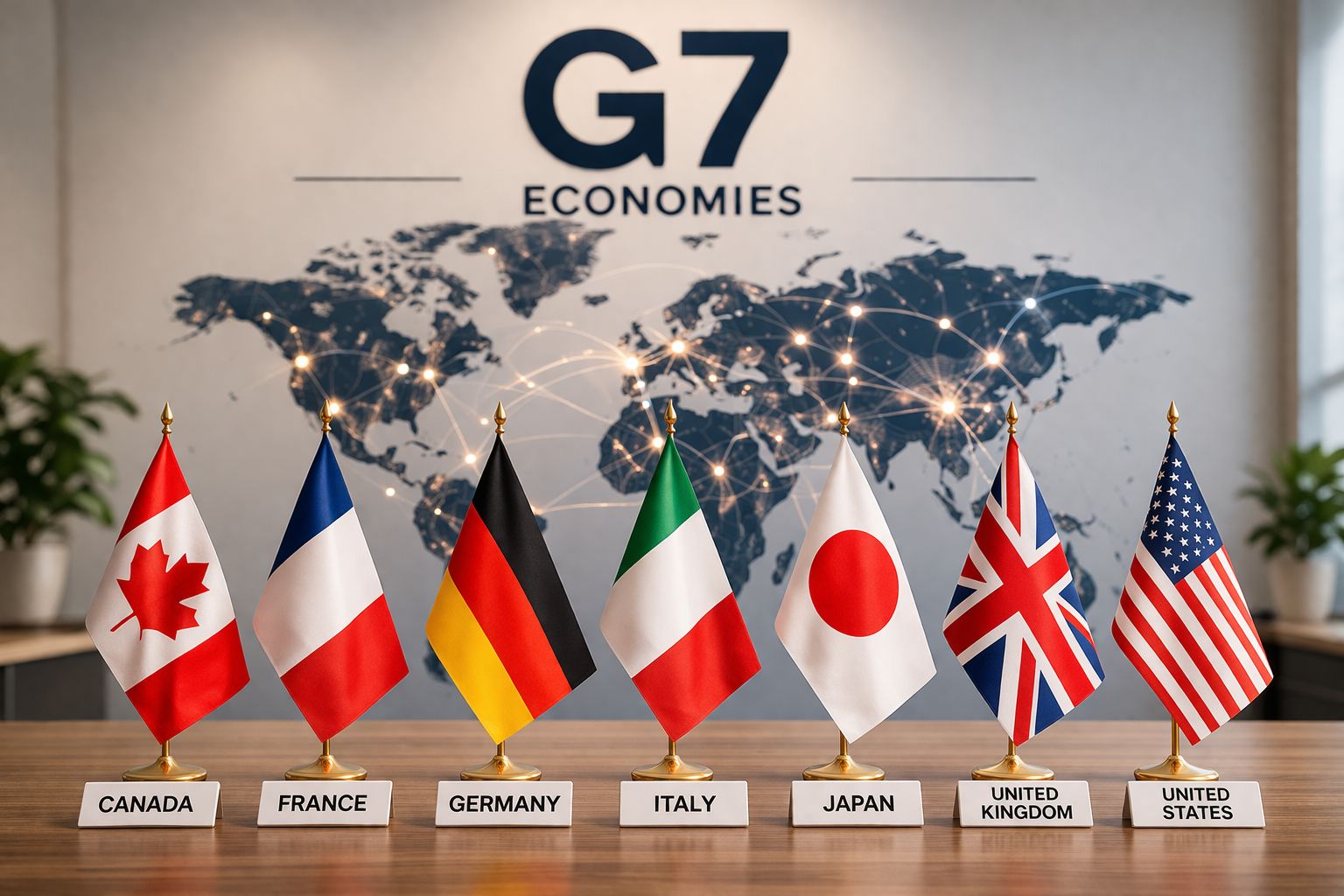
G7 Economies
The global economic landscape in 2026 is increasingly defined by divergence among the world’s most advanced economies. The G7, comprising of the United States, Canada, United Kingdom, Germany, France, Italy, and Japan is no longer moving in sync. Instead, the group reflects a widening gap between economies driven by innovation and flexibility, and those constrained by structural inefficiencies, demographic pressures, and external shocks.
At the forefront, the United States continues to demonstrate economic leadership within the G7, supported by strong productivity growth, a resilient labor market, and global dominance in high-value sectors such as technology and artificial intelligence. Its deep capital markets and entrepreneurial ecosystem enable rapid capital deployment and innovation, allowing it to outperform peers even in a higher interest rate environment. While fiscal deficits remain elevated, the U.S. economy’s underlying dynamism continues to offset these concerns in the near term.
Canada occupies a strong relative position, benefiting from its resource-rich economic structure and stable financial system. Energy and commodity exports provide a structural advantage during periods of global supply constraints, while its banking sector remains well-capitalized and resilient. However, Canada faces growing vulnerabilities tied to elevated household debt and sensitivity to housing market conditions, which could moderate growth under prolonged restrictive monetary policy.
In Europe, France stands out as a relatively stable performer, supported by a diversified industrial base and significant state involvement in economic planning. Its strengths in aerospace, energy, and luxury goods provide consistent export demand, though structural rigidities and persistent fiscal deficits limit its long-term growth trajectory. France’s model prioritizes stability over dynamism, positioning it as a middle-tier economy within the G7.
Japan continues to navigate a complex economic environment shaped by demographic decline and high public debt levels. Despite these constraints, recent corporate governance reforms and improved capital allocation have enhanced shareholder returns and equity market performance. Japan’s advanced manufacturing capabilities and technological expertise remain competitive advantages, although overall growth remains modest relative to global peers.
The United Kingdom faces a more challenging outlook, characterized by subdued growth and lingering structural adjustments following Brexit. Trade frictions, weak business investment, and periodic inflationary pressures have constrained economic momentum. Nevertheless, the UK retains a globally significant financial services sector and a flexible labor market, which provide a foundation for longer-term recovery.
Germany, historically the industrial engine of Europe, is currently experiencing pronounced cyclical weakness. Its export-driven manufacturing base has been impacted by slowing global demand, particularly from China, while higher energy costs following the reduction of Russian gas supplies have eroded industrial competitiveness. Although Germany maintains strong institutional and industrial foundations, its near-term growth outlook remains subdued, reflecting structural adjustments within its core industries.
At the lower end of the spectrum, Italy continues to face significant structural challenges. Persistently high public debt, weak productivity growth, and unfavorable demographic trends have resulted in prolonged economic stagnation. These constraints limit fiscal flexibility and reduce the country’s ability to respond effectively to economic shocks, leaving Italy as the most structurally vulnerable economy within the G7.
In aggregate, the divergence among G7 economies underscores a broader shift in the global economic order. Growth is increasingly concentrated in economies that combine innovation, flexibility, and capital efficiency, while those burdened by structural rigidities and demographic headwinds struggle to keep pace. For investors, this environment necessitates a more selective approach, with an emphasis on geographic allocation, sector exposure, and sensitivity to macroeconomic policy. As global conditions remain uncertain, the relative positioning of G7 economies will continue to play a critical role in shaping investment outcomes.

STA Research (StockTargetAdvisor.com) is a independent Investment Research company that specializes in stock forecasting and analysis with integrated AI, based on our platform stocktargetadvisor.com, EST 2007.